


Foreign Aid Cuts Jeopardize U.S. National Security

 by Steve Rothman

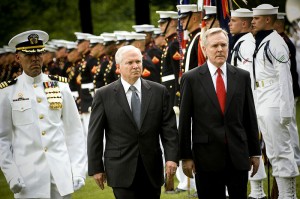
Secretary of Defense the Honorable Robert Gates, left, and Secretary of the Navy.
America’s national deficit will burden future generations and hurt the long term well-being of our nation. That is why, as the stewards of our constituents’ hard-earned taxpayer dollars, Congress must always ensure that every cent we spend is absolutely essential. But we can never forget that in meeting Congress’ first priority – keeping America safe – there is no better value than the one percent of the U.S. budget that is spent on foreign aid and diplomacy.
Some of my Republican colleagues have suggested that America would be better off if we drastically cut our foreign aid and State Department funding. This type of thinking is based on the faulty assumption that this level of funding is disproportionately high compared to other spending priorities. With only one percent of the U.S. federal budget allocated for these programs, nothing could be further from the truth.
U.S. spending on foreign aid and diplomacy under President Ronald Reagan was never less than 1.1 percent of the federal budget. Today, in our more interconnected, just as complex, and equally hostile world, our country would be less secure if we removed our diplomatic presence from the globe. It would be a detriment to our national security if the United States didn’t have Americans who know foreign languages, live in countries throughout the world, and understand the cultures, ways of thinking, and history of those nations.
Without knowledgeable American personnel on the ground, how would we be able to make fully-informed decisions on which diplomatic and military alliances to strengthen and which to weaken or break? Without the information we gather from our international efforts, how would we know which countries could be brought over to democracy, become better trading partners with America, or be more cooperative with the West?
Military professionals, from the Secretary of Defense to the American forces on the ground, agree about the importance of foreign aid and State Department programs. As Secretary of Defense Robert Gates said last September, “Development is a lot cheaper than sending soldiers.” Regarding the perspective of the professional officers who direct our soldiers on the battlefield, a poll commissioned in 2010 by the U.S. Global Leadership Coalition concluded, “nearly 90 percent of active duty and retired military officers agree the tools of diplomacy and development are critical to achieving U.S. national security objectives and a strong military alone is not enough to protect America.” And put succinctly by the Chairman of the Joint Chiefs of Staff, Admiral Mike Mullen, in a letter to Congress last year about these programs, “The more significant the cuts, the longer military operations will take, and the more and more lives are at risk.”
With U.S. troops deployed in Afghanistan and Iraq; Iran racing toward nuclear weapons; the volatile situations in Egypt, Lebanon, Sudan, and Tunisia; and terror threats emerging from Somalia, Yemen, and virtually every corner of the world; now is not the time to have less knowledge of foreign languages, fewer embassies, or fewer diplomats working to avert war and nuclear proliferation. The interests of the United States would certainly not be well served if we were to deny military aid to indispensible allies that help us fight terrorism, protect essential sea lanes, provide safe ports for our troops, and deliver world-class intelligence in real time.
Indeed, for these reasons, and many more, our foreign aid and diplomatic budget has a return on investment that is at least a thousand fold. Cutting foreign aid will not right our struggling economy, but will ultimately cost us more in U.S. lives and taxpayer dollars. It will surely cause direct and substantial harm to America’s national security.
That is why, while we need to cut spending, while we need to get rid of waste, while we need to find additional sources of revenue, a dramatic reduction in the one percent of the U.S. budget devoted to foreign aid and diplomacy is not wise. There are other cuts in spending that would reduce our deficit without harming our national security.
For example, we could begin with cutting the approximately $4 billion a year given to the oil and gas industries to encourage them to look for energy. Oil companies do not need taxpayer encouragement for that purpose, especially as they continue to post record-breaking profits. Congress also can cut bloated agriculture subsidies, particularly for food-based biofuels, and roll back non-stimulative tax breaks for individuals with incomes of more than one million dollars per year. These policies amount to billions of wasted taxpayer dollars each year.
I look forward to working with my Republican and Democratic colleagues to address our unacceptable federal deficit, but we must make cuts where they make sense, not where they jeopardize the national security of the United States.
Congressman Steve Rothman (D-NJ) is in his eighth term in the U.S. House of Representatives. He serves on the House Appropriations Subcommittees on Defense; and State and Foreign Operations, which appropriate all spending for the United States military and foreign aid respectively.
Share this Story:


Let your voice be heard!
Join the Algemeiner
Trending
-

 Biden Declares ‘Ironclad’ Support for Israel in Passover Message Amid Tensions Over Gaza War
-
 ‘Useless Pigs’: Anti-Israel Demonstrations Rage at Yale University, Forcing Police Intervention
-
 Drone, Rocket Attacks Targeted US Forces in Iraq, US Officials Say
-
 ‘Hamas, We Love You!’ A List of the Chants, Statements From Columbia University’s ‘Gaza Solidarity Encampment’
-
 Mohamed Hadid Apologizes for Sending Racist, Homophobic Messages to US Rep. Ritchie Torres for Supporting Israel