Orthodox Response to an Un-Orthodox Sport

February 23, 2011 1:29 pm 2 comments

Author:

avatar Ben Horne

Share this Article

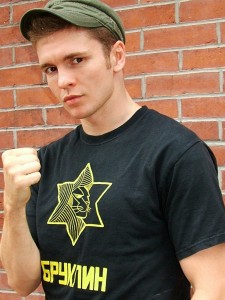
Yuri Foreman. Photo: Adam Ritter

Imagine the conversation between a Rabbi and his son. Says the Rabbi, “son, when you grow up I want you to honour the traditions of this family and become a well respected Rabbi”. Answers the son, “but daddy, I don’t want to become a Rabbi. I want to become a World Champion boxer!” The response from the Rabbi would probably be something like,  “’Let the goyim be the fighters, the murderers — we are the scholars.”

The scenario may seem fictitious, but this was the response that Rabbi Isidore Rasofsky gave to his son Dov-Ber Rasofsky (a.k.a Barney Ross) in an attempt to discourage him from becoming a boxer, and persuade him to keep his mind focused on Talmud learning. Unfortunately for the Rabbi his words failed to work and Ross subsequently became one of the most successful Jewish boxers of the 1920’s and 1930’s. His strength in the ring made him an iconic figure amongst American Jews. They viewed Ross as someone who had the potential to fight back against the rise of the Nazi party and the anti-Semitic behavior which was rampant during that period.

Now image a Rabbi, who is a member of a Chasidic sect, and is also a professional boxer. Step into the ring Yuri Foreman. Originally born in Belarus to a secular Jewish family, Foreman is currently in the process of taking Semicha. His family made aliyah when Foreman was aged nine and subsequently moved to America, where Foreman was able to grow religiously and develop his boxing. He follows the Chabad movement and has previously entered the ring to the sound of the Lubavitcher rebbe signing a Chassidic melody! Outside the ring, Foreman’s toughest fight remains attempting to defend himself against questions relating to the apparent contradiction between being an orthodox Rabbi and pursuing a career in professional boxing. The responsibility of the Rabbi is to ensure he is role model to his community and this is achieved by demonstrating moral and ethical behaviour within the public sphere. If Foreman decides to continue boxing once he has gained semicha, he risks jeopardising his rabbinical authority. Foreman’s next fight is scheduled for March 12 and will be against Pawel Wolak.

Foreman is not the only contemporary professional boxer to adhere to orthodox Judaism. Born in Ukraine to a secular Jewish family, Dimitry Salita, like Foreman, is an immigrant to America. His family made the decision to leave Ukraine as they became increasingly concerned for their safety with the rise of anti-Semitic abuse. Indeed, as a child, Salita used violence as a means to protect himself against Ukrainian Jew hatred. Upon moving to America, Salita continued to suffer from bullying because he was an immigrant and his family was very poor. Once again, he used his fists to fight back and was regularly involved in fights. He subsequently joined his first boxing gym at the age of 13 and used the opportunity as a means to escape from poverty. After the death of his mother, Salita became more involved in Judaism with help from the local Chabad community. Salita came to prominence within the British media in December 2009 during the build up to his WBA light welterweight fight against Amir Khan, who is ironically an orthodox Muslim. The press focused their reporting on Salita’s Jewish identity and some of the customs and laws he observes. Unfortunately for Salita, the fight didn’t go as planned and he was knocked out after just 76 seconds. In the post fight analysis, questions arose relating to Salita’s future in the sport. However, Salita has had a successful return to the ring; winning his past two fights, and is now considering arranging his next fight in Israel.

Although orthodox Jewish boxers are novel, Jews are no strangers to the boxing ring. For example, in England, Daniel Mendoza was one of the most prominent and successful prize fighters (prize fighting was an early form of boxing) of the 19th century. He was among the first Jewish people to meet British royalty when he met King George III, and this helped to elevate the social position of Jewish people within British society. During the 1920’s and 1930’s, Jewish immigrant boxers were common in America as they attempted to use boxing to escape their impoverished status within society. In London’s East End, Jewish boxers also featured prominently during the 1920’s and, as in America, boxing was a seen as way out of social deprivation. One of the most prominent boxers during this period was Jack ‘Kid’ Berg. His trademark was to enter the boxing ring wearing Tefilin in a ploy to get the crowd on his side!

In an age when many Jews would rather distance themselves from Judaism, the bravery and commitment shown by Foreman and Salita to adhere to their faith deserves a high level of credit and respect. Indeed both Boxers testified that being religious and having faith has helped develop their boxing careers. The main responsibly for both men is to continue to represent orthodox Judaism in a positive light. This has the potential to educate secular Jews about the importance of maintaining a proud Jewish identity in today’s society.

Stay tuned for the next edition, which will investigate the relationship between Jews and the Olympic games.

2 Comments

  • Betrayal of jewish women, mothers and everybofy
    Who war born in jewish family
    Israel is the only place that fights fake giurs
    Otherwise it says that. Fake ger will bring sufferinh
    To our nation it seems that some rabbies fullishly
    believe that they can make artificial jews

  • not rabbi AKiva

    To be a rabbi one should be born and raised by jewish mother. And if your mother and wife is not jewish how can u be a role model to jewish youth? ?

Leave a Reply

Please note: comments may be published in the Algemeiner print edition.


More...

  • Arts and Culture Jewish History The Marx Brothers and Jewish Identity

    The Marx Brothers and Jewish Identity

    JNS.org - The sons of Jewish immigrants from Germany and France, the Marx Brothers became zany masters of stage and screen who continue to captivate audiences. But in addition to providing comic relief, their films captured the drama of the entry of their marginalized religion into the U.S. Wayne Koestenbaum, author of the 2012 book The Anatomy of Harpo Marx, explains that the Marx Brothers’ Jewishness as a family “was evident, marked, thoroughly legible.” “Within a family already marked as Jewish within [...]

    Read more →
  • Arts and Culture Jewish Identity SuperJew

    SuperJew

    For my shekels, the question of whether the comic book character Superman, is Jewish or not shouldn’t even be questioned. Born and named Kal-El by his father Jor-El, “El” is one of the ancient names for God used throughout the bible and found in great prophets such as Samue-el, Dani-el and angels Micha-el and Gavri-el and of course, Isra-el. As Simcha Weinstein in his entertaining book, “Up, Up And Oy Vey” points out, “Kal” is the root of several Hebrew [...]

    Read more →
  • Israel Sports Formula 1 Road Show Thrills Jerusalem

    Formula 1 Road Show Thrills Jerusalem

    JNS.org – Some 100,000 people attended Israel’s first-ever Formula 1 Road Show in Jerusalem on Thursday and Friday. For several hours, the controversies that normally characterize Jerusalem were put aside, and a diverse mosaic of Israelis watched up close as the motor-sport stars temporarily conquered the city. “It was an amazing experience, the most fast and furious thing I have seen,” spectator Masada Porat told Israel Hayom. “It was a rare, extreme event that explodes in your face.” Spectator Irena [...]

    Read more →
  • Book Reviews Jewish Identity Klara’s Journey Casts Jews in Fast-Paced Adventure Through Russian History

    Klara’s Journey Casts Jews in Fast-Paced Adventure Through Russian History

    JNS.org – “If you’re sick, move away. Have some consideration for others,” a red army soldier scolds a slow-moving old man selling train tickets. “No, fires back the old man, proud, haughty, not realizing it’s a new country, a Bolshevik country where force heads the list instead of civility,” reads the following line in Ben G. Frank’s new novel, Klara’s Journey, released June 1. Reminiscent of Boris Pasternak’s Dr. Zhivago—whose backdrop is also a train ride across the Russian frontier during the [...]

    Read more →
  • Personalities Theater Nora Ephron, Famed Jewish Screenwriter, Remembered Through Tribeca Film Festival Prize

    Nora Ephron, Famed Jewish Screenwriter, Remembered Through Tribeca Film Festival Prize

    JNS.org – For filmmaker Meera Menon, no honor could have been more fitting than winning the inaugural award named after famed Jewish screenwriter and novelist Nora Ephron, the woman whose work inspired her. At the recent 2013 Tribeca Film Festival, Menon was named the first recipient of the $25,000 Nora Ephron Prize, given to a writer or director whose work embodies that of the late Ephron, who wrote the scripts for a number of hit films, including “When Harry Met [...]

    Read more →
  • Book Reviews Personalities Book Review: ‘Jewish Jordan’ Memoir an Important Guide for Players and Coaches

    Book Review: ‘Jewish Jordan’ Memoir an Important Guide for Players and Coaches

    JNS.org – Despite his friends’ and family’s doubts that a young Orthodox Jewish athlete could ever play college or professional basketball without compromising his religious values, between 1999 and 2009 the “Jewish Jordan” defied conventional wisdom and found his place on the court. In his new memoir, Jewish Jordan’s Triple Threat, Tamir Goodman describes his triumphs and disappointments in life, crediting his practice of Judaism for shaping his identity as an athlete and his understanding of basketball as a team sport. [...]

    Read more →
  • Blogs Sports Omri Casspi, ‘Jewish Jordan’ Partner on Basketball Camps to Inspire Youths On and Off the Court

    Omri Casspi, ‘Jewish Jordan’ Partner on Basketball Camps to Inspire Youths On and Off the Court

    Tamir Goodman (left) and NBA forward Omri Casspi—pictured on the court of the United Center, home of the Chicago Bulls—together run basketball camps that seek to inspire youths on and off the court. Photo: Courtesy Tamir Goodman. JNS.org – Before last year, basketball camps for Jewish youths never had an instructor quite like Omri Casspi, a forward for the National Basketball Association’s (NBA) Cleveland Cavaliers and the first Israeli-born player in NBA history. Casspi is a de facto ambassador for [...]

    Read more →
  • Jewish Identity Music Zion80 Mixes Shlomo Carlebach With Fela’s Afrobeat (VIDEO)

    Zion80 Mixes Shlomo Carlebach With Fela’s Afrobeat (VIDEO)

    Zion80 is a 13-piece band inspired by Nigerian Afrobeat creator Fela Anikulapo Kuti. The same way Matisyahu looked to Jamaican legend Bob Marley for inspiration and the right bass line to underscore his raps based on the Psalms, Zion80 guitarist and composer Jon Madof looked to Nigeria for his own rhythm section. On top of Fela’s conga-heavy Afrobeat groove, which has more urgency and immediacy than the Jamaican varietal, Madof’s guitar lays down familiar Jewish melodies from Reb Shlomo’s greatest [...]

    Read more →
Sign up now to receive our regular news briefs.