






From Napoleon to Mubarak: Jews and Revolution
Error: Contact form not found.

 by Don Seeman

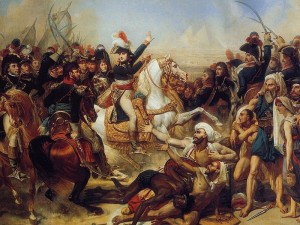
Napoleon at the Battle of the Pyramids. Antoine-Jean Gros 1771-1835
Jews with a strong historical sense may be excused for their uncertainty about how to respond to the revolutions and armed conflicts currently rocking the Middle East. We have seen the enthusiasm before: dawn of a new era, uprising of the people for the common good. Yet every revolution has its victims and many brave new dawns have plunged the world into even darker night. It is not convenient to remember now just how many Jews were enthusiastic supporters of the 1917 revolution in Russia and continued to support the Soviet Union well into the twentieth century as it slid headlong into brutal repression, murder, and wars of conquest. It need hardly be mentioned that Jews in the Soviet orbit themselves suffered as much as anyone for their messianic delusions. Stalin’s plans for the Jews were better than Hitler’s—but that isn’t saying much.
Of course, 2011 is not 1917, and the stakes today are different. For one thing, most Jewish communities in the Middle East either left or were driven out following the establishment of the State of Israel, and most commentary on the Middle East revolutions in Jewish circles today has focused not on what they mean for local Jews, but on what they mean for Israel. This is understandable and necessary but insufficient. We should be insisting that along with maintaining their treaties with Israel (in Egypt’s case) and working towards normalization with Israel (in every other case) fledgling Arab democracies also make explicit their plans for ensuring freedom and tolerance of minorities– including Jews, Christians, Berbers and Kurds– as a crucial early test. In some instances, small Jewish communities who remained in Arab lands and kept their heads down have enjoyed a degree of tacit protection by autocratic rulers, and their fate in the new Middle East ought to be on the table at least as much as what these changes might mean for the rights of Palestinians. The events engulfing the region today are not focused primarily on Israel or on Middle Eastern Jews, and that is a good thing, but history also teaches that we need to do what we can to look after our own.
Many Israeli leaders seemed almost panicked in the early days of turmoil in Cairo, and not without reason. Since we have never had one, no one knows what an Arab democracy will look like, and it is still far from clear that this is what will emerge when the dust has settled. Egypt need not even renege of its peace treaty with Israel in order to cause significant difficulties for the Jewish State. As one Israeli commentator wrote, it is hard to imagine an Israeli military option against Iran’s nuclear program if Egypt decides to play truly neutral behind the scenes or to passively back Iran. That may seem unlikely, but that is what many of us thought about Turkey’s current belligerence not long ago. If Israel is forced to redeploy its forces to protect its southern border even without military conflict, the drain in economic capital and human resources, not to mention the country’s morale, will be enormous. American Jews should use their contacts in Washington to keep this issue on the front page for American policy makers, and to oppose any soft or creeping appeasement of new or old Arab governments.
These concerns notwithstanding, there are at least two enormous reasons for optimism about current events. The first, in a universalistic vein, is that Jews ought to celebrate any time any group of people anywhere begin the arduous process of shaking off their chains to seek a better future. The State of Israel, and Jews around the world, ought to convey their congratulations to forces of democracy and moderation in the Arab world and do what we can to establish good working relationships with them. It is a mistake to view these events only through our own narrow prism. The fall of tyrants is an inherent good, as long as it does not lead to even worse tyranny down the road. And as Rabbi Abraham Isaac Kook wrote some time before his death in 1935, the quest for human betterment for all societies and the gradual improvement in the human condition should be experienced by faithful Jews as an inescapable component of the love of God. One cannot love the Creator without rejoicing in the good fortune of all created beings—despite the potential risks that all change brings. The fall of Sadaam’s statue in Baghdad, like the moment in which peaceful protesters retook the main square in Cairo, are moments that help to remind us in a concrete way of the human potential for redemption.
There are other reasons to see current events in a positive light. Thomas Friedman noted recently that he thought media exposure to Israel’s strong (if imperfect) democracy may have played a role in helping to inspire protesters in the Arab world. I would not expect any acknowledgement from the Arab street any time soon, but intuitively this has to be right. Watching a strong Middle Eastern country that has won its wars prosecuting politicians for fraud or misconduct and removing them from power without bloodshed has to have made an impression. Moreover—and this has not been sufficiently appreciated in recent commentary—the current unrest in the Middle East quietly helps to underline the success (with all its difficulties) of the Jewish national liberation movement known as Zionism. For millennia the kind of turmoil we are witnessing today almost always spelled difficulty and devastation for whole regional Jewish populations because of the inherent weakness of their position as a despised minority who were without real protection almost anywhere. Yet today, in addition to the secure position that so many Jews have achieved in the Western democracies there is also a sovereign state in the ancient homeland that possesses the will and capacity to defend them diplomatically and militarily when necessary. Jews used to have no direct voice in the corridors of power where borders were drawn and real outcomes of wars decided. And if Israel’s isolation within the broken UN system still resonates with those old traumas, it must nevertheless be admitted that Jews as a nation now possess tools that would have astounded any of our grandparents—and that less fortunate minorities in the Middle East still suffer without.
Deciding how to respond to complex historical events is never easy. When Napoleon swept through Europe in 1812, promising emancipation for Jews in the territories he conquered, it was natural for Jews to disagree internally about what this might mean for their future. Even closely aligned groups sometimes found themselves at odds with one another. In the Hasidic world, we find for example the luminary Rabbi Menachem Mendl of Ryminov praying for Napoleon’s victory while his contemporary Rabbi Schneur Zalman of Liadi (founder of the Habad movement) actively took sides with the Czar. In a letter, Rabbi Schneur Zalman writes that he feared the secularization he thought Napoleon’s victory would bring. We cannot know what he would have said if he had known that a scant decade and a half later the successor to the Czar he supported would begin a ruthless campaign of drafting Jewish boys as young as nine for 25 year terms of service in the Russian military from which most would never return. Nor can we know how he would have viewed the future ascendancy of the Soviet Union which his own descendants spent nearly a century fighting to survive. Rabbi Schneur Zalman was given Russian military escort as he fled across Russia to avoid capture by Napoleonic forces before he died far from home in 1813. While followers to this day argue vociferously for the correctness of his choice, I take away a somewhat different message: that there are costs to all choices, even the right ones, but that we usually can’t see them except in distant retrospect. In the meantime, we make the best choices we can based on limited information.
Those of us who have been arguing for years that repressive authoritarian regimes are the real barriers to lasting peace in the Middle East will not weep for the loss of those regimes, even the ones like Mubarak’s who kept the peace with Israel. It was always a devil’s bargain that could not last. Yet it is hard to be euphoric when so much of the future remains unclear and so much of the past littered with wreckage. Wisdom for now is to celebrate what can be celebrated and to extend a helping hand to all who seem to be on the right side of history. We cannot know precisely what the future holds, but we can try to respond with humanity, courage and cautious good cheer.


