







Apples and Oranges – What Japan’s Nuclear Crisis Tells Us About Iran
Error: Contact form not found.

 by Gabriel Latner

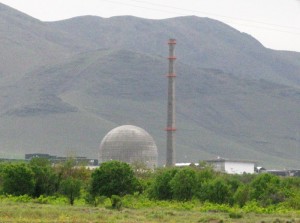
The IR-40 nuclear facility in Arak, Iran.
The tragedy that has befallen Japan should make any sensible person even more wary of Iran’s nuclear ambitions. For years, Iran has attempted to alleviate the world’s fears over its nuclear program by maintaining that any nuclear technology would only be used for civilian power plants.
That’s scary enough.
The crisis in Japan highlights that while nuclear is still the cleanest form of practical energy production – it is only safe in the right hands. Japan handled this crisis as well as anyone could have hoped – they responded quickly, en masse, and the worst seems to be behind them. But Japan is one of the most sophisticated, technologically advanced countries in the world, with an infrastructure that is incredibly well developed. Iran on the other hand, is not.
Where Japan has a basic literacy rate of 99% across the board, Iran’s literacy rate is 83.5% for men, but only an appalling 70.4% for women and girls. Japanese children have an average of 15 years of schooling, at least two more than their Iranian counterparts. Japan boasts five of the world’s 100 top universities- including #20 – Tokyo – beating out UK heavyweights UCL and Imperial, and US contender University of Michigan- Ann Arbor. No Iranian institution even makes the top 500.
Japan is also a world-leader when it comes to patents (a good indicator of a country’s technological and industrial health) – it is second only to the US in total number of in-force patents (circa 1.2 million and growing), and is rapidly gaining: according to the latest statistics it is out performing the US in its total number of applications and grants each year. Comparatively, Iran’s patent system is archaic, and so out of step with the modern international legal community that its patent approval procedure doesn’t even take into account inventions and discoveries in other countries. To put things in perspective – Iran has 4.7 patents per million persons, and Japan has 2660.82. Do a quick test – look around the room and try find a product made or designed in Japan: for me it took less than a second, I’m typing on a Toshiba. Now try the same thing for Iran.
In short, Japan has intellectual capital and resources that Iran just doesn’t possess. Because of its stellar education system and strong focus on R&D, Japan is not only able to develop tools and infrastructure to handle predictable crises – they have teams of highly skilled people who can react to those calamities that are unpredictable.
Japan has another major advantage over Iran: the Japanese government has proven time and again that it cares about its people’s wellbeing – and that it can care for them. The Iranian regime has never shown any such concern or ability. The Japanese ethos has produced world class hospitals and health coverage, a thriving free press, a strong system of civil liberties, an independent judiciary, and a democratic government. The government can’t just hush-up a disaster in Japan. None of that exists in Iran.
Even if Iran hadn’t experienced over 25 major earthquakes in the last 100 years (including one in 2003 that killed over 30,000) – there would still be ample cause for worry- human error. The last time the world saw an infrastructurally weak, under educated, under trained, frankly, under developed country in charge of running a civilian nuclear reactor – someone made a mistake and the locale known as Chernobyl ceased to exist in any inhabitable form. And the USSR was miles ahead of Iran.
But just like the USSR, Iran’s government doesn’t seem to put its subjects’ safety and well-being at the top of its ‘to do list’. Just as it is unfair to the people of Iran for the international community to support the ayatollahs and their repressive regime – it would be unfair and irresponsible for the world to allow the life of every Iranian citizen to be jeopardized by allowing Iran’s government to be in charge of a nuclear reactor’s safety precautions. We wouldn’t hand a lit stick of dynamite to a toddler – no matter how good the child’s intentions.


