
Organ Donation: Jews Can Learn Something From Atheists

February 26, 2012 11:56 am 4 comments

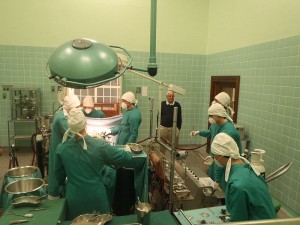
The restored scene from Dr Barnard's first human heart transplantation.

Recently while renewing my driver’s license, the DMV attendant looked surprised when I requested organ donor designation. She remarked how she thought being an organ donor is against the Jewish religion. I suppose my yarmulke (head covering) gave away the fact that I was Jewish, but this encounter did not surprise me given conversations I’ve had with many of my religious friends who will not become posthumous organ donors because they believe it would interfere with a religious duty to be buried intact.

Last week the NY Times reported that in response to a growing resistance by Haredi Jewish patients unwilling to consider donating organs but perfectly willing to accept organs from others, Israel has become the first country to implement a priority system:

[I]f two patients have identical medical needs for an organ transplant, priority will be given to the patient who has signed a donor card, or whose family member has donated an organ in the past.

According to OrganDonor.gov, in the U.S. alone, there are currently 112,674 people waiting for an organ, 18 people die each day waiting for an organ and one organ donor can save up to eight lives. Why wouldn’t everyone want to be an organ donor? More specifically, why are many of my Jewish religious friends so wary of becoming posthumously dismembered? Why did Israel need to implement a priority system to encourage organ donation by Orthodox Jews? Orthodox Jews should be lining up to become organ donors, especially considering that under Jewish law saving a life supersedes concerns around desecration of the dead.

The Halachic Organ Donor Society (HOD) is an organization that encourages Jews to become organ donors in accordance with Jewish law. Rabbi Adin Steinsaltz, hailed by Time Magazine as a “once-in-a-millennium scholar,” arguably the foremost Talmudic scholar in the world today, supports the mission of the organization. Many other leading rabbis support HOD.

According to Bobby Berman, the director of HOD, the reason for the low rate of posthumous organ donation among religious Jews is that “[m]ost Jews are under the mistaken impression that traditional Jewish law requires a body be buried whole at all costs.”

In realty, except for the prohibitions against illicit sexual relations, idol worship and murder, saving a life (pikuach nefesh) overrides every other commandment and prohibition in Jewish law. Saving a life is like saving an entire universe. Therefore it is understood that saving a life overrides any concerns regarding the proper treatment of a cadaver and therefore organ donation is a mitzvah (positive commandment) in Jewish law.

A student once asked a religious sage what lesson he could learn from an atheist. The sage answered: “If someone comes to you for help, you should never assume God will help him. Rather become an atheist for a moment by recognizing only you can help him.”

On the issue of posthumous organ donation my religious friends could learn a lesson from my atheist friends. They should recognize that only they can help those in need of organ transplants.

The obsession with preserving a dead body by keeping it intact is historically based on Egyptian culture of mummifying. Judaism was a rejection of that culture. The ancient Egyptian’s philosophical basis for mummifying and preserving the body was to insure proper passage into the afterlife, which ironically is the same concern my religious friends raise when refusing to become organ donors. Judaism was a rejection of Egypt’s glorification of the body but rather a recognition that the body is just a vessel that houses the soul.

Atheists believe that when you are dead your lifeless body is just a cadaver. The notions of afterlife and proper burial are nothing more than delusions and rites that help us cope with death. The atheist has no basis to object to organ donation. If you can help someone in your death, then why not? The religious person on the other hand is sometimes fraught with questions about the afterlife and preserving the body for proper burial. Question that may unfortunately lead one to hesitate from becoming an organ donor.

I think all religions can and should agree that in this matter, a lesson can be learned from the atheists. Atheists ideology posits that our dead bodies will ultimately decay anyway, so why not use them for something positive? At the end of the day, there should be nothing more life affirming and religious than being able to save someone in your death.

4 Comments

  • The reason religious Jews don’t donate there organs has little to do with staying in tact (in fact, religious Jews are encouraged to give, for example, kidney donations). The reason is that most major organs are taken before death according to Jewish law. So, there’s no hipocracy. Saving a life comes first- namely, one’s own life.

    • That goes to the heard of the dispute as to whether or not death occurs at brain cessation or heart cessation. Rabbi Steinzalts and many other authorities hold that organ donation is fine because death occurs at brain death as opposed to heart. Organ are only harvested after brain death. Halachically that is fine. Check out the HOD society that this article mentions.

      Also the article is correct that desecration of the body (nivilut hames) is a major factor preventing Jews from donating organs. In fact ….

      According to the New York Times, “Organ donation rates in Israel are among the lowest in the developed world, about one-third the rate in Western Europe, in large part because of what Health Ministry officials and doctors describe as a widespread impression that Jewish religious law prohibits transplants as a ‘desecration of the body.’”

      Rohter, Larry (2004-05-23). “THE ORGAN TRADE: A Global Black Market; Tracking the Sale of a Kidney On a Path of Poverty and Hope”. New York Times. http://www.nytimes.com/2004/05/23/world/organ-trade-global-black-market-tracking-sale-kidney-path-poverty-hope.html?pagewanted=2. Retrieved 2010-05-20.

  • There is only one lesson that atheism teaches; there are no such things as gods.

    It’s truly bizarre how that simple fact is so hard for some to learn.

  • “The notions of afterlife and proper burial are nothing more than delusions and rites that help us cope with death.”
    Great quote..hopefully repeated for all of time.
    Wouldn’t it be wonderful if all the money wasted on Funerals, caskets, burial plots and buried jewelry and riches were used for those who are alive??? ~Atheist.

Leave a Reply

Please note: comments may be published in the Algemeiner print edition.


More...

  • Personalities Sports NBA Finals a Time to Remember Legendary Jewish Coach Red Auerbach

    NBA Finals a Time to Remember Legendary Jewish Coach Red Auerbach

    JNS.org - At the start of each nationally televised game of the 2013 NBA Finals between the San Antonio Spurs and the Miami Heat, ABChas aired a film-clip montage of basketball’s great players and coaches—a montage that includes Jewish coach Arnold “Red” Auerbach, the mastermind behind nine championship teams for the Boston Celtics. Red was one of four children of Marie and Hyman Auerbach. Hyman was a Russian-Jewish immigrant who left Belarus when he was 13. The couple owned a deli and [...]

    Read more →
  • Arts and Culture Jewish History The Marx Brothers and Jewish Identity

    The Marx Brothers and Jewish Identity

    JNS.org - The sons of Jewish immigrants from Germany and France, the Marx Brothers became zany masters of stage and screen who continue to captivate audiences. But in addition to providing comic relief, their films captured the drama of the entry of their marginalized religion into the U.S. Wayne Koestenbaum, author of the 2012 book The Anatomy of Harpo Marx, explains that the Marx Brothers’ Jewishness as a family “was evident, marked, thoroughly legible.” “Within a family already marked as Jewish within [...]

    Read more →
  • Arts and Culture Jewish Identity SuperJew

    SuperJew

    For my shekels, the question of whether the comic book character Superman, is Jewish or not shouldn’t even be questioned. Born and named Kal-El by his father Jor-El, “El” is one of the ancient names for God used throughout the bible and found in great prophets such as Samue-el, Dani-el and angels Micha-el and Gavri-el and of course, Isra-el. As Simcha Weinstein in his entertaining book, “Up, Up And Oy Vey” points out, “Kal” is the root of several Hebrew [...]

    Read more →
  • Israel Sports Formula 1 Road Show Thrills Jerusalem

    Formula 1 Road Show Thrills Jerusalem

    JNS.org – Some 100,000 people attended Israel’s first-ever Formula 1 Road Show in Jerusalem on Thursday and Friday. For several hours, the controversies that normally characterize Jerusalem were put aside, and a diverse mosaic of Israelis watched up close as the motor-sport stars temporarily conquered the city. “It was an amazing experience, the most fast and furious thing I have seen,” spectator Masada Porat told Israel Hayom. “It was a rare, extreme event that explodes in your face.” Spectator Irena [...]

    Read more →
  • Book Reviews Jewish Identity Klara’s Journey Casts Jews in Fast-Paced Adventure Through Russian History

    Klara’s Journey Casts Jews in Fast-Paced Adventure Through Russian History

    JNS.org – “If you’re sick, move away. Have some consideration for others,” a red army soldier scolds a slow-moving old man selling train tickets. “No, fires back the old man, proud, haughty, not realizing it’s a new country, a Bolshevik country where force heads the list instead of civility,” reads the following line in Ben G. Frank’s new novel, Klara’s Journey, released June 1. Reminiscent of Boris Pasternak’s Dr. Zhivago—whose backdrop is also a train ride across the Russian frontier during the [...]

    Read more →
  • Personalities Theater Nora Ephron, Famed Jewish Screenwriter, Remembered Through Tribeca Film Festival Prize

    Nora Ephron, Famed Jewish Screenwriter, Remembered Through Tribeca Film Festival Prize

    JNS.org – For filmmaker Meera Menon, no honor could have been more fitting than winning the inaugural award named after famed Jewish screenwriter and novelist Nora Ephron, the woman whose work inspired her. At the recent 2013 Tribeca Film Festival, Menon was named the first recipient of the $25,000 Nora Ephron Prize, given to a writer or director whose work embodies that of the late Ephron, who wrote the scripts for a number of hit films, including “When Harry Met [...]

    Read more →
  • Book Reviews Personalities Book Review: ‘Jewish Jordan’ Memoir an Important Guide for Players and Coaches

    Book Review: ‘Jewish Jordan’ Memoir an Important Guide for Players and Coaches

    JNS.org – Despite his friends’ and family’s doubts that a young Orthodox Jewish athlete could ever play college or professional basketball without compromising his religious values, between 1999 and 2009 the “Jewish Jordan” defied conventional wisdom and found his place on the court. In his new memoir, Jewish Jordan’s Triple Threat, Tamir Goodman describes his triumphs and disappointments in life, crediting his practice of Judaism for shaping his identity as an athlete and his understanding of basketball as a team sport. [...]

    Read more →
  • Blogs Sports Omri Casspi, ‘Jewish Jordan’ Partner on Basketball Camps to Inspire Youths On and Off the Court

    Omri Casspi, ‘Jewish Jordan’ Partner on Basketball Camps to Inspire Youths On and Off the Court

    Tamir Goodman (left) and NBA forward Omri Casspi—pictured on the court of the United Center, home of the Chicago Bulls—together run basketball camps that seek to inspire youths on and off the court. Photo: Courtesy Tamir Goodman. JNS.org – Before last year, basketball camps for Jewish youths never had an instructor quite like Omri Casspi, a forward for the National Basketball Association’s (NBA) Cleveland Cavaliers and the first Israeli-born player in NBA history. Casspi is a de facto ambassador for [...]

    Read more →
Sign up now to receive our regular news briefs.