






Egypt at a Crossroads, Watch Closely
Error: Contact form not found.

 by Alon Ben-Meir

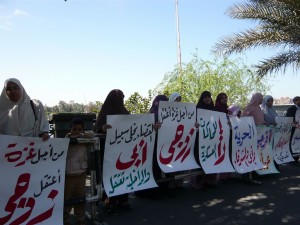
Muslim brotherhood women. Photo: Gainor Barton.
A few days after the Egyptian uprising, I argued that the Arab Spring could well turn into a long and cruel winter due to a host of prominent factors including: the lack of traditional liberalism, the elites’ control of business, a military that clings to power, and the religious divide and Islamic extremism. These factors are making the transformation into a more reformist governance (slow, filled with hurdles and punctuated with intense violence) much to the chagrin of Utopian-minded Western governments who thought that the transition to democracy would be attainable within months. If and when the Muslim Brotherhood (MB) and the ruling Military Council reach a power-sharing agreement, the situation will continue to unravel and be punctuated by chaos and accompanied by violence.
A testimony to this chaos is the recent crisis over the democracy-promoting U.S. NGOs working in Egypt. In a classic case of diversionary policies, the military-led government attempted to divert the attention of the public away from the worsening economic and security conditions by putting 19 U.S. citizens on trial for illegally working in Egypt for NGOs that receive unregistered foreign funding. U.S. threats to cut off the $1.3 billion in aid to the military resulted in the release of its citizens a few days ago. Left confused as to what this fuss was all about, the Egyptian public reacted sharply against the military, accusing it of being too incompetent to run the country’s affairs. While this does not suggest that the Egyptian revolution or the Arab Spring is doomed, it does offer a reminder to those young men and women who seek a promising future that they must remain armed with determination, prudence and the courage to act when a change of course is needed yet again.
To set the path for future democratic stability in Egypt, a resuming of the country’s leadership role in the Arab world and carefully considered regional responsibilities, any new Egyptian government needs to follow a number of steps:
First, the electorally-triumphant Islamic parties should not be tempted to exercise hegemony, but should rather push for pluralism ensuring that any government is representative, in word and deed, of Egypt’s wide political spectrum. Demonstrating prudence, the MB has decided to distance itself from a coalition with the ultra-conservative Salafi party and has instead sought out an agreement with the liberal parties. But there is a growing concern amongst Egypt’s democrats that the MB will use their sugar-coated coalition with the liberals to hide their real intentions: to gradually “Islamize” the country’s institutions and society instead of working on the desperately-needed socioeconomic reforms. The policies that the new government will pursue and to what extent it will embrace pluralism will signal not only to the Egyptian people how it is responding to their needs, but will also send a clear message to the Arab world as to where Egypt is actually heading. The Arab youth do not want their or any other Arab government, to be fashioned after the Iranian regime and will rise again if they feel betrayed.
Second, the new government should embark on extensive sustainable development projects to revive the economy. To some, the economic gloom might seem to be lifting in Egypt, but they must remember that this brighter prospect is mainly due to the $3.2 billion loan the government expects to sign shortly with the International Monetary Fund in the hopes that this will clear the way for other foreign aid. However, foreign aid can only solve immediate and not long-term economic problems and no foreign-aid-dependent country is likely to become prosperous. Egypt’s current dismal economic reality can only be solved through sustainable development strategies, which depend on decentralized decision-making on the economic projects and the transfer of managerial authority, skills, and capacities to sub-national levels, all of which are key to advancing democracy and development from the bottom-up.
Decided on by the local communities, and funded by micro-finance loans, these development projects will help alleviate the country’s endemic poverty, create jobs and empower the masses, particularly women. Islamic parties can be a natural ally to this form of economic development, not only because the majority of their activities have historically been providing social services at the grassroots level, but also because this model identifies with the Islamic concepts of Shura (consultation) and Ijma (consensus-building). Instead of responding to a recent call from the prominent Salafi preacher Mohamed Hassan for citizens to raise money to do away with US aid, wealthy Egyptians should donate towards this type of development. Knowing the experience of Bangladesh and Morocco, the wealthy donations will get a significant return and help advance the country’s economic and democratic prospects.
Third, the new government (that would have a significant MB component) should maintain the peace with Israel as a pillar of Egypt’s national security. In a panel discussion I participated in on al-Hurra channel last month which included the chairman of the MB Freedom and Justice Party (FJP), Dr. Mohamed Morsy, it was stated by Dr. Morsy that the FJP would honor the peace but is not really interested in talking with the Israelis. Also, in the midst of the American NGO crisis in Egypt, the FJP countered the U.S. threat to cut aid to the country by threatening to review the peace treaty with Israel. These are worrying signs as they ignore the major outcry of the Egyptian and other Arab revolutionaries who were spurred by domestic failures and deprivations and not by hatred and disdain toward Israel. The revolutionaries did not burn Israeli flags and call for death to Israel but instead demanded freedom, opportunity and dignity. The MB seems to treat the peaceful relations with Israel as if they are doing Israel a favor, when in fact the peace is in Egypt’s own national interest. The preservation of the peace will prevent another deliberate or accidental armed confrontation, which would heavily tax the Egyptian economy. Egypt would have to allocate tens of billions of dollars towards a war with Israel, which it does not have, while losing U.S. financial assistance without any prospect of challenging Israel militarily. And to what end? Israel is an unmitigated reality and the Egyptian people can benefit greatly from normal relations from a technologically and economically-advanced neighboring country.
Finally, any new government should aggressively pursue a restoration of Egypt’s regional role. Though poor in resources, Egypt has always been the epicenter of the Arab world, and the model that emerges in Egypt will certainly have an impact on the entire Middle East. But for the Egyptians to set an example for the rest of the Arab world, they will have to take the lead in the Arab Spring revolutions. Thus far, unfortunately, the military-led government has chosen to remain an observer in Libya, Syria, and Yemen. It has even allowed Iranian ships to cross the Suez Canal en route to Syria carrying arms to the Assad regime to suppress and kill his people who, like their Egyptian counterparts, simply seek to be free. For political, security and geo-strategic reasons, the new government in Egypt cannot afford to lose Egypt’s traditional leadership role in the Arab world by allowing a small Arab country like Qatar to take the lead or permitting Iran to rise to the position, a country that is laying in wait to usurp the political and regional agenda.
Neither the Egyptian people nor the international community should expect a velvet transition from dictatorship to democracy. But the new government in Cairo should work, in cooperation with its regional and international partners, to smooth the transitional process and shorten the period of chaos and instability, which will lead to sustained democratic reforms (albeit with Islamic values). Egypt can rise to the historic occasion but it must now choose wisely.