



Israel’s Most Famous Holocaust Survivor
Error: Contact form not found.

 by News Editor

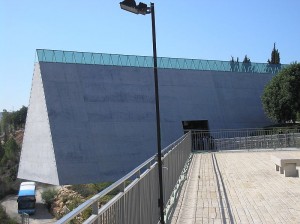
Enterance to Yad Vashem in Israel. Photo: wiki commons.
Tablet – Virtually every educated Israeli knows Ka-Tzetnik, or more precisely, Ka-Tzetnik 135633. Born in Poland as Yehiel Feiner, he moved to Israel after World War II and started writing in Hebrew; he would become Yehiel Dinur. But these names were eclipsed by the number tattooed on the author’s arm at Auschwitz, and so they appeared on none of his books. Instead, the covers of these books announced that they were written by Ka-Tzetnik 135633, a prisoner in Auschwitz in the terrible years 1943 to 1944 who emerged to write the very first novel about the Shoah, closely based on his own experience. (The writing was done in two and a half weeks in 1945, while he was lying in a British army hospital bed in Italy.)
KZ (pronounced “Ka-Tzet”) is the German acronym for Konzentrationslager (concentration camp), and in camp slang a Ka-Tzetnik is a prisoner. In later years, Ka-Tzetnik would claim he was born at Auschwitz when he arrived there in 1943. He said he was the true representative of the camps: the archetypal “Muselmann,” or walking dead man. In his books, he insisted, he spoke for all the others, the anonymous lost ones. Of all the witnesses at the Eichmann trial, the event that gripped the Jewish world in 1961, he is the one the Israeli public would remember most vividly. Facing Eichmann in his glass booth, he spoke for a few minutes, in agonized, disconnected fashion, and then collapsed in a faint. A few minutes later he was carried off to a hospital, to be treated for a nervous breakdown.


