






Romney, Obama and the Future of Jerusalem
Error: Contact form not found.

 by Dore Gold

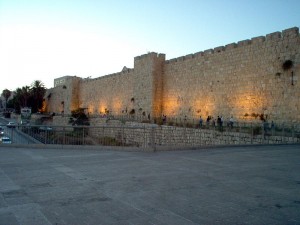
Jerusalem: Wall leading to Jaffo Gate. Photo: wiki commons.
What helped set the stage for former Massachusetts Governor Mitt Romney’s visit to Israel this week was a heated exchange several days earlier between President Barack Obama’s spokesman, Jay Carney, and several reporters in the White House briefing room.
Carney adamantly refused to answer their repeated questions about the view of the U.S. on what the capital of Israel was. He only answered: “Our position hasn’t changed.” He kept dodging the question when it was asked again. All Romney had to do to set his position apart from that of the Obama administration was to craft a single sentence which provided the clarity that Carney had avoided.
Romney opened his first public address during his Israel visit with the words: “It is a deeply moving experience to be in Jerusalem, the capital of Israel.” The choreography of Romney’s speech was almost as important as its content. He was not going to go into detailed aspects of his Middle East policy and directly criticize the Obama administration while he was outside the U.S. But Romney could also deliver a strong statement just by his location. He stood before the golden walls of Jerusalem at sunset, just as the fast of Tisha B’av, commemorating the destruction of the temple, was drawing to an end.
With this solemn setting, at the very beginning of his speech, he also acknowledged Israel’s historical rights: “To step foot into Israel is to step foot into a nation that began with an ancient promise made in this land.” With this, there was a subtle critique of Obama’s famous Cairo speech from 2009, which tied the creation of Israel to the suffering of the Jewish people in the Holocaust. Obama’s speech did not address the ancient ties of the Jewish people to their land that predated the horrors of the 20th century. In contrast, Romney began his visit to Israel by acknowledging Jerusalem, with its historic past, as part of modern Israel’s origins.
Whether Romney was fully aware of it or not, the subject of Jerusalem has dogged Obama’s relations with Israel during most of his period in office. As a candidate, on June 4, 2008, then Senator Obama gave a forceful defense of Israel’s rights in Jerusalem during his speech at the annual AIPAC policy conference: “Jerusalem will remain the capital of Israel and it must remain undivided.” Within a day, however, he appeared on CNN and said that he had misspoken, for Jerusalem was an issue for permanent-status negotiations. He then added later that Jerusalem should not be divided physically with “barbed wire,” implying that some political division might be possible in the future.
What made Jerusalem into a major subject of particular contention between the administration and Israel was Obama’s insistence that his demand for an Israeli settlement freeze apply to Jewish neighborhoods in east Jerusalem, as well. This became clear in explicit statements made by Ian Kelly, the State Department spokesman, in June 2009, just one month after the first Obama-Netanyahu summit meeting in the White House.
Practically, past U.S. administrations drew a distinction between their opposition to Israeli settlement construction in the territories and their more tolerant approach to construction in the neighborhoods of Jerusalem that Israel had annexed in 1967. True, in March 1980, the Carter administration supported U.N.Security Council Resolution 465 that called on Israel to halt construction in east Jerusalem and even dismantle Israeli housing there. But President Jimmy Carter later admitted that the U.S. vote at the U.N. was a mistake and he disavowed it because of the references to Jerusalem. Carter lost the New York Democratic Primary to Senator Ted Kennedy, who backed Israel on Jerusalem. Unfortunately, the distinction between West Bank construction, which the U.S. opposed, and Jerusalem construction, which it tolerated, appeared to have changed with the advent of the Obama administration.
The controversy reached a high point in March 2010, when the Housing Ministry announced a tender for the construction of 1,600 apartments in Ramat Shlomo, a Jewish neighborhood beyond the 1967 lines that has existed since the mid-1990s, when it was built during the Clinton administration. The construction proposals coincided with a visit by U.S. Vice President Joe Biden, who appeared to understand that the decision was taken by low-level officials. Nonetheless, tensions between Washington and Jerusalem increased. In an unusual step, Nobel Peace Prize laureate Elie Wiesel felt compelled to publish a full-page advertisement in The Washington Post on April 16, 2010, explaining to Obama the attachment of the Jewish people to Jerusalem.
The American Jewish Committee, which has been surveying Jewish opinion in the U.S. over the last decade, found in a 2011 survey that nearly 60 percent of American Jews opposed the redivision of Jerusalem. In Israel, the opposition to dividing Jerusalem was even greater: A 2011 poll by the Dahaf Institute of Mina Tzemach found an overwhelming majority of 85% recognized the importance of maintaining a united Jerusalem under Israeli sovereignty within the framework of any peace arrangement.
Clearly taking a strong stand against Israel on Jerusalem placed Obama at a difficult position with both Israelis and American Jews. True, Obama did not formally declare that Jerusalem must be redivided, but his opposition to Israeli construction in east Jerusalem would have any objective observer conclude that this was indeed his intention, unless he makes a declaration to the contrary.
Romney left Israelis with a positive feeling about his warm connection to Israel. But once he is back in the U.S., and no longer restricted by being on foreign soil, he should consider providing more details about his policy. Will he use the language of some of his predecessors that Jerusalem will not be divided? A capital in Western Jerusalem alone does not assure a united city in the future. To his credit, Romney declared on March 6, 2012, at the last AIPAC conference, that he “would never call for a return to the ’67 lines.”
But does he also support the language of former President George W. Bush’s famous 2004 letter to then Prime Minister Ariel Sharon recognizing Israel’s right to defensible borders instead? What are the implications for his remarks on the 1967 lines for how he envisions the future map of Jerusalem? For Israel, which is facing great uncertainty about the shape of the Middle East in the future, the answers to these questions will be critical for it being able to determine the extent of the diplomatic support it can count on as it seeks to protect its most vital interests in the future.
This post first appeared in Israel Hayom.