

Russia, Unfortunately, Being Russia

September 4, 2012 2:11 pm 0 comments

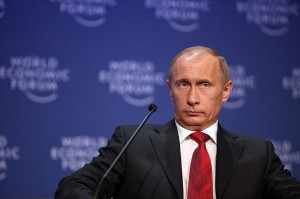
Russian President Vladimir Putin. Photo: wiki commons.

Before the pundits start telling you the Romney campaign stepped into a time-warp on the subject of Russia, it’s worth considering what adviser Rich Williamson said and what it means.  ”They’re trampling civil rights,” and “they’re our foe,” and “they’ve chosen a path of confrontations, not cooperation.”  Pierre-Richard Prosper, another campaign adviser, added that “rule of law” has evaporated.

They might also have noted that Russia has staked its position as the guardian and defender of Syria.  And that Putin has announced an upgrade in Russia’s nuclear arsenal that caused Poland to consider its own missile defense system.  (President Obama canceled plans for interceptors in Poland as part of his early “reset” of relations with Putin.)

Russia is asserting its interests the way large, dictatorial, and resource-rich countries do.  The problem for President Obama — which the Romney people can reasonably point out — is that Putin’s definition of Russia’s interests doesn’t correspond with the administration’s desire for “reset.”  Jailing rock singers for “hooliganism” and businessmen for “corruption,” stealing elections, murdering journalists and dissidents, eviscerating reliable civil and contract law, and protecting murderous dictators makes it hard for President Obama to claim that the only thing wrong with U.S.-Russian relations was the previous U.S. president.

The Obama administration, unfortunately — like its predecessor — has an ahistorical and rose-colored view of Russia.

In the heady days of the collapse of communism and the liberation of what were called “the captive nations” of Central Europe, the West made a key mistake.  The U.S. and its allies generally treated Russia as if it had been one of the victims of communism, like Poland or Estonia, rather than the colonial occupier of the others.  Communism was, in fact, the 20th-century iteration of Russian empire — no different for the captives than tsarist Russia’s occupations.  Where Czechoslovakia (in those days), Poland, and the Baltic States had histories of capitalism, parliaments, and varied alliances, Russia had decades of Stalinist-designed destruction and famine, and a deal with Hitler to divide Poland.  At the fall of the Berlin Wall in 1989, generations of people remembered life before the post-war Russian occupation.  When communism fell in Russia in 1991, far fewer remembered life before 1917 — and the waning days of the tsar were nothing on which to look back fondly.

In the decades since, Central Europe has had some problems adjusting to democratic liberalism (small d, small l), political diversity, and free markets.  Czechoslovakia had a civilized divorce, but Yugoslavia’s was gruesome.  Hungary and Romania flirt with fascism, as does border-state Austria.  But NATO and the EU have provided a strong framework in which to pull toward “Europe whole and free.”  How much harder would it be for Russia to adopt the economic and political norms of the West with which it was entirely unfamiliar?  And why would it want to?

Russia has moved back toward traditional Russian norms.  The rise of the Orthodox Church — and its popularity with young people — is striking.  The Russian view of defense, empire, nationalism, and relations with its “near abroad” are throwback positions, as is the oligarchic nature of Russian politics and economics.  Russia, rather than becoming more like us, is becoming more like itself.

It might have happened no matter how the West treated post-communist Russia; making democratic systems where none previously existed is clearly an uphill battle (see Iraq, Libya, Uzbekistan, Afghanistan).  But the fact that the smallest and most lonely marker in Washington is the Monument to the Victims of Communism (2nd & G Streets, NW in case you’re interested) might also be an indicator that post-communist-era United States has never had a clear picture of the victims and the aggressor in the Cold War.

Maybe another administration will do better.

This post first appeared in American Thinker.

Shoshana Bryen is Senior Director of The Jewish Policy Center.

Leave a Reply

Please note: comments may be published in the Algemeiner print edition.


More...

  • Arts and Culture Blogs Film Review: Fill the Void (VIDEO)

    Film Review: Fill the Void (VIDEO)

    Rama Burshtein’s Fill the Void (Lemale et ha’halal) is the second film in as many years to emerge from Israel with not only a strong international presence, but a unique perspective on religious Judaism. Just as Footnote before it, this was nominated for Best Foreign Language Film at the Academy Awards after a run of significant festival appearances (including winning Best Actress at the 2012 Venice Film Festival). The film represents the crowning jewel of an emerging religious women’s cinema [...]

    Read more →
  • Arts and Culture Blogs EXCLUSIVE: Gal Gadot on Jewish Identity, American Films and Representing Israel in Hollywood (INTERVIEW)

    EXCLUSIVE: Gal Gadot on Jewish Identity, American Films and Representing Israel in Hollywood (INTERVIEW)

    Gal Gadot is arguably Israel’s second hottest export at the moment. The former Miss Israel 2004 and Miss Universe contestant has a starring role in the most recent film from the Fast and the Furious Franchise and is one of the faces of Israel’s largest clothing brands, Castro. Now she’s teaming up with Vine Vera skin care products,which incorporates the breakthrough ingredient Resveratrol, which she tells The Algemeiner is  “a new innovative discovery which helps slow down the aging process [...]

    Read more →
  • Arts and Culture Blogs Jonathan Ames, ‘Herring Wonder’ and HBO Series Creator, Does Israel

    Jonathan Ames, ‘Herring Wonder’ and HBO Series Creator, Does Israel

    Writer Jonathan Ames, creator of the HBO television series “Bored to Death,” is known for his fearless and exhibitionistic persona. One can find YouTube videos of him eating herring and boxing at the same time, having knives thrown at him by a person called “Throwdini,” and ranting drunkenly at an awards ceremony. And when it comes to writing, Ames’s essays tend to cover racy topics. Given these exploits, it’s a bit surprising to learn that Ames’s recent trip to Israel [...]

    Read more →
  • Arts and Culture Beliefs and concepts Jewish Presence in Contemporary Art

    Jewish Presence in Contemporary Art

    The Jewish presence and identity in the contemporary world of art is one truly worth noting. At the 3rd annual conference of “Jewish Arts & Identity in the contemporary world” in Baruch College’s Jewish Studies Center, at a panel entitled “Jewish Ways of Seeing: The Visual Arts and the Jewish Tradition”, the Jewish impact on the creative world is exemplified through the discussion of artist Audrey Flack and her various works. Flack was born in 1931 to a fairly Orthodox [...]

    Read more →
  • Blogs Features Black Jazz Musician Encounters Mixed Reactions to Subway Renditions of Hatikvah, Hava Hagila

    Black Jazz Musician Encounters Mixed Reactions to Subway Renditions of Hatikvah, Hava Hagila

    At first you may be skeptical of Isaiah Richardson Jr. He doesn’t look like somebody who would be playing Hava Nagila for passengers waiting for their train in the subway. Firstly, he seems too young,  and secondly, he’s a black kid from the Bronx, dressed sharply, derby hat and all. But when upon meeting Isaiah, the 32-year-old ticked off “Hevenu Shalom Aleichem,” “Bashana Haba’ah,” and “Zum Gali Gali” as some of his favorite songs to play passing crowds, I knew [...]

    Read more →
  • Blogs Music Mother’s Day Performer Blends Israeli Independence and the Jewish Side of Verdi

    Mother’s Day Performer Blends Israeli Independence and the Jewish Side of Verdi

    This Mother’s Day, the music of opera singer Sharon Azrieli Perez will integrate the varied threads that have made up the fabric of her life. Perez, in a Mother’s Day concert May 12 at the 92nd Street Y in New York City, will weave a musical experience that brings together intimations of Israeli independence, Giuseppe Verdi’s use of Jewish melodies, medieval Ladino music, and modern Jewish show music. These musical elements are particularly personal for Perez, whose Juilliard education has [...]

    Read more →
  • Blogs Jewish 100 Social Harvey Weinstein to Elie Wiesel: Without You There Would be no ‘Schindler’s List’ (VIDEO)

    Harvey Weinstein to Elie Wiesel: Without You There Would be no ‘Schindler’s List’ (VIDEO)

    Famed film producer Harvey Weinstein presented Nobel Laureate Elie Wiesel with the Algemeiner newspaper’s ‘Warrior for Truth’ award at its recent star studded 40th anniversary ‘JEWISH 100’ Gala. “My mother, the Miriam of Miramax […] was so thrilled when she heard that I was presenting to Professor Wiesel,” Weinstein said as he called on the professor to accept the award. “I am happy to be here on the Algemeiner’s 40th anniversary and to celebrate their top 100,” Weinstein added. Commenting [...]

    Read more →
  • Israel Sports Israeli Soccer Star Victim of Anti-Semitic Abuse on Twitter

    Israeli Soccer Star Victim of Anti-Semitic Abuse on Twitter

    Israeli soccer star Yossi Benayoun, who currently plays for FC Chelsea in the English Premier League, was recently the victim of anti-Semitic abuse on Twitter. After thanking his Twitter followers for sending him birthday wishes, Benayoun, who many consider to be the greatest Israeli soccer player ever, was sent the following message: “f***in Jew a**hole.” Benayoun posted a response, saying, “Some nice people in the world.” His team has called on the police to investigate the matter, according to the Britain’s [...]

    Read more →
Sign up now to receive our regular news briefs.