



Yom Kippur Guide for the Perplexed 2012
Error: Contact form not found.

 by Yoram Ettinger

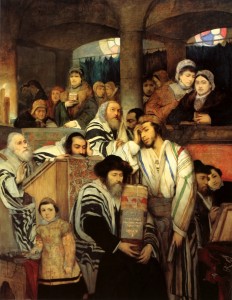
Jews praying in synagogue on Yom Kippur. Photo: Wikimedia Commons.
1. Yom Kippur is observed on the tenth day of the Jewish month of Tishrey, whose astrological sign is Libra (♎). Libra symbolizes key themes of Yom Kippur: scales, justice, balance, truth, symmetry, sensitivity and optimism. Libra is ruled by the planet Venus (Noga, × ×’×”, in Hebrew), which reflects divine light and love of the other person. The numerical value of Venus, × ×’×” is 58 just like the numerical value of ×זן, which is the Hebrew root of “balance” and “scale.”
2. Three holidays – Rosh Hashanah, Yom Kippur and Sukkot (Tabernacles) – are celebrated during the month of Tishrey. The number 3 is identified with balance, stability and The Essence. The triangle is a symbol of stability.
3. On the first day of Tishrey, the first human being, Adam, was created. Each year on the tenth day of Tishrey, Yom Kippur, human beings are accorded an opportunity to recreate themselves spiritually. Tishrey and Libra are dominated by the Hebrew letter ל, which is the tallest Hebrew letter, consisting of 3 parts, aiming upward, reflecting the need to elevate-oneself morally, self-enhancement. Yom Kippur is not driven by punishment, but by behavioral-enhancement.
4. Yom Kippur’s central theme is the plea for forgiveness – directly and not merely via prayers – from fellow human beings. It highlights humility (admitting fallibility), faith, soul-searching, thoughtfulness, being considerate, compassion, accepting responsibility, magnanimity. Speaking ill of other people (“evil tongue” in Hebrew) may not be forgiven.
5. The Jubilee – sanctifying each 50th year by proclaiming liberty, as also inscribed on the Liberty Bell – is announced by blowing the Shofar (a ritual ram’s horn) on Yom Kippur. The Jubilee liberates people physically and spiritually. The word “jubilee” (יובל) is a Hebrew synonym for “Shofar.” Yom Kippur and Jubilee highlight liberty and the subordination to God.
6. Yom Kippur culminates the ten days of genuine, heart-driven atonement/repentance, which begin on Rosh Hashanah, the first day of the Jewish month of Tishrey – an Acadian word for forgiveness and Genesis. It is observed on the tenth day of Tishrey. Ten has special significance in Judaism: God’s abbreviation is the tenth Hebrew letter (Yod – ×™); Ten attributes of God – Divine perfection – were highlighted during the Creation; the Ten Commandments; the Ten Plagues; Ten reasons for blowing the Shofar; 10% gift to God (tithe); The Ten Martyrs (Rabbis who were tortured/murdered by the Roman Empire); Ten generations between Adam and Noah and ten generations between Noah and Abraham; a ten worshipper quorum (Minyan) is required for a collective Jewish prayer; etc.
7. Yom Kippur is a Happy Jewish Holiday, replacing vindictiveness and rage with peace-of-mind and peaceful co-existence between God and human beings and, primarily, among human beings. Yom Kippur emphasizes God’s Covenant with the Jewish People, ending God’s rage over the sin of the Golden Calf.
8. The Hebrew word Kippur כיפור (atonement/repentance) is a derivative of the Biblical words Kaporet כפורת – which covered the Holy Ark at the Sanctuary – and Kopher כופר, which covered Noah’s Ark and the Holy Altar at the Temple. Yom Kippur resembles a spiritual cover (dome), which separates between the holy (days) and the mundane (rest of the year), between spiritualism and materialism. The Kippa כיפה (skullcap, Yarmulke), which covers one’s head during prayers, reflects a spiritual dome.
9. Yom Kippur calls for repentance – Teshuvah, תשובה, in Hebrew. The root of Teshuvah is similar to root of the Hebrew word for Return שובה – returning to positive values – and Shvitah שביתה – cessation (strike) of mundane thoughts and actions and eating. It is also similar to the root of Shabbat שבת. Yom Kippur is also called Shabbat Shabbaton – the supreme Sabbath. The last Sabbath before Yom Kippur is called Shabbat Teshuvah (based on Hosea’s prophesy, chapter 4). While the Sabbath is the soul of the week, Yom Kippur is the soul of the year.
10. The Hebrew spelling of “fast” (צ×/צו×) – abstinence from food – reflects the substance of Yom Kippur. The Hebrew word for “fast” is the root of the Hebrew word for “reduction” and “shrinking” (צמצו×) of one’s wrong-doing. It is also the root of the Hebrew words for “slave” (צמית) and “eternity” (צמיתות) – enslavement to God, but not to human-beings. “Fast” is also the root of עצמי (being oneself), ×¢×¦×•× (awesome), עצמה (power), עצמ×ות (independence), which are gained through the process of fasting, soul-searching, spiritual enhancement and trust in God.
11. The prayer of Veedooi-וידוי (confession/reaffirmation in Hebrew) is recited ten times during Yom Kippur, re-entrenching genuine repentance and the plea for forgiveness. The prerequisites for forgiveness are the expression and exercise (talking and walking) of repentance; assuming full-responsibility for one’s (mis)behavior, and significantly altering one’s behavior. King Saul sinned only once – ignoring the commandment to annihilate the Amalekites – but was banished from the crown and killed, because he shirked responsibility, while responding to Samuel’s accusation. King David sinned twice (The “Bat-Sheba Gate” and the “Census Gate”), but was forgiven, because he accepted full-responsibility and the death sentence (as proclaimed by Nathan the Prophet), which was promptly rescinded.
12. A Memorial Candle, commemorating one’s parent(s), is lit during Yom Kippur. It reaffirms Honor Thy Father and Mother, providing another opportunity to ask forgiveness of one’s parent(s), as well as asking forgiveness on their behalf.
13. The Scroll of Jonas is read on Yom Kippur. It demonstrates that repentance and forgiveness is universal to all peoples. Among its lessons: commanding one to assume responsibility; getting involved socially/politically; sounding the alarm when wrong-doing is committed anywhere in the world; displaying compassion for all peoples and adhering to faith and optimism in defiance of all odds.
14. A long sound of the Shofar (תקיעה גדולה) concludes Yom Kippur. It commemorates the covenant with God (the almost-sacrifice of Isaac), the receipt of the Torah on Mt. Sinai, Liberty (Jubilee) and the opening of Gods gates of forgiveness. The Hebrew root of Shofar שופר means to enhance/improve oneself (שפר). A Hebrew synonym for Shofar is Keseh כסה, which also means cover-Kaporet-Kippur.
Happy New Year.