


Israeli Oscar’s Entry Offers ‘Window to the Orthodox World’

November 4, 2012 3:59 pm 1 comment

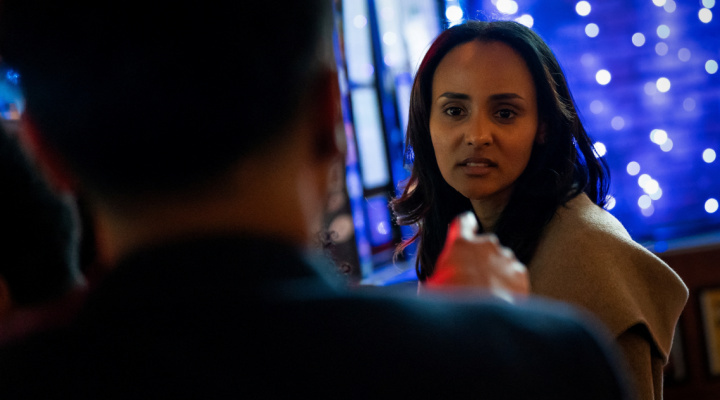
"Fill the Void" director Rama Burshtein and producer Assaf Amir at the 50th New York Film Festival at Lincoln Center. Photo: New York Film Festival.

NEW YORK—At a time when the secular world looms just beyond the boundaries of Tel Aviv’s Haredi neighborhoods and the government of Israel considers ways to integrate young men of the ultra-Orthodox communities into the general social fabric of the country, Rama Burshtein has “opened a window” into the day-to-day life of the deeply religious, tradition-bound community—so often mysterious and shrouded behind the curtains of separation.

Her film Fill the Void—which took the top prize at this year’s “Ophir Awards” (Israel’s version of the Oscars), thereby earning an entry into the “Best Foreign Language Film” category at the 2013 American Oscars—welcomes the viewer into this family-focused, Torah-centered world, viewed from the perspective of protagonist Shira, an 18-year-old young woman tasked with making the decision that will define her life.

Burshtein provides an unprecedented entry into the Haredi community of Tel Aviv. In conversation following the film’s recent screening at the 50th New York Film Festival at Lincoln Center, she said Fill the Void provides “a look inside the private world of Tel Aviv’s Hasidic community.” The film, she said, is “a movie taken from within… a window to the Orthodox world.”

“The real location of the film is Shira’s heart,” said producer Asaf Amir. “Detail is an integral part of the story. The need to be creative lends to the magical quality.” He noted that integrating the secular and religious cast was a challenge—few of the main characters had any experience with the Orthodox world. Yiphat Klein, who portrayed the widower Yochay, credited the film’s success to the work of Burshtein, who “has the ability to take everything in hand. It is her influence…First of all, Rama’s a storyteller.”

Before directing her first full-length feature for the secular market, Burshtein said she made films for Orthodox women “to help promote self-expression.”

Fill the Void, is not a film for Orthodox people,” she said. “The language would be different. Still, nothing is crossing the lines.”

Burshtein is more familiar with such “lines” than many in the Haredi community: the ba’alat tshuvah filmmaker grew up as a secular Jew in New York, attended film school in Jerusalem, and became observant about 20 years ago. “I love my role as a woman,” she said. “I feel it is true. I chose it. It doesn’t stop me from doing films, but the way I see the home, between a man and a woman, it is more sexy.”

“I felt it was time to tell a story from within and say something that comes from really living the life,” said Burshtein. “Fill the Void tells its story from within the Orthodox world, avoiding all but the most cursory intrusions of the secular world. The film tells a story of transition: from heights of joy to depth of sadness, from death to life, from brother-in-law to widower to husband, from teenager to young woman to bride, from mourning to celebration.”

At a celebration in the family’s apartment, Yochay calls his very pregnant wife outside. “You are my Torah!” he tells Ester, expressing a depth of love the secular world might not expect. Younger sister Shira is actively involved in the innocence of matchmaking, and is looking forward to engagement and marriage (albeit, arranged), in which “everything is new.”

‪The dynamics of every relationship change dramatically when tragedy strikes and the beloved Ester dies in childbirth. Left behind are her bereaved widower, her newborn son, and her distraught family.

Months pass and Yochay is pressured to remarry. His disconsolate mother-in-law, Rivka, proposes a union between the widower and Shira, her second daughter. Both are faced with the challenge of an unexpected life choice. Neither one of the proposed pair immediately accepts the “match.” Eventually, however, both agree to follow the rituals of Haredi courtship, though neither believes the relationship can succeed. The unexpected is yet to occur.

When attempts at courtship fail and both decide a marriage relationship cannot grow, the amount and intensity of time Shira and Yochay are allowed together is unique. As brother and sister-in-law, they are unchaperoned. He sees her at a bus stop and drives her to her work. They are together at family events. Shira, caring for Mordechai, the child of her sister, has direct contact with Yochay, his father. They argue, alone together on a dark Tel Aviv terrace. The growing tension between them—as man and woman—is palpable. They are angry, he breathes heavily, and they nearly touch. “You are too close,” warns the young woman, as they argue about love and heartbreak.

Burshtein, step by step, brings the film towards it inevitable conclusion. “Haredi couples,” she said, “have their own playbook for expressing emotion.”

“Fill the Void” (Hebrew: “Lemale et Hachalal”), Rama Burshtein, 2012. Hebrew with English subtitles; 90 minutes. North American Distribution: Sony Pictures Classics.


1 Comment

  • Ilbert Phillips

    I find the article interesting. Being the father of three children all of whom are Orthodox (with ten children) and my wife and I are Reform Jews, I have discovered that Orthodox Jews are deemed different only because they do not accept the myths about the nature of human being the non-Orthodox believe. Since they are my children, accept their choice (raising children to be independent has its consequences) and they accept my choice which is to remain non-Orthodox. I am constantly amazed at their bravery and what wonderful people they are. They are complex, honest, hardworking and committed to the State of Israel, where two live with their 9 children. In other words, they are human but unique as we all are.

Leave a Reply

Please note: comments may be published in the Algemeiner print edition.


More...

  • Personalities Sports NBA Finals a Time to Remember Legendary Jewish Coach Red Auerbach

    NBA Finals a Time to Remember Legendary Jewish Coach Red Auerbach

    JNS.org - At the start of each nationally televised game of the 2013 NBA Finals between the San Antonio Spurs and the Miami Heat, ABChas aired a film-clip montage of basketball’s great players and coaches—a montage that includes Jewish coach Arnold “Red” Auerbach, the mastermind behind nine championship teams for the Boston Celtics. Red was one of four children of Marie and Hyman Auerbach. Hyman was a Russian-Jewish immigrant who left Belarus when he was 13. The couple owned a deli and [...]

    Read more →
  • Arts and Culture Jewish History The Marx Brothers and Jewish Identity

    The Marx Brothers and Jewish Identity

    JNS.org - The sons of Jewish immigrants from Germany and France, the Marx Brothers became zany masters of stage and screen who continue to captivate audiences. But in addition to providing comic relief, their films captured the drama of the entry of their marginalized religion into the U.S. Wayne Koestenbaum, author of the 2012 book The Anatomy of Harpo Marx, explains that the Marx Brothers’ Jewishness as a family “was evident, marked, thoroughly legible.” “Within a family already marked as Jewish within [...]

    Read more →
  • Arts and Culture Jewish Identity SuperJew

    SuperJew

    For my shekels, the question of whether the comic book character Superman, is Jewish or not shouldn’t even be questioned. Born and named Kal-El by his father Jor-El, “El” is one of the ancient names for God used throughout the bible and found in great prophets such as Samue-el, Dani-el and angels Micha-el and Gavri-el and of course, Isra-el. As Simcha Weinstein in his entertaining book, “Up, Up And Oy Vey” points out, “Kal” is the root of several Hebrew [...]

    Read more →
  • Israel Sports Formula 1 Road Show Thrills Jerusalem

    Formula 1 Road Show Thrills Jerusalem

    JNS.org – Some 100,000 people attended Israel’s first-ever Formula 1 Road Show in Jerusalem on Thursday and Friday. For several hours, the controversies that normally characterize Jerusalem were put aside, and a diverse mosaic of Israelis watched up close as the motor-sport stars temporarily conquered the city. “It was an amazing experience, the most fast and furious thing I have seen,” spectator Masada Porat told Israel Hayom. “It was a rare, extreme event that explodes in your face.” Spectator Irena [...]

    Read more →
  • Book Reviews Jewish Identity Klara’s Journey Casts Jews in Fast-Paced Adventure Through Russian History

    Klara’s Journey Casts Jews in Fast-Paced Adventure Through Russian History

    JNS.org – “If you’re sick, move away. Have some consideration for others,” a red army soldier scolds a slow-moving old man selling train tickets. “No, fires back the old man, proud, haughty, not realizing it’s a new country, a Bolshevik country where force heads the list instead of civility,” reads the following line in Ben G. Frank’s new novel, Klara’s Journey, released June 1. Reminiscent of Boris Pasternak’s Dr. Zhivago—whose backdrop is also a train ride across the Russian frontier during the [...]

    Read more →
  • Personalities Theater Nora Ephron, Famed Jewish Screenwriter, Remembered Through Tribeca Film Festival Prize

    Nora Ephron, Famed Jewish Screenwriter, Remembered Through Tribeca Film Festival Prize

    JNS.org – For filmmaker Meera Menon, no honor could have been more fitting than winning the inaugural award named after famed Jewish screenwriter and novelist Nora Ephron, the woman whose work inspired her. At the recent 2013 Tribeca Film Festival, Menon was named the first recipient of the $25,000 Nora Ephron Prize, given to a writer or director whose work embodies that of the late Ephron, who wrote the scripts for a number of hit films, including “When Harry Met [...]

    Read more →
  • Book Reviews Personalities Book Review: ‘Jewish Jordan’ Memoir an Important Guide for Players and Coaches

    Book Review: ‘Jewish Jordan’ Memoir an Important Guide for Players and Coaches

    JNS.org – Despite his friends’ and family’s doubts that a young Orthodox Jewish athlete could ever play college or professional basketball without compromising his religious values, between 1999 and 2009 the “Jewish Jordan” defied conventional wisdom and found his place on the court. In his new memoir, Jewish Jordan’s Triple Threat, Tamir Goodman describes his triumphs and disappointments in life, crediting his practice of Judaism for shaping his identity as an athlete and his understanding of basketball as a team sport. [...]

    Read more →
  • Blogs Sports Omri Casspi, ‘Jewish Jordan’ Partner on Basketball Camps to Inspire Youths On and Off the Court

    Omri Casspi, ‘Jewish Jordan’ Partner on Basketball Camps to Inspire Youths On and Off the Court

    Tamir Goodman (left) and NBA forward Omri Casspi—pictured on the court of the United Center, home of the Chicago Bulls—together run basketball camps that seek to inspire youths on and off the court. Photo: Courtesy Tamir Goodman. JNS.org – Before last year, basketball camps for Jewish youths never had an instructor quite like Omri Casspi, a forward for the National Basketball Association’s (NBA) Cleveland Cavaliers and the first Israeli-born player in NBA history. Casspi is a de facto ambassador for [...]

    Read more →
Sign up now to receive our regular news briefs.