








Refusenik’s Translated Memoir Offers Rare Glimpse Into Soviet Oppression
Error: Contact form not found.

 by Jeffrey Barken / JNS.org

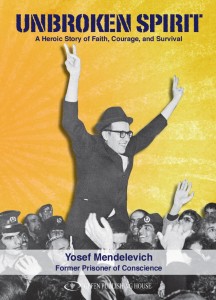
The cover of "Unbroken Spirit," by Yosef Mendelevich. Photo: Gefen Publishing.
“With neither family nor human warmth, it was an existence lived against the grain of human nature.”
That is how Yosef Mendelevich remembers the deprivations of his darkest hours in Soviet captivity. In 1971, Mendelevich and several comrades belonging to a Riga-based group of Zionist activists attempted to hijack a Russian airplane and escape to Israel. Thwarted by KGB operatives moments before initiating the operation, their capture ultimately ignited an international movement that helped ease the plight of Russian Jews. Mendelevich, meanwhile, endured a 12-year sentence in the Gulag.
Unbroken Spirit, Mendelevich’s memoir, vividly describes the inner workings of Soviet justice and its harsh penal system. The memoir, originally published in 1987 in both Russian and Hebrew, only recently has been translated into English. In a later-added epilogue, the author recalls one westerner’s encouragement to pursue an English speaking audience: “Your story is critical for Jews on this side of the ocean. You can’t imagine the disastrous toll that assimilation is taking on Jewish communities here.”
In this new era of a perceived crisis of western Jewish culture, Mendelevich’s forceful character and sad story take on renewed significance. Modern audiences may feel distanced from the Cold War political tension that forced his hand and may even criticize the extremism that led the author to hijack a plane, however, the post war history of Jewish displacement and fears of annihilation that Mendelevich recalls, are poignant.
Mendelevich’s account reaffirms the need for Jewish solidarity. Growing up in the aftermath of the Second World War, he embraced Zionism as the only way to repair the damage done to European Jewry by the Holocaust and Soviet atheist totalitarianism.
“Where have I seen this vision before?” the author asks when he witnesses a peculiar smile cross his comrade’s face following his capture by KGB agents. Recalling an image of the Warsaw Ghetto uprising, a Jewish fighter, arms raised in “triumphal gesture,” Mendelevich passionately defends his principles and his Jewish heritage. Even as the Nazis prepare to execute their prisoner, the captured man is “happy to go to his death this way, in battle rather than as sheep to the slaughter.”
These were the images that inspired members of Mendelevich’s generation to assert their religion and individuality at a time when the sickening realities of Nazi genocide were not yet fully revealed, hostile neighbors threatened Israel’s existence, and the Soviet Union refused to allow Jewish emigration. Without fervent belief in God, devotion to Jewish practices, and a willingness to fight to the death for self-determination, it was unclear to Mendelevich whether Judaism indeed would survive.
In the Gulag, Mendelevich meets a spectrum of Soviet political prisoners. Frozen in time, former Nazis and counter-revolutionaries spout dated, ridiculous propaganda as they cope with the misery of interminable imprisonment. The Soviet Union declared its enemies of the state by Stalin’s ever-changing whims, and many prisoners are forgotten. Likewise, punishments are devised to deprive prisoners of a sense of routine or security in their daily lives, thereby molding people into “mindless puppets controlled by Soviet propaganda.”
This book reads like an interview with Mendelevich. Interspersed between historical analysis and prison-life anecdotes, the author describes emotional encounters like the last prison visit he had with his father, and his philosophical conversations with other inmates about the nature of God.
“The question arises: Did I have in mind to sacrifice myself in order to break open the gates of aliyah for others?” Mendelevich records. As Mendelevitch crisscrosses Siberia on various forced relocations, guards persecute him for his beliefs. Mendelevich, meanwhile, grows defiant in every aspect of his life, demonstrating remarkable survival instincts as he scratches a drawing of two candles on his prison wall to mark the Sabbath and folds a handkerchief to improvise a makeshift kippah. Mendelevich clings to Jewish symbols for guidance and rejoices when reports ultimately indicate a relaxation of Soviet immigration policy. These small emotional triumphs are his only reprieve from the psychological tortures meant to break his courage and impose communist conformity.
“Life without principles is life without meaning,” Mendelevitch writes in his forward to the new translation. Tremendous strength of will was required for him to emerge from this experience with an unbroken spirit. Although a few of his stories may seem redundant, readers will find riveting the author’s bleak depiction of cold Siberian prison cells, a hunger strike that tested his physical stamina, and abusive Soviet interrogation methods.
Mendelevich’s observation that “all enthusiasms wax and wane, but it is up to us to keep the flame bright,” anticipates the declining interest in Zionism and Jewish religious life that his western colleagues fear at present. Time and relative prosperity may be testing Jewish solidarity and tradition around the world, but it is clear that many Jews are unwilling to forget the heroism that Mendelevich has come to represent. This new translation provides English-speaking audiences a rare glimpse into one of history’s most oppressive regimes and forces readers to assess their own strength of spirit.
Jeffrey Barken, Cornell University graduate and University of Baltimore MFA candidate, frequently reports on Israel news topics and Jewish-interest literature. He is currently writing a collection of stories, “This Year in Jerusalem, Next Time in America,” based on his experiences living on a kibbutz in Southern Israel from 2009-2010.


