


Menachem Elon and Theocracy
Error: Contact form not found.

 by Jeremy Rosen

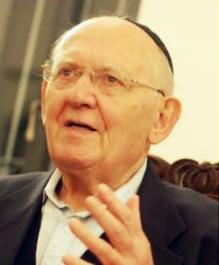
Menachem Elon. Photo: Wiki Commons.
One of the greatest of Jewish jurists, Menachem Elon, former Supreme Court Judge in Israel, died this week. He was steeped in the Talmudic tradition as well as the secular, and he was a moral, just human being. He stood for a balance between the standards of Jewish law and the more universal and sometimes contradictory demands of a pluralistic, democratic, and largely secular society. He was strongly opposed to theocracy. His classic “Jewish Law: History, Sources, Principles” remains the best book by far for anyone who wants to understand Jewish law. He was a rabbi, graduate of Yeshivat Chevron, a top academic and he fought in the War of Independence. He stood for values, both religious and secular that are under threat as a new generation seems bent on turning Israel back to medievalism.
In the wake of the recent elections, different sectors of Israeli life are jockeying for positions in the government and campaigning for their own agendas. Amongst the most sensitive of the issues being debated is the nature of the state. Should it be a civil democracy, a religious democracy, or a theocracy?
Broadly speaking, there are three positions:
- Israel is a secular democracy in which religion should not interfere in the private lives of its citizens regardless of faith.
- Israel is a Jewish state, run according to Jewish law.
- Israel should combine Jewish legal and spiritual values with those of secular democracy. The state will accept the Jewish calendar alongside the universal, and its prime cultural obligation is the perpetuation of the Jewish religion. It will recognize and protect other religions and enable their specific legal systems to function alongside, but not in conflict with, those of the wider state. It will not interfere in the private lives of individual citizens.
You will doubtless be able to guess that I identify with the third.
Rabbi Eliezer Melamed, Head of Yeshivat Har Bracha and a prolific author on Jewish Law, is what one might call a religious nationalist Zionist. He is typical of a new breed that is pushing for a more assertive religious position from a non-Charedi point of view. In the light of over 40 new members of the Knesset who are Orthodox, he has recently called for a review of the status quo in regard to religious matters and a redefinition of Israel as a Jewish state. I fear if he were taken seriously, this would be the next step towards a theocracy and a theocracy cannot possibly work where most of the population is either not religious or of a different religion.
This struggle over definition has been simmering for a long time. Israel has no constitution and its declaration of independence talked about establishing a Jewish state in Palestine. Its laws–a melange of Ottoman, British Mandate, and Jewish–are modulated by the Supreme Court and the Knesset; in addition, certain governmental agreements have accumulated over the years, commonly called Basic Laws. These include laws regulating religious matters, often called “The Status Quo”, laws concerning the status of marriage and divorce, according to which family relationships or their annulment are determined by halakha (Jewish law) in rabbinical courts, the status of Shabbat observance and kashrut (Jewish dietary laws) in all government and public frameworks, the obligation of the Israel Defence Forces to enable Jewish law to be observed within its ranks, and the exemption of those who wish to study Torah.
Melamed wants to pass a “chok yesod” (Basic Law) regulating these matters, instead of their being simply “agreements”. The reason he claims it is necessary is that Israel has adopted a basic law of human rights which enables the largely secular Supreme Court to gnaw away at the status of the rabbinical courts and Jewish family values, in the name of the “Basic Law of Human Dignity and Liberty”.
If Israel is really a Jewish and democratic state, he argues, it is unacceptable that the democratic side of the equation receives backing and significance in “Basic Law”, and in various other laws while the Jewish side receives only limited and inferior expression in “common law”. This, he claims, puts Judaism at a disadvantage although I find this hard to see happening on the ground.
I strongly oppose empowering the rabbinate or any religious authority with any increased basic legal powers. In a word, the rabbinate has failed its constituency. Once upon a time there were two separate camps in Israeli religious life. The State Rabbinate was predominantly religious Zionist, inclusive, and tolerant in its application of Jewish law to accommodate the national majority, which was traditional rather than Orthodox. The Charedi Rabbinate, with its Chassidic and Lithuanian wings completely devoted to their leaders, was at best disdainful of secular Zionism, but tended to stand apart from and ignore its religious institutions. It set much stricter standards for itself. It is also true to say that the Charedi Rabbinate was less nationalist and more concessionary when it came to Palestinian aspirations and the possibility of exchanging land for peace. Had things remained that way, I would have had less of a complaint. There was at least choice.
Over the years, as the Charedi community has exploded, it has infiltrated and taken over the moderate rabbinate and has made increasingly hard-line demands on the rest of Israeli society. The scandalous state of conversions in Israel amply highlights this trend. If their uncompromising mentality becomes enshrined in Israeli law, it will lead to a paralysis of inter-human legislation and will only damage Israeli civil society.
Both the Israeli Rabbinate and the Charedi world have manifestly failed to regulate themselves on matters such as sexual and financial abuse. They have not moved towards giving women fairer rights in divorce, inheritance, or custody. Such moral failure, if extended to the law of the land, would lead to the same collapse of religious morality that caused the destruction of both Temples and the exiles. The religious world must and will fight to protect its own. But I have no confidence that if given more power and authority it would protect others. Israeli society has not done enough to protect minorities. But I certainly do not think we could count on the established rabbinate to redress this balance. In most places (there are of course exceptions) that I have encountered religious courts, Batei Din, I have not been impressed with the way they have heard the pleas of “the widow, the orphan, and the oppressed”. I do not see the religious leadership in Israel or in the diaspora at present that I would have the confidence in to govern a state, or indeed a religion.
Israel must preserve its system of checks and balances and avoid at all costs granting religion even more power in the land. It is not that I think the Supreme Court is perfect. Far from it. But I want more counterbalances, not fewer. So far “human rights” have all but been ignored by the religious authorities.
So I fear the mentality of men like Melamed, and I mourn the loss to our people of men like Menachem Elon. They knew the value of Torah, but they also understood the nature of a modern state for all its citizens. Chaval Al DeAvdin. What a sad loss. If only there were more like him.