





Rabbi David Hartman Remembered as Interdenominational Force in Jewish Learning
Error: Contact form not found.

 by Maxine Dovere / JNS.org

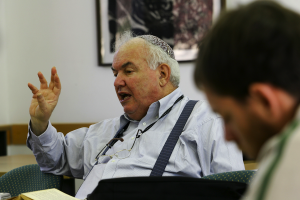
Rabbi David Hartman in the classroom. Photo: Shalom Hartman Institute.
Rabbi Michael Siegel, senior rabbi of Chicago’s Anshe Emet Synagogue, recalls meeting Rabbi David Hartman following a lecture Hartman gave at the University of Chicago. Hartman asked for a ride to downtown Chicago, and for months, Siegel proceeded to become Hartman’s “rabbinic driver.”
“The time we spent in the car was one of the more valuable educational experiences of my life,” Siegel told JNS.org. “He was so alive with ideas, challenges. His teaching was mesmerizing.”
Siegel was among the numerous and varied students of Hartman, who died Feb. 10 at 81. Those students included rabbis and lay leaders of all denominations, men and women, Jews and non-Jews.
Upon first hearing the name “Shalom Hartman Institute,” it might be assumed that one is encountering a center for “peace” studies. The source of the name, however, is different: it is the egalitarian Beit Midrash named by Rabbi David Hartman in memory of his father.
“Hartman’s intent was to open a conversation among rabbis for the sake of the Jewish people,” Rabbi David Steinhardt of B’nai Torah Congregation in Boca Raton, Fla., and a Rabbinic Fellow at the Shalom Hartman Institute, told JNS.org. “The Shalom Hartman Institute is one of the only places of interdenominational conversation… David Hartman was passionate about everything he did… Of central concern was how we translated our tradition and our text into a living reality. He compelled us to be able to live a Jewish life and understand Jewish life in different ways.”
The Shalom Hartman Institute occupies three acres of land along Jerusalem’s “Cultural Mile.” Its mission has been to “help build a more pluralistic and tolerant Israeli society.” In July 2012, the institute began a partnership with Hillel: The Foundation for Jewish Campus Life, called the Fellowship for Campus Professionals. The program brings Hartman Fellows to campuses in America in order to teach about the Jewish relationship with Israel.

Rabbi David Hartman, known for his inclusive approach, studies with Jewish women. Photo: Shalom Hartman Institute.
“One of the great opportunities and blessings was knowing and learning from David Hartman and being part of his Beit Midrash,” Steinhardt said.
“The institute is for rabbis of all denominations,” he added, noting that the institute fostered “deep and wide-ranging conversations” at a time when the “Who is a Jew?” question arose.
Hartman’s theology transformed as he aged and as the conditions of the Jewish people began to change, Steinhardt explained.
“He emphasized the partnership of God and the Jewish people—which has a significant vote and voice in the determination of its identity and behaviors,” he said.
Hartman “believed people were obligated to take control of their destinies… Not having power or control of their destiny was no longer an option,” according to Steinhardt.
Steinhardt said Hartman recognized the new realities in thinking about Jewish peoplehood. Hartman opined that current Jewish thought needed to be considered in light of 2,000 years of statelessness, the experiences of the generation living after the Holocaust, and the reality of the modern State of Israel. He suggested that the Jewish people have a capacity for self-determination, both politically and religiously.
“The conversation [led by Hartman] was about learning and defining Jewish peoplehood, and defining Judaism for Israel and North America and the relationship [between them],” Steinhardt said.
“Upon learning of his death, I felt the pain very profoundly,” he said. “I had the experience of losing an intellectual and spiritual father.”
Anshe Emet’s Siegel called Hartman “a storehouse of knowledge.”
“The questions he would ask were not the normal questions,” Siegel said. “He was a traditional thinking iconoclast who demanded clarity in thinking not only from his students but from the Jewish tradition as well.”
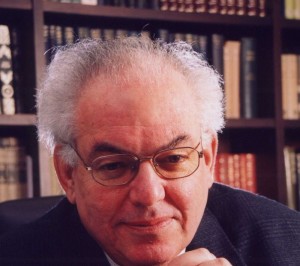
Rabbi David Hartman. Photo: Reehmy/Wikimedia Commons.
Siegel said Hartman “had a profound effect” on his rabbinate.
“He became a rebbe to me on a level with which I was really unfamiliar,” Siegel said. “He actually engaged me on a spiritual level—more than ‘What are you reading?’ [rather], ‘Are you feeling it in your kishkes.'”
“His thought process was extraordinary.”
Rabbi Don Goor of Los Angeles spoke with JNS.org soon after returning from a Shalom Hartman Institute alumni retreat that included “studying in his memory, reminiscing about how he touched lives.”
“Study with Hartman is the greatest gift of my rabbinate,” Goor said. “He opened new ways of approaching text… to engage congregants seriously with the voices of our tradition and challenge them to see.”
At his congregation, Temple Judea of Tarzana, Goor encourages his congregation to undertake “the endeavor of being a part of the Jewish tradition and to see their voices as a valid part of the tradition.”
“The impact [Hartman] had on me continues through my rabbinate and the impact I have on my students,” said Goor, who teaches second-and fifth-year rabbinical students at Hebrew Union College in Los Angeles. “The texts I choose to teach are the texts that he inspired to come alive.”
Hartman was a strong advocate for inclusion of the different streams of Jewish life and sought to create a place where all could come together. He had the unique ability to make each individual feel as significant as the other, according to his students.
The influence of Hartman reaches well into both the present and future. Two recently elected members of the Israeli Knesset, Dr. Ruth Calderon and Dr. Aliza Lavie, attended classes at his institute. More than 120 synagogues and Jewish Federations in the United States and Canada have developed curriculums based on his teachings. Some 50,000 individuals are enrolled annually in the institute’s courses. Rabbi Dr. Daniel Hartman, David’s son, was named the institute’s president in 2009 and carries its philosophy forward.
Steinhardt related what might be called a “Hartman Midrash” to JNS.org, recalling, “I once explained to Rabbi Hartman that at the beginning of tefilah we have people introduce themselves to one another.” Hartman responded, “You may come to meet each other, but I came to meet God.”
“There is a deeper level to what we are doing [as Jews], and he wanted us to be at that deeper level,” Steinhardt said.