




Secretary Kerry’s Maiden Speech

 by Shoshana Bryen

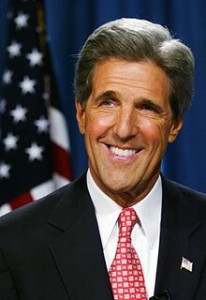
Secretary of State John Kerry.
Stipulating that foreign aid can be an important part of American foreign policy, and further that trade is an important component of U.S. foreign policy; Secretary of State John Kerry made two really important mistakes in his maiden speech, delivered to a fawning audience of American university students.
The first was in the definition of America’s challenges in the second decade of the 21st Century. Mr. Kerry posited:
“Our challenge is to tame the worst impulses of globalization even as we harness its ability to spread information and possibility, to offer even the most remote place on Earth the same choices that have made us strong and free.”
“Our challenge” is, in fact, to defeat the forces of Islamic radicalism that threaten us at home sometimes, and that threaten our friends in the Middle East, Southwest and East Asia all the time. Secular people, Christian people, Jews, women and progressive people in those regions — including Afghanistan, Pakistan, Indonesia, North Africa, Egypt, Jordan, Nigeria, Mali, Iraq and Turkey, and more — feel the pressure of the Muslim Brotherhood, Salafists, al Qaeda and Taliban forces snuffing out the tentative whiffs of freedom and equality presaged by President Bush’s “democracy agenda” and the now-cold “Arab Spring.” The less-than-optimal “impulses of globalization” are far more benign than the less-than-optimal impulses of a political-religious philosophy that holds the 7th Century to be the apex of human endeavor.
The destruction of the Bamiyan Buddhas and the Sufi treasures of Timbuktu are object lessons; Nedha Sultan and Malala Yusufzai are object lessons in the threats posed by a maleficent strain of Islam.
Second was his failure to connect the speech to the reality of radical Islamic reach. Mr. Kerry rightly wanted Americans to understand, “why the price of abandoning our global efforts would be exorbitant, and why the vacuum we would leave by retreating within ourselves will quickly be filled by those whose interests differ dramatically from ours.” He suggested that “We learned that lesson in the deserts of Mali recently, in the mountains of Afghanistan in 2001 and in the tribal areas of Pakistan even today.”
He learned nothing.
The United States abandoned Mali. Having trained the Malian army to fight al Qaeda, we were unprepared when that same army overthrew its own elected government. We pulled out our aid and our influence — Mali was suspended from the African Union and The Economic Community of West African States (ECOWAS). The space was “quickly filled by those interests differ dramatically from ours,” al Qaeda and the Malian Tuareg rebels. Fidelity to an abstract “democracy” in the face of a terrorist reality prevented U.S. from coming to Mali’s aid when the rebels took over Timbuktu and large chunks of the north, and threatened the capital, Bamako. We refused to partner with the French, limiting ourselves to ferry duty — carrying French troops where they couldn’t go themselves. [This is something else Mr. Kerry might address — what happens to Western influence when a) our allies can’t move a brigade and a half from one place to another and b) the United States is reduced to providing taxi service.] Even now, the U.S. predicates future aid to Mali on new elections to produce a “legitimate government.”
Narrowly, and perhaps temporarily, escaping al Qaeda isn’t enough.
Secretary Kerry equated foreign aid with promoting moderation. “The investments that we make support our efforts to counter terrorism and violent extremism wherever it flourishes. And we will continue to help countries provide their own security, use diplomacy where possible, and support those allies who take the fight to terrorists.”
Consider Pakistan. Between 2001 and 2012, the United States spent almost $18 billion in Pakistan. From 2009-2011, under the Kerry-Lugar-Berman bill, the U.S. provided $2.8 billion in civilian aid, including $1 billion in emergency humanitarian aid. About $855 million of that was in the FY2011. And yet, our bilateral relationship is defined mainly by arguments over drone strikes and collateral damage. Regarding Pakistani willingness to “take the fight to the terrorists,” Pakistan-based Taliban groups remain committed to attacks on targets in both Pakistan and Afghanistan and more than 300 civilians, mainly Shiites in a predominantly Sunni country, were killed in sectarian assaults in 2012. More than 80 people were killed last week when a bomb went off in a largely Shiite marketplace.
Is more American money going to change and moderate Pakistan? Or those who support the United States in opposition to a nuclear Iran?
Secretary Kerry said,
“When we join with other nations to reduce the nuclear threat, we build partnerships that mean we don’t have to fight those battles alone. This includes working with our partners around the world in making sure that Iran never obtains a weapon that would endanger our allies and our interests.”
Our regional allies in opposition to Iran are, first and foremost, Israel, then Saudi Arabia and the Gulf States who are threatened by Shiite triumphalism. And only Israel shares our presumed opposition to Sunni triumphalism. There is Jordan, and increasingly, Turkey. Where will more foreign aid help shore up the anti-nuclear-Iran coalition? Israel’s aid, 75% of which is mandated to be spent in the U.S., is fixed in a 2007 deal with President Bush. Of the remaining countries, only Jordan receives U.S. foreign aid.
But Secretary Kerry persisted.
“When we help others create the space that they need to build stability in their own communities, we’re actually helping brave people build a better, more democratic future, and making sure that we don’t pay more later in American blood and treasure.”
While not directly aimed at opposing Iran, it could be said that American aid — properly directed — might, in fact, help people “build a better, more democratic future,” but $1.2 billion of our aid — the largest chunk not directed at Israel and thus largely returned to the U.S. — goes to Egypt in the form of military assistance. America’s failure even to note the increasingly repressive and undemocratic behavior of Egypt’s Mohammed Morsi must be more demoralizing to Egyptian democrats than any aid to civil society organizations can counteract. Our failure to protest anti-Semitic ravings and physical attacks on Coptic Christians abandons the “brave people” to their intolerant majority.
Finally, Mr. Kerry said,
“I agree with President Obama that there is nothing in this current budget fight that requires us to make bad decisions, that forces us to retrench or to retreat.”
True enough. The Obama Administration decided to retreat from Iraq and Afghanistan; decided to remove an aircraft carrier from the Persian Gulf, allowing the Iranian government to claim to have driven “the Great Satan” from the vital waterway; decided to empower the Egyptian government as democratic; decided to distance itself from Israel; decided to create the process of sequestration that will bring the axe down most heavily on defense spending; decided to discuss global warming with China before human rights; and decided to pursue negotiations with Iran and North Korea in the face of blatant lying and cheating on both their parts.
America has made and continues to make bad decisions, retrench and retreat unforced.
This article by Shoshana Bryen was originally published by the American Thinker.
Share this Story:


Let your voice be heard!
Join the Algemeiner
Trending
-

 Man Arrested in Paris After Iran Consulate Incident
-
 US Money to Convicted Terrorists; US Training to Aspiring Terrorists
-
 Palestinian Cameramen Exposed in New Footage Documenting Oct. 7 Atrocities Side by Side with Terrorists
-
 Israel’s Iran Attack Carefully Calibrated After Internal Splits, US Pressure
-
 This Passover, Combine Respect for Tradition with the Courage to Innovate