



Reestablishing the Great Sanhedrin and Gerusia?
Error: Contact form not found.

 by Brandon Marlon

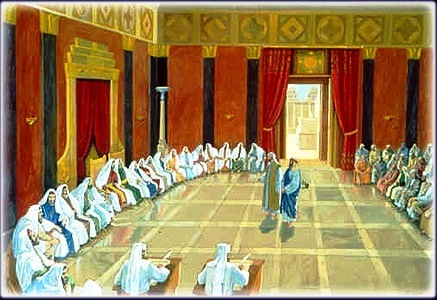
Chamber of Hewn Stones
From the time of Moses and for over 1,500 years, the Jewish People had legislative-judicial councils that went by various names and exercised powers that were sometimes expansive, other times circumscribed.
Since the year 358 C.E. when the last Sanhedrin was disbanded, and 425 C.E. when the last rabbinical patriarch Gamaliel VI was executed by Roman emperor Theodosius II, there have been numerous attempts to revive this ancient institution and its leadership positions. While the 3-member Bet Din magistracy survived the long night of Jewish exile, the Great Sanhedrin of 71 sages and Lesser Sanhedrin of 23 sages in each municipality throughout the Land of Israel were left defunct. The honorable roles of Nassi (Prince/President), Av Bet Din (Vice-President), and Chacham (Sage) went unfilled.
Practical questions as to the re-formation of such a body abound: should a Great Sanhedrin be invested with religious authority alone, or political authority as well? Should its 71 members be drawn only from Israel, or also from the Diaspora? Should its membership represent all of modern-day Judaism’s denominations (Hassidic, Orthodox, Conservative, Reconstructionist, Reform, Humanistic)? If not, how could it claim relevance for non-traditional factions, who might easily establish an alternate Sanhedrin? Should women, homosexuals, or other constituencies be eligible for membership?
With such contentious intra-communal issues involved, it would be perfectly understandable to consider the proposition as a fanciful non-starter, dead on arrival.
Still, the incomparable potential for consensus, cohesion, unity, and authority are hard to resist. To tackle its weighty challenges, there are some preliminary measures that may prove helpful. For example, during the Greek era there seems to have been a Gerusia or council of elders that dealt primarily with the political sphere; this body evolved into–or gave way to–the Great Synagogue which in turn, during the Roman era, became the Great Sanhedrin (dealing primarily with the religious sphere). Both the Gerusia and Great Sanhedrin might be concurrently reconstituted, thereby maintaining the useful arms-length separation between synagogue and state.
An inclusive Great Sanhedrin could serve the entire Jewish People worldwide, and democratically determine Jewish law with regards to salient contemporary matters as specific as Jewish access atop Temple Mount, female rabbinical ordination, or the concerns of the Women of the Wall, and matters as general as conversion, medical procedures, scientific discoveries, technological innovations, environmental issues, and so forth. Moreover, its rulings could lay claim to an authoritativeness that no individual rabbi or rebbetzin/rabbanit could possibly match. A Great Sanhedrin would also obviate the need for the Chief Rabbinate, which as an institution is commonly regarded as symbolic, populated by political appointees, and too often mired in petty scandals. And a Great Sanhedrin does not require the prerequisite of an existing Temple, since in the Roman era the institution moved from the Lishkat Ha-Gazit (Chamber of Hewn Stones) in Jerusalem to Yavneh (Jamnia), Usha, Shefaram, Bet She’arim, Tzippori (Sepphoris), and Teverya (Tiberias).
For its part, the Gerusia could function as a bicameral parliament’s upper chamber like the Senate in the United States and Canada or the House of Lords in the UK. Its ambit would be the State of Israel. It could, for example, help the Knesset and its committees formulate a national Constitution that is Torah-friendly and respects tradition, while making accommodations that recognize the large non-Jewish minority in Israel who would not be subject to Jewish law, only Israeli law. A Gerusia could also bring a Torah perspective to seminal priorities in the current political context such as land concessions, military service, foreign policy, and the like.
Critics of the idea of a new, functioning Sanhedrin system will undoubtedly decry a perceived atavism at work, but by this line of thought all of Zionism and Jewish political sovereignty itself must be similarly atavistic. Other observers are likely to suggest that a reestablishment of the Sanhedrin is fundamentally far-fetched…though it is already underway.
The latest attempt to reestablish the Great Sanhedrin, begun in October 2004 at Tiberias, continues its efforts to play a meaningful role in Jewish life. This self-styled “nascent” or “developing” Sanhedrin, headed by Nassi Rabbi Adin Steinsaltz, acts as a synod with limited functions and even more limited authority. Overall, its activities are modest and its attitude tentative. Most Jews don’t even know it exists. And yet, it is a start.
For 1,813 years the Jewish People were homeless. It has now been 65 years since the Third Commonwealth put an end to that desperate plight. Naturally, you don’t reconstitute a state or replenish a people all at once. The dust of the Diaspora will linger upon us a while. But one by one, our ancient institutions that can be of modern value and service should be restored. In history are the seeds of futurity.