





A Clue to Obama’s Post-POTUS Career Move?
Error: Contact form not found.

 by Edward Alexander

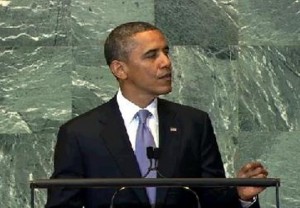
President Obama addressing the United Nations General Assembly. Photo: White House.
Two prominent articles in the Wall Street Journal of 20-21 July beg to be connected. One is Sohrab Ahmari’s shrewd and unsettling interview with ex-senator Jon Kyl about the potential threat to American sovereignty posed by the transnational legal movement modeled on the European Union and its wonderful “progressive” and humanitarian values. These values are articulated in Brussels without regard to representative national legislatures – in Ireland or Italy or France.
The other article is about the European Union’s latest fusillade of fire and vitriol directed at Israel. With typical spite, the EU announced on Tisha b’Av – the saddest day in the Jewish calendar, when Jews mourn the destruction of both Temples, exile from the land of Israel, and numberless subsequent calamities, including (if not especially) European ones – that it would sever all relations with “entities linked to settlements.” This is Eurospeak for the disputed territories of Judea (including East Jerusalem), Samaria, and the Golan Heights, all of which were used, repeatedly, by the Arabs to launch wars of aggression in their interminable campaign to destroy Israel.
We learn from the Kyl interview that the greatest success of “transnational legal thinking” has come via the Obama Administration. It was President Obama who appointed the most zealous devotees of this “thinking” – Anne-Marie Slaughter of Princeton and Howard Koh of Yale – to high positions in the State Department. What Mr. Ahmari neglected to mention is that Obama was the first American candidate for president to campaign “transnationally” for the White House – in Europe (also Egypt) as well as America, as if his popularity there would redound to his credit here. What was one to make of the acclaim he won on a continent where, unless we made an exception for one undersecretary in France at the time (2008), not a single high government position was held by a black person?
Was it that he kept offering “apologies” for many instances of American misbehavior? Or that he promised, for example at the G-20 summit (March 30, 2009), that he would be more respectful of Europe than George W. Bush, and that Americans would no longer be “dictating solutions” to other countries? Did it have something to do with the fact that, unlike President Bush speaking in London in November 2003, he did not express unmannerly disapproval of Europe’s resurgent antisemitism to European political leaders? Or that he kept sneering at the notion of “American exceptionalism”?
In July of 2008, before a crowd of 200,000 at Berlin’s “Victory Column,” Obama showed not the slightest discomfort about rousing the passions of a huge throng in the land whose mass frenzies had unleashed Hitler on the world. More importantly, he endorsed the idea of “global citizenship” and described himself as “a citizen of the world.” Was he already thinking eight years ahead to 2016, when the 22nd amendment to the U. S. constitution (should it still be in effect) might require a career move from President of the United States to President of… ?