





Time for Churches for Middle East Peace (CMEP) to Change its Name
Error: Contact form not found.

 by Dexter Van Zile

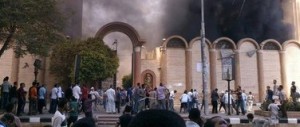
A burning church in Egypt. Photo: IPT News.
It is time for some truth in advertising. It’s time for Churches for Middle East Peace to change its name.
CMEP, as the organization is often called, does not promote the cause of peace and human rights in the most troubled region on the planet.
It promotes the cause of Palestinian statehood and that’s about it.
Every once in a while, the organization will refer to tragedies in other places in the Middle East, such as Syria and Egypt; but it does not engage in any sustained activism on behalf of the victims of violence in these countries.
This is odd. CMEP, a coalition of approximately two dozen Christian churches and para-church organizations founded in 1984, states in its tax documents that its mission is “to inform and educate the general public and national policy makers about Middle East peace and justice issues and maintaining just and stable relationships throughout the Middle East.”
The organization’s website says that it “helps church organizations, leaders and individuals nationwide advocate in a knowledgeable, timely, balanced, and effective way to express their concerns about justice and peace for all peoples in the region. CMEP activists, board and staff engage directly with policy makers at every level.”
Reading the two statements quoted above, it looks like CMEP has a pretty broad mandate – to promote peace and human rights for all peoples in the Middle East. But if you look at the organization’s internet presence, you’ll see that CMEP’s raison d’être is to highlight Palestinian suffering that can be blamed on Israel.
As of this writing, the organization’s Facebook page highlights the impact of Israel’s security barrier on a Catholic monastery and convent in the West Bank’s Cremisan Valley. The organization’s website also highlights the Cremisam valley controversy. Additionally it draws attention to the peace negotiations currently taking place between Israeli and Palestinian leaders, and the appropriation of land for Betar Illit, an Israeli settlement in the West Bank.
But when it comes to commenting on the August 21 gas attack in Syria that left hundreds of people (including many children) dead, you won’t find much outrage. Nor will you find much information about Islamist violence against Coptic Christians in Egypt.
To be fair, there is a brief statement, issued in April, calling for the release of two abducted Christian in Syria, where more than three million people have become refugees as a result of the civil war that began in 2011. But that’s about it.
The way it stands, CMEP can either lift up its voice on behalf of the victims of violence in other countries in the Middle East.
Or it can change its name.
Churches for Palestine, perhaps?