

Israeli Settler Doctor Provides Free Care to Ailing Palestinians
Error: Contact form not found.

 by Anav Silverman Peretz

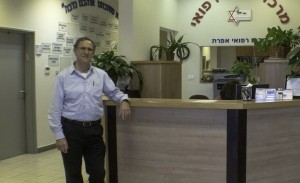
Dr. Yitz Glick at the Efrat Emergency Medical Center. Photo: Natan Epstein / Tazpit News Agency.
On a day when snow still covers the Judean hills, a Jewish doctor from Efrat drives into the neighboring Palestinian village of Wadi Nis. He is greeted by the local Palestinian villagers with smiles and warm hellos. “There’s the doctor,” says one Palestinian woman to another as Dr. Yitzchak Glick lowers his car window to say hello.
To the people of Wadi Nis and six other Palestinian villages in the Gush Etzion region, the kippah-wearing Dr. Glick is a familiar and welcome face. The U.S.-born doctor, who made aliyah with his parents in 1974, makes personal house calls every week, providing medical treatment to ailing Palestinians free of charge.
When Dr. Glick sees Mohammed, a construction worker who he treated for injuries from a fall from a building a couple of years ago, he stops to get out of the car. With his red keffiyeh, Mohammed greets Dr. Glick with a hug and the two converse as old-time friends. “The people here don’t forget what I and other doctors from Efrat have done – from treating expectant mothers and providing free medicine to saving lives, you become part of their families.”
The connection runs so deep that the Arab villagers have alerted Efrat authorities on several occasions about terror cells on their way to attack the community.
Glick, a religious Zionist, not only provides medical care to Palestinians in the vicinity of their homes. In 2000, he founded the Efrat Emergency Medical Center (EEMC) during the second Intifada. Glick serves as the center’s medical director and has done so for nearly 14 years in a voluntary position.
The medical center serves both Israelis and Palestinians in Gush Etzion and treats anywhere from 50 to 100 patients a day, providing services that include emergency care, radiology, and women’s health services. In total, EEMC provides medical care to approximately 50,000 people a year from the Gush Etzion-Hebron area.
“Co-existence has always been behind the mindset of Efrat’s founders and Rabbi Shlomo Riskin,” says Dr. Glick. “There have always been good neighborly relations between many of the local Palestinians and the community of Efrat.”
“In the medical field, doctors are used to treating all walks of life. Here in Gush Etzion, it’s no different – everyone is treated with respect and accorded quality medical care,” adds Glick. The doctor is also well-known for his care of Israeli terror victims and those injured in traffic accidents, arriving first on the scene with medical help. Dr. Glick was awarded the Presidential Award for Volunteerism by Shimon Peres in 2009, and the Moskowitz Prize for Zionism in 2012.
Glick, along with his right-hand man and EEMC’s development manager, Yossi Hass, also described how, during the recent snowstorm, an ambulance volunteer was driving around and came upon a hypothermic Palestinian in the Hebron area. The volunteer brought the man to the medical center, where he was treated and remained throughout the snowy night.
“There are so many stories like this that happen daily,” said Dr. Glick. “They show another side of reality – where Jewish and Arab residents live together and do their best for each other.”
According to Nave Dromi, a spokesperson for Blue&White Human Rights, an organization that works to implement equal medical treatment of Palestinians in Judea and Samaria, the public both in Israel and abroad has no idea of such co-existence initiatives.
“It is little known to even many Israelis that there are Jewish residents in Judea and Samaria who ensure human rights for all the citizens in the region, specifically for Palestinians,” says Dromi.
“There is a completely different side to the politics and conflict that the mainstream media chooses highlight in Judea and Samaria. In the field of medicine and healthcare, politics has no place.”
Indeed, Dr. Glick, who has been a resident of Efrat for 20 years and is a father to five children, believes that “the universe is big enough for all of us here.”
Pointing to the local Rami Levy supermarket where both local Jewish and Palestinian residents go shopping and work as employees, Dr. Glick says “We go shopping for food together, we buy gas for our vehicles together, we get the same medical care and we work together – Jewish and Palestinian residents share a way of life in Gush Etzion.”
“We aren’t going anywhere and they [the Palestinians] aren’t going anywhere – we are all here to stay,” says Dr. Glick.