




Some Operas You Won’t Be Seeing at the Met
Error: Contact form not found.

 by Ben Cohen / JNS.org

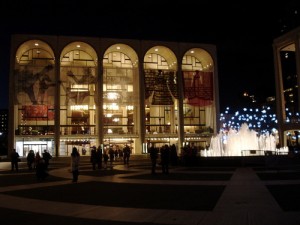
Outside the Metropolitan Opera at Lincoln Center in New York City. Photo: Wikimedia Commons.
JNS.org – Here are three operas that won’t get staged at the famed Metropolitan Opera (Met) in New York City anytime soon.
“Omar.” The story of a young Iraqi man who was beaten and tortured by Saddam Hussein’s secret police. Omar’s experience, relayed in the Iraqi writer Kanan Makiya’s superlative book “Cruelty and Silence,” exposes a world in which, as the lead character says, “Words can kill. Words are what got us in the end, not anything we did.”
“A Persian Grandmother in Tokyo.” Based on a short memoir published by a young Iranian writer in a collection entitled “Arab Spring Dreams,” the opera relates the story of an Iranian family reunited in Tokyo, a city that provokes the grandmother to observe ironically, “these infidels have created their own heaven on earth.”
“The Last Days of Hugo Chavez.” Set in Havana, where the late Venezuelan tyrant Hugo Chavez died of cancer, the opera focuses upon the exploitation of Venezuela’s natural resources by the Cuban regime through its depiction of the relationship between Chavez and the Castro brothers, Fidel and Raul.
These operas aren’t coming to the stage of the Met, or any other prestigious venue, because, so far as I know, they haven’t been composed. And even if they had been, who would dare stage them? Wouldn’t liberal sensibilities be offended by a reminder of the grotesque violence inflicted by Saddam’s regime, given that the Iraqi dictator was removed by the hated George W. Bush? Wouldn’t efforts to lift the U.S. embargo against Cuba be compromised by a portrait of the dirty dealings of the Castro brothers? Wouldn’t an opera that tackles the sensitive subjects of Islamism and Muslim identity result in the kinds of angry demonstrations brought about by the publication, in Denmark, of the infamous cartoons of the Prophet Muhammad?
In any case, why is there a need for operas like these? After all, there already is an opera—”The Death of Klinghoffer”—which engages subjects like ethnic identity, terrorism, and the struggle of the voiceless to find a voice. Moreover, it does so on a terrain that is comfortingly familiar to the bearers of liberal angst in our time: that of the conflict between the Palestinians and Israel.
As readers doubtless know, “Klinghoffer,” an opera that was first introduced to a New York audience in 1991, will enjoy yet another outing, courtesy of the Met. Most of the arguments around the opera now surfacing are, in fact, far from new. There is the accusation of anti-Semitism – shrugged off, as usual, by partisans of the work—in the way that American Jews are portrayed. There is also the misleading title—to speak of the “death” of Klinghoffer overlooks the unfortunate fact that this elderly Jewish man, a passenger on board the Achille Lauro cruise ship seized by Palestinian terrorists in 1985, was actually murdered, by dint of his being shot and then thrown overboard while in his wheelchair.
But few have asked the critical question: why does the art world, like so much of the media and human rights community, default to the Palestinians when it comes to exploring the overarching moral issues facing our civilization? What is it that gives the Palestinians unrivaled authenticity when it comes to such febrile issues as statelessness and terrorism?
For one thing, the Israeli-Palestinian conflict resonates, in America, in a way that other, far more terrible conflicts don’t. If you want to counter the “neoconservative attack on the literary and pictorial arts,” in the words of the late Palestinian critic Edward Said’s passionate defense of “Klinghoffer,” than the plight of the Palestinians carries the advantage of instant recognition, particularly on the left—if that means obscuring other human rights abuses, like those experienced by the Bedoon people in Kuwait (I can already hear the chorus of “Who?!?”), then so be it.
For another, invoking the Palestinians is an acceptable route for demonizing the identification and solidarity that many American Jews feel towards Israel. When Leon Klinghoffer’s daughters slammed the doctrine of moral equivalence at the heart of the opera, its librettist, Alice Goodman (a Jew who has since converted to Christianity) declared, “To those who come prepared to see and hear only what they want to see and hear, nothing one can say is of any use.” In other words, “You people are philistines whose fealty to the Zionist cause blinds you to the truth, as well as to great art.” There is no record, of course, of Goodman ever asking the Klinghoffer sisters why they reacted in the way that they did.
I don’t believe that the defenders of “Klinghoffer” are capable of interrogating the unspoken assumptions they carry. Nor will they ever address the contradiction between promoting art that they deem to be “provocative” on the one hand, while stubbornly sticking, on the other, to the one issue they know will play well with a liberal audience.
That’s why I’ll wager that someone—perhaps John Adams, the composer of Klinghoffer—will come up with an opera that humanizes the Hamas kidnappers of the three Israeli teenagers (Eyal Yifrach, Naftali Frankel, and Gilad Shaar) way before the topic suggestions I’ve outlined above even get considered. For when all is said and done, “The Death of Klinghoffer” is an opera for those who live in an echo chamber that shuts out any dissenting views. To them, it’s beautiful music. To others, like myself, it’s a discordant racket.
Ben Cohen is the Shillman Analyst for JNS.org and a contributor to the Wall Street Journal, Commentary, Haaretz, and other publications. His book, “Some Of My Best Friends: A Journey Through Twenty-First Century Antisemitism” (Edition Critic, 2014), is now available through Amazon.