



Hamas Spox: We Deported Foreign Journalists for Filming Missile Launches
Error: Contact form not found.

 by Joshua Levitt

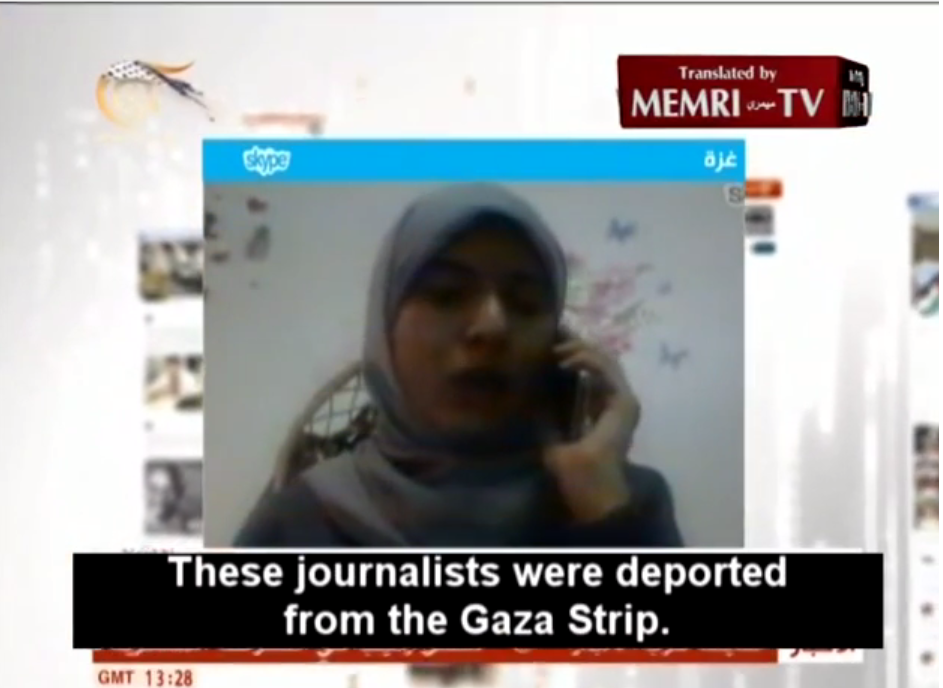
Hamas spokeswoman Isra Al-Mudallal, head of foreign relations in the Hamas Information Ministry, describing to Mayadeen TV how foreign journalists were deported for filming rocket launch sites. Photo: MEMRI / Screenshot.
Hamas spokeswoman Isra Al-Mudallal, head of foreign relations in the Hamas Information Ministry, on Thursday told Lebanon’s satellite broadcaster Mayadeen TV that journalists who filmed missile launch sites were given a chance to change their stories, or deported from Gaza.
MEMRI, The Middle East Media Research Institute, on Friday published a translation of her Skype interview. The matter-of-fact confirmation by Al-Mudallal provided the context to the many reports from Gaza of Hamas intimidating journalists, forcing retractions, omissions and censoring impromptu reporting via social media. This week, Israel’s Foreign Press Association also condemned Hamas’s policies towards the press.
Al-Mudallal said journalists came into Gaza through the Beit Hanoun Crossing, also known as the Erez Crossing. Most were freelancers or from news agencies. Fewer journalists entered Gaza during this war than in the previous rounds, in 2008 and 2012, she said.
The coverage by foreign journalists in the Gaza Strip “was insignificant compared to their coverage within” Israel, Al-Mudallal said. “Moreover, the journalists who entered Gaza were fixated on the notion of peace and on the Israeli narrative,” she claimed.
“So when they were conducting interviewers, or when they went on location to report, they would focus on filming the places from where missiles were launched. Thus, they were collaborating with the occupation. These journalists were deported from the Gaza Strip.”
“The security agencies would go and have a chat with these people,” she said. “They would give them some time to change their message, one way or another.
“Some of the journalists who entered the Gaza Strip were under security surveillance,” the spokeswoman said. “Even under these difficult circumstances, we managed to reach them, and tell them that what they were doing was anything but professional journalism, and that it was immoral.”
Watch a sub-titled interview with the Hamas spokeswoman.