







Study: Muslims, Atheists, Most Likely to Believe in Aliens; Jews, Christians, Not So Much (VIDEO)
Error: Contact form not found.

 by Dave Bender


Menorah crop circle. Photo: One-vibration.com
An astronomer is claiming in a new book, that individual notions of sentient life beyond Earth may be pegged to ones religious belief or disbelief, with – perhaps ironically – atheists and Muslims, leading the list, according to a report in the UK’s Daily Mail.
“When I did a library search, I found only half a dozen books and they were all written about the question of extraterrestrial life and Christianity, and mostly about Roman Catholicism, so I decided to take a broader look,” said Prof. David Weintraub, of Vanderbilt University in Nashville, Tennessee.
Religions and Extraterrestrial Life, surveys 24 religions on their views of extraterrestrial life.
Some of the results:
55 percent of Atheists, 44 percent of Muslims, 37 percent of Jews, some 36 percent of Hindus, and 32 percent of Christians believe in aliens and or divine beings.
The Catholic Eastern Orthodox sects held at 41 percent against the Baptists’ 29 percent.
“Very few among us have spent much time thinking hard about what actual knowledge about extraterrestrial life, whether viruses or single-celled creatures or bipeds piloting intergalactic spaceships, might mean for our personal beliefs [and] our relationships with the divine,” according to Weintraub.
Asian religions, in his view, would be the most accepting of the prospect of life in other worlds, since Hinduism posits that humans and aliens could reincarnate into each others’ worlds; as well, Buddism allows for the possibility of endless populated planets.
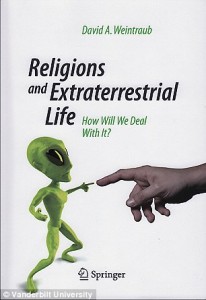
Religions and Extraterrestrial Life. Image: Book cover
Among Jews and Muslims, Weintraub pointed to passages in the Koran referring to spiritual beings, but added that they might practice a version of the faith unknown on Earth.
Judaic sources are limited in scope on the prospect of life elsewhere, although Talmudic and some rabbinic tomes hold that the universe is infinite, and as such, could, in kind, hold an infinite number of beings.
For Roman Catholics, however, the idea of life elsewhere has been a debating issue for a thousand years, with the chief dispute being over original sin for creatures not descended from Adam and Eve, and whether Jesus had visited them, as well.
“From a Roman Catholic perspective, if sentient extraterrestrials exist, some but perhaps not all such species may suffer original sin and will require redemption,” according to Professor Weintraub.
Since the year 2000, astronomers have discovered more than 1,000 exoplanets – that is, worlds outside of our solar system.
Watch a video interview with Weintraub:
[iframe frameborder=”0″ width=”698″ height=”503″ scrolling=”no” id=”molvideoplayer” title=”MailOnline Embed Player” src=”http://www.dailymail.co.uk/embed/video/1124035.html” >]


