Military Option Prevents War
Error: Contact form not found.

 by Yoram Ettinger

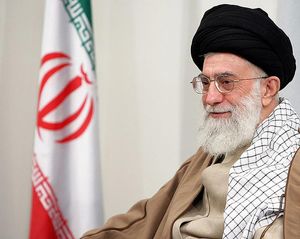
The assertion that the Ayatollah's regime can only be dealt with negotiations or military action is misleading, Yoram Ettinger explains. Photo: Wikimedia Commons.
The assertion that there are only two options in dealing with the rogue ayatollah regime — negotiation or a military option, which supposedly amounts to war — defies reality. Such an assertion is either mistaken or misleading.
The threat of a limited surgical naval or air force bombing of critical nuclear installations, with no ground troops, would not amount to a war but it would deter the ayatollahs, possibly moderating their nature. If activated, it could permanently cripple their pursuit of nuclear capabilities. If necessary, strikes could be repeated from U.S. military bases in Qatar, Bahrain, Saudi Arabia, Oman and the Indian Ocean or from U.S. aircraft carriers.
Recent precedents demonstrate that there are many military options, dramatically short of war, that are critical to moderating the nature of rogue regimes and preventing war. On the other hand, the removal of a military option from the table while negotiating with rogue regimes whets their appetite and fuels war.
On Dec. 19, 2003, Libyan leader Moammar Gadhafi announced a drastic shift in his modus operandi: the dismantling of his chemical, nuclear and long-range ballistic missile capabilities. Gadhafi’s stunning decision was induced by the high visibility of the U.S. military option. He was traumatized by the capture of Iraq’s Saddam Hussein the previous week, which upgraded the U.S. posture of deterrence, convincing the Libyan tyrant that the U.S. was determined to leverage the military option in its battle against additional rogue regimes.
In fact, Iran’s ayatollahs suspended their nuclear program in 2003 precisely due to fear of the U.S. military option. Alas, the ayatollahs resumed, expanded and accelerated their nuclear program upon realization that there was no actual threat of an imminent U.S. military operation against them or against their ally, Syrian President Bashar Assad. They were emboldened by then-U.S. President George Bush’s embrace of then-Secretary of State Colin Powell’s May 3, 2003, remark that the military option against Syria “was not on the table.”
On July 20, 1988, following eight years of intransigence, Iran accepted a cease-fire agreement, ending its eight-year war against Iraq — including full retreat from occupied Iraqi territory — in response to a surgical U.S. attack on sensitive Iranian installations, and the unintentional downing of an Iran Air plane by the U.S. Navy.
However, on July 25, 1990 — one week before the Aug. 2 Iraqi invasion of Kuwait — then-Secretary of State Jim Baker removed the U.S. military option from the table, misleading Saddam Hussein into believing that he could get away with murder, unintentionally paving the road to the first (1991) and second (2003) Persian Gulf wars. Baker instructed the U.S. Ambassador to Baghdad, April Glaspie, to tell Saddam Hussein: “We have no opinion on the Arab-Arab conflicts, like your border disagreement with Kuwait. … Secretary of State Jim Baker has directed our official spokesmen to emphasize this instruction [that the Kuwait issue is not associated with America].”
Baker assumed that the overwhelming U.S. military edge would deter Saddam Hussein from invading Kuwait. He underestimated Saddam’s megalomaniac ideology and the erosion of the U.S. posture of deterrence.
Today, the U.S. administration is applying the same assumptions when dealing with the supremacist, Islamist, repressive, violently intolerant, megalomaniacal, expansionist, anti-U.S. ayatollahs. Unlike Saddam, the ayatollahs are apocalyptic and undeterred, in fact they are energized by the notion of mutual assured destruction. They are emboldened by the dramatic decline of U.S. power projection in the Middle East and beyond.
When dealing with the ayatollahs, the removal of the military option from the table would be similar to a police chief stripping his officers of guns, tasers, rubber bullets and tear gas and sending them to confront violent criminals. Intensified crime will inevitably follow.
The removal of the military option from the table projects the intent to ignore precedents and to repeat, rather than avoid, devastating mistakes.
When dealing with the rogue ayatollah regime, the stick/threat of the military (not war) option constitutes a most effective, and humane, means to spare humanity the wrath of a global nuclear war. The absence of such an option brings the globe closer to such a chaotic reality.
This article was originally published by Israel Hayom.