









Why the Iran Nuclear Deal Won’t Be a Final Deal
Error: Contact form not found.

 by John Bolton

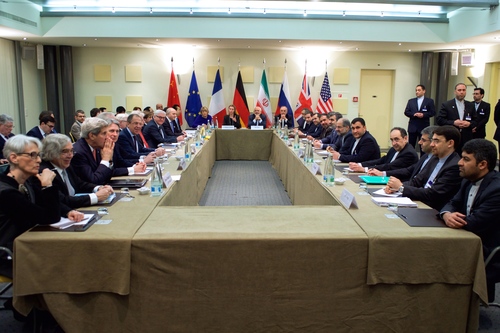
Negotiators at the Iran nuclear talks. Photo: U.S. Department of State.
After repeatedly ignoring self-imposed deadlines, Iran and the U.N. Security Council’s five permanent members (plus Germany) are about to sign a nuclear deal in Vienna. To most Americans, reaching an agreement means moving on to performance.
But the Tehran regime has a very different view. To the mullahs, the Vienna accord is merely a rest stop before starting new negotiations, not their conclusion. This so-called “final” agreement is simply one more interim step, one more tactic to extract further concessions from Barack Obama. Whatever Congress acts on in the coming days is already on the way to becoming just another dusty document in the archives.
The recent frantic discussions in Vienna did not produce real breakthroughs or compromises resolving longstanding disagreements. Instead, for many hotly disputed issues, the sides have been crafting what the British primly call “a form of words” that obscures the continuing differences rather than decides them. Dominating the next round of talks will be renewed efforts, yet again, to resolve the continuing disagreements over what these “forms of words” actually mean.
Of course, far too many substantive concessions have already been made, starting with allowing Iran to retain any uranium-enrichment capacity. By giving away this basic point, President Obama erased years of U.S., European and even Security Council insistence that Iran cease all enrichment and reprocessing activity. All the other concessions flowed downhill from there.
Moreover, leaks indicate that the Vienna deal will be implemented in stages, with partial performance from both sides before it “goes live” completely. These significant unresolved areas provide new opportunities for Iran to extract concessions from Obama. Consider just three examples still being disputed even in the last hours:
• Iran’s prior weaponization activities (the military work to take enriched uranium or plutonium and actually create the critical mass necessary for the uncontrolled chain reaction of a nuclear explosion) are far from resolved. Endless disputes and obstruction by Tehran are still entirely possible.
• The extent and nature of inspections by the International Atomic Energy Agency are still very much undecided. Whatever paper agreement is reached is worth little until actual implementation, when Iranian concealment, cheating, delay and obstruction can defeat whatever is written.
• The White House claims the parties agreed on a “snapback” mechanism to revive economic sanctions if Iran is found to have violated the deal. This highly questionable assertion turns critically on deciding that there is actually a violation, which itself can be subject to endless dispute and further delays.
These outstanding issues exemplify the enormous loopholes Tehran can already exploit and substantive policy areas where Obama, incredibly, still has more concessions he can make. The entire accord is shaped around the central premise that Iran has lied in the past and will lie in the future. It has already violated its Nuclear Non-Proliferation Treaty pledge not to develop nuclear weapons, not to mention all the commitments made in prior negotiations over the past 12-plus years.
The basic difference in the parties’ respective approaches to negotiation was one of many things the White House never understood about Tehran. This is not about policy substance, but negotiation methodology and tactics. We have known for some time that Iran was winning on substance. Now, we can see unambiguously that Iran is also winning on diplomatic tradecraft.
But what is Tehran’s objective through this endless negotiation process? Iran’s perspective, warped but determined, is that it is engaged in a millennial religious struggle with the United States, Israel and the Sunni Muslim world. Iran is simply not playing for the same stakes as the United States: acceptance in the ill-defined “international community” and an end to its global “isolation.” The mullahs don’t think they are isolated; they think they are right and the rest of us are wrong.
Ironically, as evidence of Iran’s trustworthiness, the administration has repeatedly cited a 2003 “fatwa” by Iran’s Supreme Leader Ayatollah Khamenei, declaring that Muslims will not use or seek nuclear weapons. Iranian President Rouhani made it a centerpiece of his 2013 United Nations address, but no Westerner has actually read this supposed fatwa’s text or even seen an actual copy.
Most importantly, Iran feels no time pressure to reach a “final” agreement on the nuclear issue. Time is rarely a neutral factor in negotiations, and with nuclear proliferation it is virtually an iron law that time works in favor of the proliferator. Time is required to overcome all the complex scientific and technological obstacles on the road to deliverable nuclear weapons. In fact, time may ultimately be more important than resources, one reason why international sanctions, despite causing harm to Iran’s economy, have done precious little to slow its nuclear program.
Continuing negotiations with Tehran, whatever deal actually emerges in Vienna, is a prescription for Iranian nuclear weapons. This is the depressing consequence of a U.S. strategy that believes that a theocratic ideology can be dissuaded by modest economic pressure and subtle diplomacy. No wonder the ayatollahs must think we are fools.
John Bolton, a senior fellow at the American Enterprise Institute, was the U.S. permanent representative to the United Nations and, previously, the undersecretary of State for arms control and international security.
This article was originally published by The Pittsburgh Tribune Review.


