








In Letter to Supporters, AIPAC President Rebuffs New York Times Article Based on Obama Admin ‘Inaccuracies’
Error: Contact form not found.

 by Algemeiner Staff

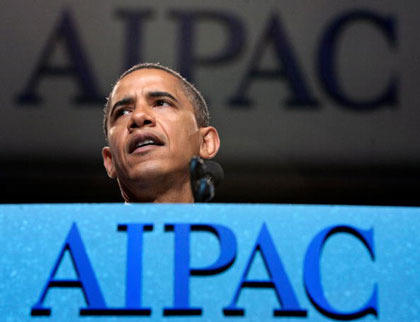
President Obama addresses AIPAC. Photo: AIPAC.
The American Israel Public Affairs Committee (AIPAC) distanced itself on Tuesday from recent White House criticisms of the lobbying efforts against the nuclear deal with Iran.
Taking a notably non-combative tone, AIPAC President Robert A. Cohen wrote in a letter sent out to supporters that the pro-Israel lobby had “taken the high road,” keeping the debate about policy rather than personalities.
Still, Cohen struck back specifically at a New York Times portrayal over the weekend of AIPAC’s millions-of-dollars campaign on Capitol Hill and throughout the country that is urging lawmakers to vote in September to reject the nuclear deal with Iran, saying the piece was based on “multiple inaccuracies stemming from claims by the administration.”
Despite President Barack Obama’s assertion that opponents of the deal are either “ideological” or “illogical,” AIPAC said its “facts are well-substantiated and accurate,” and stood behind the credibility of its analysis, which largely mirrors criticism out of the government of Israeli Prime Minister Benjamin Netanyahu — mainly, that the deal offers Iran windfall sanctions relief without dismantling its nuclear infrastructure, does not provide effective verification mechanisms, does not address concerns that the Iranians were working to develop nuclear weapons, and provides Iran with a window after 15 years to become a legitimized nuclear threshold state.
AIPAC also took issue with the Times’ claim that a $25 million subdivision of the lobby was running television “spots” in New York City, saying the group has only run one politically gentle advertisement that does not single out the president “in any way.”
Though the Times wrote that Obama had taken offense to an AIPAC activists meeting in Washington, DC where top administration officials including Undersecretary of State Wendy Sherman and White House Chief of Staff Denis R. McDonough were unable to answer questions or “confront the ‘inaccuracies'” the White House claims are being spread over the deal, Cohen insisted “AIPAC treated these speakers with great courtesy and respect.”
Cohen also distanced the lobby from White House charges that the same “warmongering” individuals opposing the Iran deal today supported the U.S. invasion of Iraq in 2003: “Leading up to the start of the Iraq War in March 2003, AIPAC took no position whatsoever, nor did we lobby on the issue.”