









Israeli Antisemitism Scholar Warns Against Translating Hitler’s ‘Mein Kampf’ Into Hebrew Without Annotations on Use of Themes in Muslim World
Error: Contact form not found.

 by Ruthie Blum

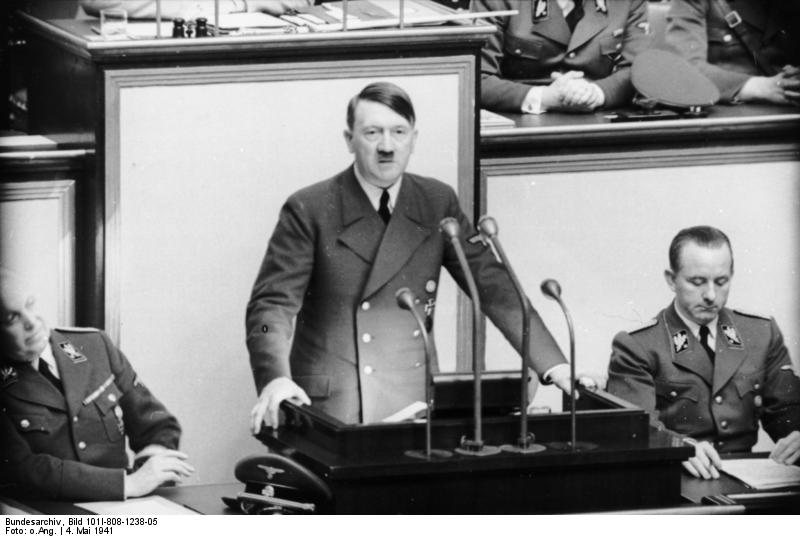
Adolf Hitler. Photo: Wikimedia Commons.
Israel-based antisemitism scholar Manfred Gerstenfeld warned Wednesday against frivolous Israeli use of the newly released worldwide rights to the distribution of Adolf Hitler’s Mein Kampf.
Responding to a query about an Israeli publisher’s belief in the value of translating the work into Hebrew, Gerstenfeld told The Algemeiner that doing so, if at all, should be undertaken with great care.
“A Hebrew edition is desirable only if it is heavily annotated,” he said. “By that I mean that it should not only show how Hitler prepared the Holocaust with this book. It should also illustrate how his ideas developed on the infrastructure created by the Catholic Church and several Protestant denominations over many centuries. Furthermore, it should explain what motifs in Mein Kampf mutated into themes used against Israel, with a particular emphasis on the Muslim world, including the Palestinian territories.”
This is in contrast to the excitement expressed by Idan Zivoni, co-editor of Resling, an academic Israeli publishing house that also translates international books, at the prospect of making Hitler’s infamous tome available to the people whose history was so affected by it.
“It is a national mission to publish the book in Hebrew,” Zivoni said during a Channel 10 talk-show discussion on the topic. “But I believe that few [Israelis] will actually read it.”
He was referring to the sensitive nature in the Jewish state of anything related to the Holocaust, as the country still has a large number – albeit dwindling – of survivors, and many more offspring.
The debate has arisen, due to the January 1 entry of Mein Kampf (“My Struggle”) into the public domain, after 70 years under the auspices of the southern German state of Bavaria, which was given control over the Nazis’ main publishing house by the Allies in 1945, following Hitler’s suicide.
Gerstenfeld, whose book The War of a Million Cuts analyzes the delegitimization of Jews and Israel, also explained that Hitler’s infamous tome has, in fact, been distributed elsewhere.
“Despite the copyright of the state of Bavaria there have been various editions of Mein Kampf in Arabic,” he said. “A few years ago one could even find some copies in London in neighborhoods with large Arab populations. Rifat Bali, an expert on Turkish antisemitism wrote a few years ago that the Turkish translation of Mein Kampf had become a best-seller in the country and could be purchased in some of the largest supermarket chains and bookstores. A few years ago it was reported that it was a bestseller in the Palestinian territories. One extreme antisemitic website lists where one can download Hitler’s book for free on the Internet in various European languages.”
Mein Kampf was written during Hitler’s term in prison, following his attempted putsch. Its first volume was released in July 1925, and its second volume in 1926. It has been translated and distributed in various Western and Middle Eastern countries.
Zivoni said the real reason for its not having been published in Israel has to do with a “silent taboo,” which is “more serious that an official taboo in Israeli society.”


