






Tel Aviv Pub Owner Says Reopening After Deadly Terror Attack ‘Will be Our Long-Term Victory’ (INTERVIEW)
Error: Contact form not found.

 by Ruthie Blum


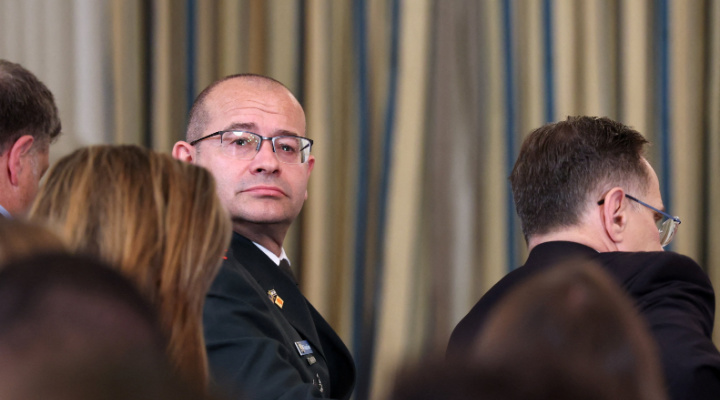
Ori Mizrachi, co-owner of the Simta pub in Tel Aviv. Photo: nrg/Screenshot.
A co-owner of the Tel Aviv pub that was the target of last Friday afternoon’s shooting attack explained to The Algemeiner why he reopened the establishment Wednesday night, even as police continued their manhunt for the terrorist, who has since been located and neutralized.
Ori Mizrachi, one of five partners who opened the “Simta” (“alley”) in the White City exactly four months ago said that his fears about resuming “business as usual” were not related to physical danger. This is in spite of the fact that Nashat Milhem, the Israeli Arab who opened fire on patrons, killing two of them, wounding seven others and subsequently murdering a taxi driver, still remained at large on Wednesday. (He was discovered in Umm el-Fahm on Friday, and was killed by Israeli security forces during a gun battle.)
No, Mizrachi told The Algemeiner on Friday, a week to the date of the attack, “If there was any trepidation – and there was – it had to do with how opening our doors so soon after the tragedy would appear to the public.”
The families of 26-year-old Alon Bakal, a Simta shift manager, and 30-year-old Shimon Ruimi, who was there attending the birthday party of a friend, were still sitting shiva (the Jewish seven-day mourning period), he said. “And we weren’t sure whether our attempt at showing that we will not be defeated by terrorism would be perceived as inappropriate.”
Nevertheless, said Mizrachi, who arrived at the pub minutes after the shooting spree, “We felt it was really important to show not only that life goes on, but that it does so in an atmosphere of unity and togetherness in the face of hardship.”
This, he asserted, was one of the original concepts on which the Simta was created in the first place: “To make people feel uplifted, surrounded by others in the same enjoyment mode.”
On Wednesday evening, this spirit was apparent, Mizrachi said, “albeit with a respectful sense that everyone was there to remember Bakal and Ruimi.”
Indeed, the room of the hip, centrally located pub was lit with yahrzeit memorial candles, not tea lights in colored glass for romantic ambiance. And Israeli flags created the decor.
And there was music, said Mizrachi. But not the usual blasting kind normally heard in bars; rather a public sing-a-long, more typical of sitting around a camp fire on the dunes than on bar stools along Dizengoff Street.
Among the first to enter the premises was Tel Aviv Mayor Ron Huldai, who shared a beer with Mizrachi and his four co-owners, and made a statement for public consumption – praising residents of his city for their resilience.
Mizrachi told The Algemeiner about the pep talk he gave to his 26 employees prior to the re-opening. “I said to them, ‘Let’s compare this to a combat unit, whose mission is to make people feel good and safe, when suddenly two of our men are killed. If we keep the place closed, the enemy has won the war. If we open it, we will have lost a small battle within the greater operation, but it will be our long-term victory.’”