


The Palestinian Authority Repudiates Oslo, and No One Reports or Cares
Error: Contact form not found.

 by Sean Durns

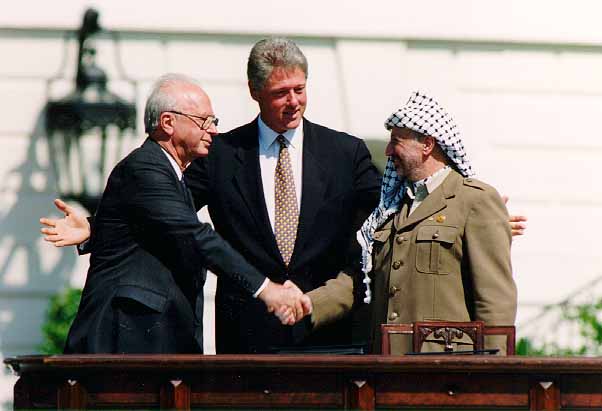
Bill Clinton, Yitzhak Rabin and Yasser Arafat at the Oslo I signing ceremony, September 13, 1993. Photo: Wikipedia.
The Palestinian Minister of Foreign Affairs, Riyad al-Maliki, said during a press conference in Tokyo on February 15, that he would never directly negotiate with Israel. Maliki’s comments — largely ignored by the US news media — violate the terms of the 1993 Oslo peace accords, under which the Palestinian Authority (PA) was created and funded.
In a September 9, 1993, letter from then-Palestine Liberation Organization (PLO) head Yasser Arafat to Israeli Prime Minister Yitzhak Rabin, Arafat promised: “The PLO commits itself to the Middle East peace process and to the peaceful resolution of the conflict between the two sides and declares that all outstanding issues relating to permanent status will be resolved by negotiation.”
As part of the 1995 Interim Agreement (Oslo II), PLO and Israeli representatives reaffirmed their desire “to achieve a just, lasting and comprehensive peace settlement and historic reconciliation through the agreed political process.”
As historian Efraim Karsh has noted, Oslo threw the moribund PLO a lifeline. In the preceding years, Arafat’s PLO had retreated from Lebanon and was a US-listed terror group with its headquarters in Tunis. Infighting had increased, and Arafat had alienated key Arab allies and donors by supporting Iraqi leader Saddam Hussein’s invasion of Kuwait.
Oslo brought the PLO in from the cold — giving it a base for limited self-rule in the West Bank (Judea and Samaria) and Gaza Strip, much needed international donor funds, and the chance to establish a state through bilateral negotiations — provided that it renounce terrorism and incitement to violence, and agree to recognize Israel, among other conditions.
Arafat’s right-hand man during the Oslo negotiations was his successor, current PLO chairman and PA President Mahmoud Abbas — Maliki’s boss. If Abbas disapproved of his foreign minister’s remarks, he has yet to repudiate them.
In Tokyo, Maliki went back on his government’s commitments, unequivocally stating, “We will never go back and sit again in a direct Israeli-Palestinian negotiations.”
Yet major US news outlets have failed to devote so much as a single sentence to Maliki, despite their previous adoration of the Oslo accords.
Further, Maliki’s renouncing Oslo confirms a pattern by PA officials. As CAMERA has noted, in a September 30, 2015, speech to the UN General Assembly, Abbas said the PA was no longer bound by the accords.
Karsh has pointed out that as early as May 10, 1994, Arafat told South African Muslim leaders that the Oslo accords “fell into the same category as the Treaty of Hudaibiya that was signed by the Prophet Muhammed with the people of Mecca in 628, only to be reneged on a couple of years later when the situation titled in Muhammad’s favor.” Arafat’s words were recorded by a member of the Jewish community who had infiltrated the meeting posing as a Muslim — provoking demands from Israeli officials that he repudiate them. Arafat never did. Instead, he reiterated the Hudaibiya comparison on several occasions, including in his August 21, 1995, remarks at al-Azhar University in Gaza.
That Maliki’s sentiments are not unique should make them all the more newsworthy. Speaking at the 1993 Oslo signing ceremony, President Clinton remarked, “Every peace has its enemies, those who still prefer the easy habits of hatred to the hard labors of reconciliation.” The late Middle East analyst Barry Rubin noted that Arafat had to be talked out of bringing his gun to that ceremony. The PA foreign minister may not carry a gun, but he reinforces Palestinian repudiation of the “peace process.” The news media, their Oslo hoopla long gone, does not notice.
The writer is Media Assistant in the Washington, D.C. office of CAMERA, the 65,000-member Boston-based Committee for Accuracy in Middle East Reporting in America.