





BBC Obscures the Truth About an Anti-Israel UN Resolution
Error: Contact form not found.

 by Hadar Sela

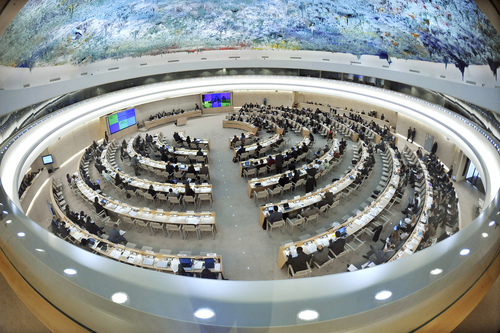
The UN Human Rights Council. Photo: UN Photo/Jean-Marc Ferré via Wikimedia Commons.
An article that appeared on the BBC News website’s Middle East page on March 25, under the headline “Israel rejects database of settlement-linked firms,” pertains to a resolution adopted by the UN Human Rights Council the previous day.
The BBC’s report is notable both for what it does and does not tell readers.
In the former category, we see the standard insert, which breaches editorial guidelines on impartiality by failing to inform audiences of alternative views to the narrative on “international law” adopted by the BBC.
Settlements built on territories occupied by Israel in 1967 are considered illegal under international law, but Israel disputes this position.
We also see employment of the term “Palestinian lands” to describe locations in Jerusalem and Judea and Samaria, which –prior to being under Israeli rule — were occupied by Jordan and have never been under the control of a Palestinian entity. Significantly, the BBC previously ruled that the employment of that term “appropriately reflected the language of UN resolutions,” despite the fact that it is obviously confusing and misleading to audiences aspiring to understand the factual background to the dispute over those locations.
The BBC’s Yolande Knell in Jerusalem says the database will provide a resource for any organisation wanting to divest from companies involved in Israel’s occupation of Palestinian lands.
It will potentially include a number of Israeli and international firms working in industries from banking to construction and security services, our correspondent adds.
Knell does not, however, inform BBC audiences that the resolution was initiated by the Palestinians and promoted by various Arab and Muslim countries. Despite her use of the term “Palestinian lands,” and the fact that the report opens by telling readers that “Israel has criticised the UN Human Rights Council for voting to establish a database of firms doing business in settlements in the occupied West Bank,” Knell does not tell readers that the resolution also includes the Golan Heights.
Readers are not told that at the same session — which took place during the week in which five years of civil war in Syria were marked — the UNHRC also passed a resolution calling on Israel to relinquish the Golan Heights to Syria, along with condemnation of alleged “human rights abuses” against the Druze population of the Golan.
Neither does Knell tell BBC audiences of the response to the UNHRC blacklist from the organizers of the anti-Israel BDS campaign.
In a official [sic] statement, the BDS Committee stated:
“This is a welcome step but the UN Human Rights Council must go further to hold Israel to account for its violations of international law including by supporting a full ban on trade with illegal Israeli settlements and a two-way military embargo.”
Although the article includes a quote from the Israeli prime minister concerning the resolution, it predictably fails to provide readers with any objective information concerning the UNHRC’s habitual disproportionate focus on Israel and its anti-Israel bias.
A media organization that genuinely aspires to enable its audiences to understand the context behind this story, and the narrative it promotes, would of course have ensured that it supplied readers with that crucial background.


