






New York Times Article on Arab-Jewish Solar Project Turns Into Attack on Settlements
Error: Contact form not found.

 by Ira Stoll

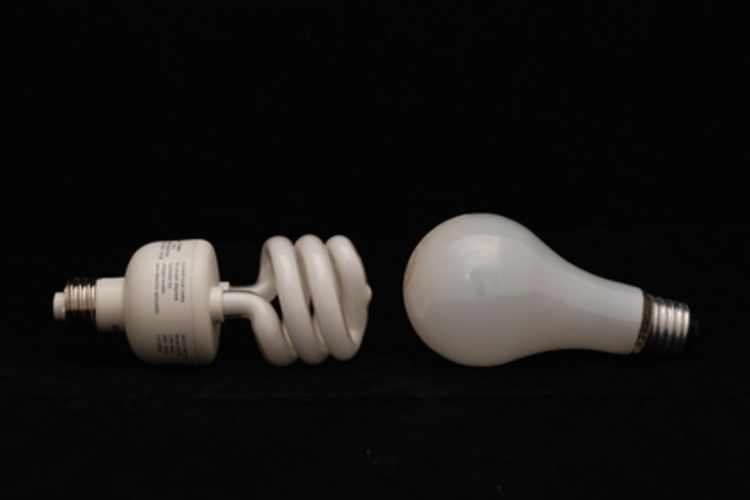
A fluorescent light bulb (left) and an incandescent one. Photo: Blight2016.com.
Just how bad is Sunday’s New York Times feature article about a solar energy array in a West Bank Palestinian Arab village that was built largely with funding from American Jews?
Never mind how the article deals with the perilous shoals of the Arab-Israeli conflict; it can’t even get the basic electricity facts correct. The article claims: “A typical light bulb uses 100 watts.” Maybe the Times West Bank bureau is lit at operating-room brightness, but a “typical” incandescent light bulb in my house is closer to 60 or 75 watts. That bulb’s work is nowadays likely to be done by an LED or compact fluorescent bulb that uses even less energy. The Times reporter whose byline is atop the piece, James Glanz, is a PhD physicist with a background in science writing, but he doesn’t seem to have been light-bulb shopping in an American hardware store anytime recently.
The Times article goes downhill from there. The first American Jew quoted in it is Peter Beinart, one of the Times’ favorite sources, who views the whole situation “as a sign that younger American Jews are less comfortable with Israeli control of the West Bank.” Mr. Beinart views pretty much everything as a sign of that.
In fact, the whole article is a one-sided exercise in settlement-bashing.
Even the chief executive of the Jewish National Fund, Russell Robinson, is quoted as having
Acknowledged that his fund had two projects in the Gush Etzion settlements south of Jerusalem, but he sought to distinguish it from its Israeli sister organization, Keren Kayemet Leyisrael, which supports parks, bike paths, an amphitheater and even a solar farm in West Bank settlements. There are separate boards of directors, he noted.
“Keren Kayemet L’Israel” — the Jewish National Fund — isn’t given an opportunity to comment in the article. Neither is a single settler or defender of the settlements. Had they been asked, they might have said something like, “What sort of perverted standard of moral vanity is on display by a person like Ben Jablonski, on whom the Times lavishes praise for quitting the JNF board ‘over its modest but politically fraught involvement in West Bank settlements,’ but who has no problem working with PLO-affiliated Palestinians?”
Are Jews who live in suburbs of Jerusalem or in other places where Jews have lived for thousands of years supposed to be deprived of parks, bike paths or solar energy? Would Mr. Jablonski and the New York Times editors, from the relative safety of Manhattan, order the West Bank immediately be rid of all Jews, so that the land there can be, like Gaza, used as a launching pad for terrorist attacks via tunnels and rockets launched at the remaining Jews of Israel?
I’m not generally a reflexive defender of Israeli settlements in the West Bank, but the one-sidedness of the Times approach on this one is just bizarre. In an article that took up huge acreage in the Times — a six-column headline, three photographs and a graphic over more than half a page of the print newspaper — they couldn’t find room for a single voice or paragraph defending the settlements?
It’s not clear to me why the article had to be mainly about the settlements at all, rather than simply a feel-good feature about Jews and Arabs working together on energy and water. But for whatever reason, the Times and its sources unfortunately took the opportunity to fit this one into an existing narrative about the “occupation.” It’s also not precisely clear what brainpower was on display by whatever Times editor okayed this one, but by the look of the article as it appeared, the editor was operating at well below 100 watts.
More of Ira Stoll’s media critique, a regular Algemeiner feature, can be found here.