


Why Susya Is a Case Study
Error: Contact form not found.

 by Josef Olmert

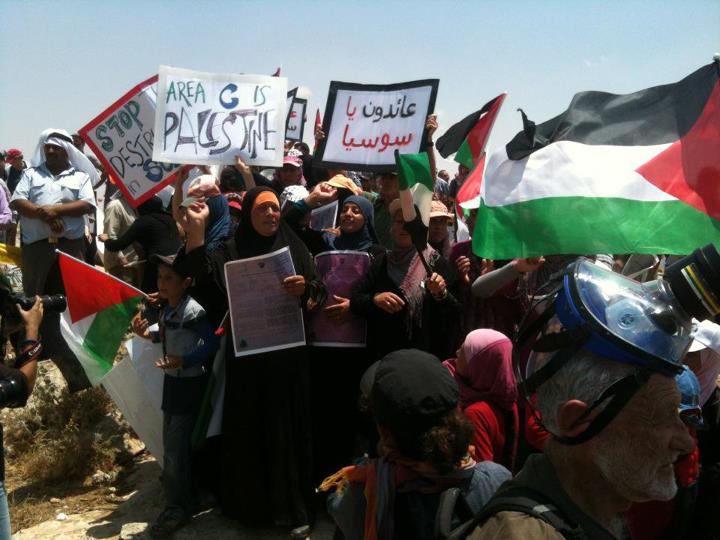
A Palestinian demonstration at Susya. Photo: Wikipedia.
Locations across Judea and Samaria often become momentary flash-points in the ongoing struggle between Israelis and Palestinians over political control of the disputed territories and in the fight for the historical narrative. In that regard, there is nothing new or special about Susya. However, the Palestinians have banded together with an international brigade of supporters, including left-wing American Jews, to turn this incident into a monumental example of the truth of their claims. So be it. Let’s have a good fight over Susya.
In 2012, Susya, located in the southern slopes of Mount Hebron, was illegally populated by a Bedouin hamula [clan] of about 300 people. Two years later, the Israeli High Court of Justice — not an institution known for pro-settler rulings — forbade the Palestinians from building more illegal structures in the area. Moreover, the High Court denied the Palestinians’ appeal to prevent Israeli authorities from demolishing the illegally erected structures, while the Israelis offered the hamula alternative land for legal settlement. On the face of it, this was a clear-cut case. Yet, the European Union and the American State Department are pressuring the Likud government not to carry out the specific orders of the Israeli High Court. A chorus of condemnation has been lobbed at the Israeli authorities by the peace-loving group Rabbis for Human Rights (for all groups but the Jews) and leftists of all kinds. Simply put, Netanyahu caved in to the pressures. The illegal Palestinian occupation continues, as does the whir of the well-orchestrated anti-Israel propaganda machine.
Historically, Susya is an ancient Jewish village that continued to exist for centuries following the destruction of the Second Temple. It was only in the seventh century that Susya, like the rest of the Jewish homeland, came to be occupied by Arabian Muslims. It is no coincidence that the names of modern-day Arab villages and towns in the Hebron area are taken from Hebrew origin: today’s Yatta is derived from the Biblical Yutta, contemporary Durrah from Adorayyim. Susya, the town’s original name, continues to be the one used by the Arabs. Long history? Yes. Irrelevant history? Emphatically not. The Palestinians and their supporters, Jews and non-Jews alike, talk constantly about history. Saeb Erekat, the chief Palestinian negotiator with Israel, stated that there was never a Jewish Temple in Jerusalem as the Temple to which the Jews lay claim was built by King Solomon, who, according to Erekat, was a Muslim. Erekat was not making a joke. This is the basis for the shameful UNESCO resolution declaring the Temple Mount to be only a Muslim site.
We are locked in a battle of the narratives. If the Jews have no history in the land they are colonialists dispossessing an indigenous people, the Palestinians. “Indigenous” is a key word for the Left, an intoxicating, powerful term. It is always reflexively understood to be a reference to the poor Palestinians. But, if we only remember Susya, we know which people are really indigenous to the land. For the Left, history is a very modern concept, dating back to 1967 with the start of the “Occupation.” However, Zionism is an ideology based on historic continuation. It organized itself politically about a century ago, but it existed throughout the ages — and not as a forlorn hope, but as an actual reality on the ground. Jews have always been in the land, including during the period when the vast majority of us were in exile. Susya and other villages with similar backgrounds are the proof. History is the key to Jewish legitimacy.
The political environment is shifting and Susya is a test for the Likud government. Rhetoric about challenging foreign interference in Israeli affairs is fine, but lofty words are not going to bring the necessary change. Indeed, the more you talk and talk, the less reliable and the weaker you seem to be. Something else is needed. Let us mimic the Israeli and American Left. Let us call upon the government to do what the leftists so cherish — when it suits them — and demand that the rule of law be enforced. Let us insist that the authorities make good on the rulings of the High Court of Justice. If Susya is a case study, let us make it the right one.
Dr. Josef Olmert is a Middle East specialist, currently a professor at the University of South Carolina. He was a director of the Israeli Government Press office, a peace negotiator and policy adviser to the defense minister.


