




Former Israel Envoy to Moscow: Despite Cooperation in Syria, Russia Does Not Trust Iran as Foreign Policy Partner
Error: Contact form not found.

 by Algemeiner Staff

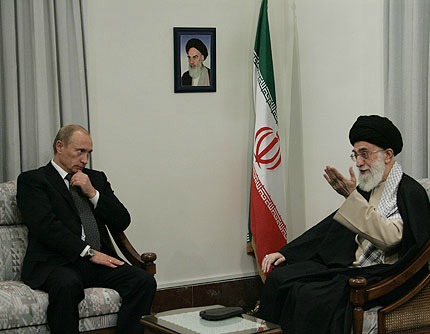
Russian President Vladimir Putin meets with Iranian Ayatollah Ali Khamenei during a 2007 visit to Tehran. Photo: www.kremlin.ru.
Despite its cooperation with Iran in Syria, Russia does not fully trust the Islamic Republic as a partner in its foreign policy endeavors, according to a former Israeli ambassador to Moscow.
Writing in the September edition of the Israel Public Diplomacy Forum’s Viewpoints newsletter, Zvi Magen — a senior research fellow at the Institute for National Security Studies — noted that an “excessive strengthening of Iran is not in the Russian interest.”
Magen explained that the Russia-Iran alliance in Syria — where they are supporting the regime of Bashar Assad in the ongoing civil war there — has let the two countries “further their joint strategic interests; battling the Islamic State, which posed a threat to Russia as well, and working toward creating a new order in the region amenable to both of them.”
But Magen went on to point out that Russia and Iran do not see eye-to-eye regarding the endgame in Syria.
“Tehran aims at achieving an Iranian area of influence, while excluding other players [among them Russia],” he wrote. “Moscow on the other hand is active in Syria to promote its global objectives and aims at obtaining a regional foothold at the exclusion of the West. Ultimately, however, it is interested in reaching an understanding with the West.”
An additional point of contention, Magen wrote, are the differing views of Russia and Iran regarding Israel. While Iran is working with Hezbollah to create a terror front against Israel on the Golan Heights, Magen said Russia and Israel have an understanding that gives the Jewish state “freedom of action against threats emanating from the Syrian arena.”
Nevertheless, Magen concluded that “significant joint interests remain” between Russia and Iran and predicted that “at least in the short term they will continue to cooperate in Syria and in the rest of the Middle East.”
When Israeli Prime Minister Benjamin Netanyahu traveled to Moscow in June for his fourth meeting with Russian President Vladimir Putin within the past year, Magen told The Algemeiner that the Kremlin was seeking greater influence in the Middle East and Jerusalem needed an alternative to the United States as a guarantor of its interests.
“What we are seeing is realpolitik in action,” Magen told The Algemeiner.