




Israel Could Be Key to 2020 Middle East Geopolitics
Error: Contact form not found.

 by Frank Musmar

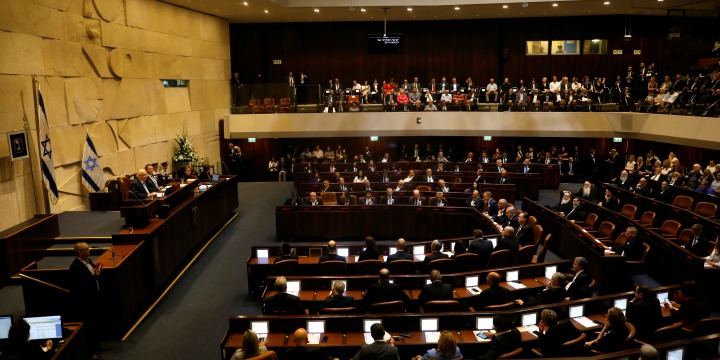
Israeli President Reuven Rivlin addresses the opening session of the 22nd Knesset, in Jerusalem Oct. 3, 2019. Photo: Reuters / Ronen Zvulun.
The geopolitics of the Middle East are changing rapidly, and competition among the key players is at a peak. The region straddles the three continents of Asia, Africa, and Europe, lending it great geopolitical significance. The Middle East overlooks the Mediterranean Sea, the Red Sea, the Indian Ocean, and the Black Sea. It contains three of the world’s leading waterways: The Strait of Hormuz, the Bab al-Mandeb Strait, and the Suez Canal. The Middle East is also the top oil supplier in the world and has its largest oil and gas reserves.
For the US, the security of Israel is one of the most critical determinants of its positions on Middle East security in the wake of the so-called “Arab Spring.” Although Israel is separate from the changes brought about by those uprisings, it can’t help but be affected by them. They shocked Jerusalem as well as the other regional actors, but it has been able to deal with the changes.
The fear of Iran and its hegemonic ambitions has pushed Saudi Arabia and the UAE toward further cooperation with Israel and the US. For over a decade, the Jewish state has been strengthening links with Gulf monarchies with which it has no diplomatic relations. Jerusalem’s strategic views regarding Iran’s regional ambitions and US policies during the “Arab Spring” converged with those of Riyadh, the UAE, and Bahrain. Longstanding Israeli security and commercial ties with the Gulf, which are now becoming more visible, look set to develop further (though overt military cooperation remains improbable). Israel is seeking active cooperation with Egypt, Jordan, and the Palestinian Authority in the field of counter-terrorism.
The current landscape in the Middle East is bringing new policy priorities to the fore, with the Arab states no longer dancing to the Palestinians’ tune. Those states have their own more immediate concerns, and the ongoing conflict between Hamas and Fatah has undermined Palestinian efforts to solicit Arab assistance. Some Arab states have begun to openly acknowledge the right of the Jewish people to their ancestral homeland.
While Turkey’s location is usually viewed as a significant advantage in the energy sphere, since the countries in its vicinity require its collaboration to transport oil and natural gas via economically feasible pipeline projects, the political, economic, and military conflicts among those same global and regional actors not only hinder the development of energy transportation routes, but present a significant foreign policy challenge for Ankara, which has traditionally sought to maintain a careful balance in its relations with the West and Russia.
The discovery of gas reserves in the Eastern Mediterranean has been met with enthusiasm due to their potential impact on the economic, geopolitical, and political balance of the region. The new reserves could have a significant positive effect on Europe’s gas-diversification strategy, enabling EU countries to realize their long-held goal of significantly reducing their dependence on Russian gas imports.
In December 2017, Cyprus, Israel, Italy, and Greece signed a memorandum “to explore the possibility of the construction of a natural gas pipeline linking [the] Leviathan [field] to European markets.” The European Commission has labeled the project technically feasible and economically viable, stating that it “strongly supports” the project.
In December 2018, at a meeting in Beersheba, the leaders of Greece, Cyprus, and Israel officially said they were ready to sign an intergovernmental agreement on the East-Med pipeline project. US ambassador to Israel David Friedman, who was present at the meeting, labeled the project “of great importance for the stability and prosperity of the Middle East and Europe.” If the project comes to fruition, Israel can eventually become a regional energy hub — a significant change from its historical geopolitical position.
Dr. Frank Musmar is a financial and performance management specialist. A version of this article was originally published by The BESA Center.