




The New York Times, Again
Error: Contact form not found.

 by Jerold Auerbach

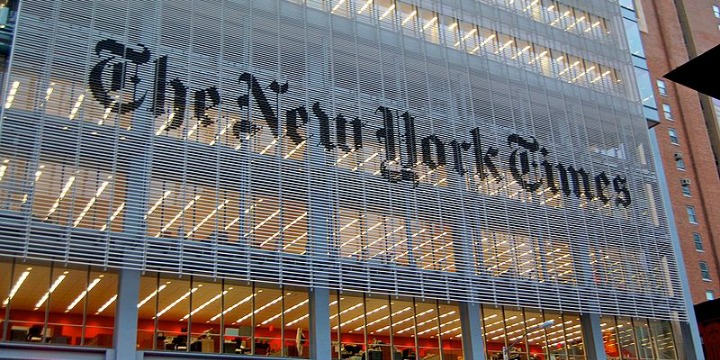
The headquarters of The New York Times. Photo: Wikimedia Commons.
Nothing seems worthier of publication in the New York Times than the laceration of Israel. This, to be sure, is nothing new. Decades before there was even a Jewish state to criticize there was the looming menace of Zionism to rile the publisher, editors and eventually columnists and Jerusalem Bureau Chiefs. As far back as the Balfour Declaration (1917), which called for “the establishment in Palestine of a national home for the Jewish people,” the Times obsessed over the danger of Zionism to the patriotic loyalty of American Jews.
By the 1930s the Times served as a welcoming platform for anti-Zionist critics. An editorial insisted that “the menace of Adolph Hitler has been grossly exaggerated.” Largely ignoring the Holocaust slaughter of six million Jews, publisher Arthur Hays Sulzberger, who launched the enduring family dynasty that has owned the Times ever since, favored the “union of Jews and Arabs within a binational Palestine.”
Once that folly was erased by the birth of the State of Israel, the Times had its favorite national target for criticism. Perhaps the most appalling example was its insistence that the trial of notorious Nazi war criminal Adolph Eichmann not be held in Israel because Nazi crimes were committed against “humanity,” not Jews. Following the Six-Day War in 1967, the Times launched a barrage of (still unrelenting) criticism of Israel for permitting evil “settlers” to inhabit what had been Jordan’s occupied West Bank, the land known to Jews as Biblical Judea and Samaria.
Fast forward to November 7, 2021 when an Opinion column entitled “Israel is Silencing Us” appeared in the Times. It was written by Palestinian-Iraqi Zena Agha, a scholar at the Middle East Institute in Washington, D.C., whose expertise includes Israel’s “spatial practices and colonial cartography.” In translation, Israel is the source of evil for its “continuous, unchecked encroachment onto Palestinian land.”
To bolster her complaint, the author refers to a list of (contrived) evils perpetrated by the Jewish state. Foremost, and predictably, is its “occupied West Bank.” In her rendition, Israeli government approval for the expansion of Jewish settlements has a clear goal: “to silence the independent monitoring of Israel’s human rights violations that stand between total annexation of the occupied West Bank and international accountability.” She even extends the “crimes of Israeli occupation” to Gaza, without mention — or, perhaps, awareness — that Israeli settlers were evicted and Israeli soldiers departed, more than fifteen years ago.
So it is, she claims, that “five million or more Palestinians [are] living under Israeli military occupation.” But according to the Palestinian Authority’s Central Bureau of Statistics (2018), that is a population exaggeration by two million. It is highly unlikely to have more than doubled in three years. As for Israeli “occupation,” perhaps the best example of her fallacious claim is Hebron, the world’s oldest Jewish community and the ancient Jewish capitol before King David relocated his throne to Jerusalem. Now two-hundred thousand Arabs and seven hundred Jews inhabit divided Hebron.
Agha is undeterred by abundant evidence that undermines her claim of Israeli “human rights violations,” “silencing” and a “continuing movement to delegitimize, defund and permanently gut Palestinian NGOs.” Yet as of January 2020, there were 135 Palestinian NGOs operating in the West Bank, East Jerusalem and Gaza. That is hardly evidence of gutting. She concludes that Israel’s goal is “targeting Palestinian human rights defenders by labeling their legitimate work ‘terror,’” the better to facilitate Israel’s “continuous, unchecked encroachment onto Palestinian land.”
Her definition of “Palestinian land” ignores the historical reality that it comprises the land of Biblical Judea and Samaria, inhabited and ruled by Jews millennia before the appearance of Palestinians. Indeed, from a historical perspective it might more accurately be said that Palestinians are encroaching upon Israel’s land. But historical truth hardly matters to Zena Agha or The New York Times.
Jerold S. Auerbach is the author of twelve books, including Print to Fit: The New York Times, Zionism and Israel 1896-2016, selected for Mosaic by Ruth Wisse and Martin Kramer as a Best Book for 2019