


How Reuters and Getty Images Platformed a Gaza Photojournalist Kissed by Hamas’ Sinwar
Error: Contact form not found.

 by HonestReporting Staff


Yahya Sinwar, head of the Palestinian terror group Hamas in Gaza, in Gaza City on April 14, 2023. Photo: Yousef Masoud / SOPA Images/Sipa USA via Reuters Connect
On October 7, 2023, Gazan photojournalist Hassan Eslaiah held a grenade in one hand and a camera in the other, documenting Hamas’ massacre inside Israel. His exposure by HonestReporting, which brought to light a cozy photo of Eslaiah and former Hamas leader Yahya Sinwar, led to the end of his employment at CNN and the Associated Press.
Yet more than a year later, his work was still being offered for sale by Reuters and stock photo agency Getty Images, along with other compromised photojournalists in Gaza. (Getty only removed his work last week after an initial version of this story was published on HonestReporting’s website — and it remains available on Reuters).
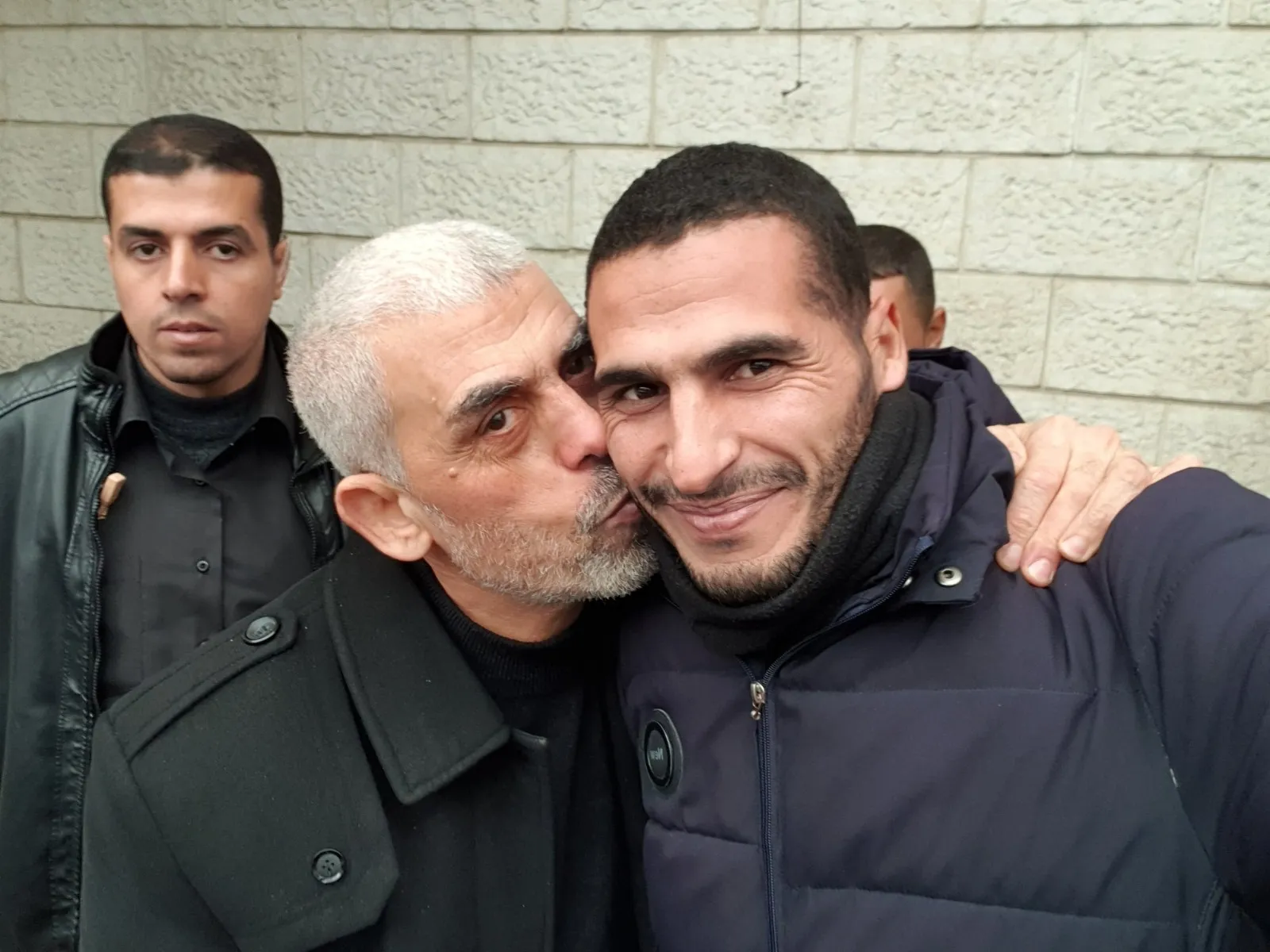
Hassan Eslaiah (r) with former Hamas leader Yahya Sinwar (l)
An HonestReporting investigation revealed that the two media companies have been distributing the tainted content in collaboration with state-run Turkish agency Anadolu — an arrangement that seems to enable their profit without liability. Both companies have a global reach, with Reuters as one of the world’s largest news agencies and US-based Getty Images as one of the world’s largest image licensing companies.
Their databases also present images by Anadolu freelancers Ashraf Amra and Mohammed Fayq Abu Mostafa, who Reuters officially distanced itself from after HonestReporting’s investigative team exposed Amra’s close relations with former Hamas leader Ismail Haniyeh, and his shared call with Abu Mostafa to invade Israel.
View this post on Instagram
One of Abu Mostafa’s images, which is still for sale on the Reuters platform, has, according to Anadolu, been used as evidence in the genocide case against Israel at the International Court of Justice.
Unethical Content Distribution
Reuters partnered with Anadolu, which also collaborates with AFP and DPA to distribute its content, back in 2019. Reuters said that “these partnerships will help us create the most comprehensive collection of real-time, multimedia news content anywhere in the world.”
Anadolu’s partnership with Getty Images started in 2013, with Getty’s Senior Director of photography for Europe, the Middle East, and Africa saying at the time: “I am very excited at the prospect of seeing the Anadolu Agency represented by Getty Images around the world … I believe that the Anadolu Agency and Getty Images will benefit greatly from this partnership.”
Indeed, the partnership proved useful not only for the companies, but also for the compromised Gazan photojournalists who can no longer work directly for Western media.
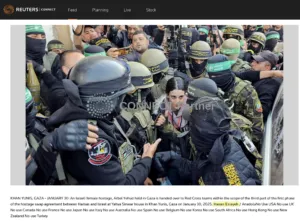
Currently, Reuters offers for sale over 200 Anadolu photos by Hassan Eslaiah (spelled Hasan Eslayeh on their platforms). Most of the photos show Hamas’ hostage release ceremonies, including the barbaric handover of terrified Israeli hostage Arbel Yehud amid a mob of terrorists (which other Western media also picked up):
Eslaiah’s easy access and proximity to the action isn’t surprising. He enjoyed the same conditions on October 7, 2023 when he infiltrated with Hamas into Israel:
And here is footage of Eslaiah after he crossed into Israel and took photos of a burning Israeli tank. He then captured infiltrators entering Kibbutz Kfar Azza.
Note that he is not identifiable as a member of the press. But AP & CNN deemed it acceptable to use his services. pic.twitter.com/fA0VI2df2i
— HonestReporting (@HonestReporting) November 8, 2023
The fact that Eslaiah was fired from CNN and AP after we exposed him in November 2023 seems not to have affected his livelihood, with Reuters and Getty Images distributing his propagandist material under the cover of the partnership with Anadolu.
And until last week, Getty Images had no qualms about charging $175-499 dollars for each photo, presumably also including a cut for Anadolu and Eslaiah himself.
Reuters keeps the pricing confidential, but adds a disclaimer distancing itself from the content. The disclaimer seems like a cop-out because on its collaborations page, where Anadolu is listed, Reuters praises its partners’ “compelling content.”
In other words — Reuters and Getty Images make a profit, while abdicating responsibility for spreading the manipulative photos of a Hamas sympathizer, whose pockets are presumably also lined.
Platform for Manipulation
The same business model also seems to work for Gazan photojournalists Ashraf Amra and Mohammed Fayq Abu Mostafa. Reuters officially cut ties with them after we exposed in January 2024 that Amra was honored by former Hamas leader Ismail Haniyeh and hosted an Instagram Live with Abu Mostafa in which they called on Gazans to infiltrate into Israel on October 7.
Here’s Amra getting a kiss from Haniyeh in 2023 and receiving an honor from the unlamented Hamas leader in 2012. pic.twitter.com/VdWXN6wB32
— HonestReporting (@HonestReporting) February 23, 2025
But as Anadolu contributors, Amra and Abu Mostafa are both featured on the Reuters platform — Amra with over 5,000 photos and Abu Mostafa with over 300. On Getty, Amra is less prominent but over 150 photos of Abu Mostafa are offered for sale, including video clips.
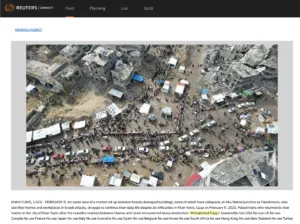
These photos don’t just sit in the databases. Reuters and Getty are among the world’s largest digital distribution platforms used by thousands of media clients worldwide.
Recently, Getty clients like The Times of London and the Daily Express were happy to buy Amra’s Anadolu photo showing the moment when Israeli hostage Omer Shem Tov “kissed” the head of his Hamas captor.
CNN did the same with Amra’s Anadolu photos of Israeli hostages Eli Sharabi and Or Levy via Getty Images.
And last year, Anadolu weaponized one of Abu Mostafa’s photos — still on sale in the Getty Images and Reuters platforms — as evidence at the ICJ case accusing Israel of committing a genocide against Palestinians in Gaza.
According to Anadolu, the photo “shows the mass burial of the Fatayer family members in a designated area in Gaza due to the lack of available space in some cemeteries.”
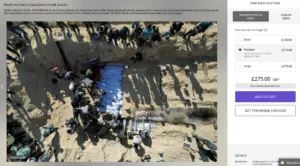
Fayq’s photo in Getty Images database
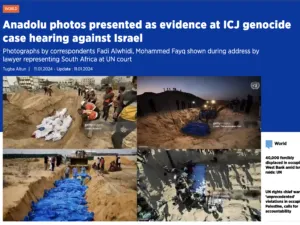
Fayq’s Photo in Anadolu website
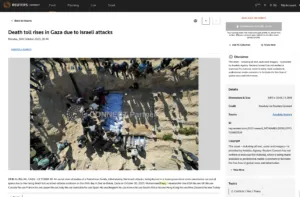
Fayq’s Photo in Reuters Database
Sadly, the court didn’t know the photo was taken by a “journalist” who was thrilled by the massacre of Jews and called on Gazans to infiltrate the border, to enjoy the abduction of “settler” women.
But more than that, it may be time for US Attorney General Pam Bondi to take an interest. In December 2023, following HonestReporting’s exposure of photojournalists who infiltrated Israel on October 7, 14 state attorneys general wrote a letter to The New York Times, AP, CNN, and Reuters calling them out for using hires with ties to Hamas and reminding them that providing material support to terrorists and terror organizations is a crime.
The letter even specifically mentions the case of Hasan Eslaiah and ends by calling on the media outlets to “ensure that you are taking all necessary steps to prevent your organizations from contracting with members of terror organizations. We urge you in the strongest terms to take care that your hiring practices conform to the laws forbidding material support for terror organizations.”
Despite whatever action may be taken, these propagandists have found a deceitful way to continue spreading their lies to the international media.
And the international media can, for at least the time being, enjoy the “goods” without getting their hands dirty.
UPDATE
Within a few hours of publication of this article on HonestReporting’s website, Getty Images, to their credit, removed all content that was flagged by HonestReporting, including a Ramzi Adel video that called Jews “dogs,” and content from Hassan Eslaiah, Ashraf Amra, and Mohammed Fayq Abu Mostafa.
The same cannot be said for Reuters, however, which gave us the following statement referring to the Connect platform it operates:
“Reuters Connect is a commercial marketplace with content from more than 100 news organizations, allowing media customers the option to select the content that is most relevant to their news cycle. This content is clearly labeled and is not endorsed by Reuters.”
HonestReporting is a Jerusalem-based media watchdog with a focus on antisemitism and anti-Israel bias — where a version of this article first appeared.


