




Obama’s Libya Missteps Imperil NATO’s Future
Error: Contact form not found.

 by John Bolton


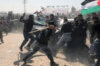
People on a tank in a Benghazi rally.
While the outcome of NATO’s intervention in Libya is still uncertain, the ongoing drift toward a negotiated solution is fraught with potentially debilitating problems for the Western alliance. Ousting Gaddafi remains a possibility, and could have been achieved much earlier with swift and decisive action, but the prospects for a clear NATO victory are now quite uncertain.
The collapse of NATO’s resolve came in several stages, with the seed planted right at the outset of the military action. First, President Obama signaled hesitancy and weakness by waiting until Gaddafi’s forces had nearly taken Benghazi, the rebels’ key stronghold, and then held NATO hostage to approval from the Arab League and the UN Security Council.
Second, after very robust U.S. participation in the opening days of the attack, Obama, demonstrating his penchant to “lead from behind,” ordered U.S. strike activity diminished almost to zero. While American forces assigned to NATO continued to provide vital command, control, intelligence and logistical support, the bulk of the strike mission fell to Britain, France and smaller NATO members, on which the strain began to show relatively quickly. America’s hesitancy and Europe’s inadequacies have significance well beyond the constraints they imposed on the action in Libya, foreshadowing both future failures in U.S. leadership and a far broader hollowing out of Europe’s contributions to NATO.
NATO’s credibility, in the region and globally, is already deeply wounded because this minor military operation, for ostensibly humanitarian purposes, has lasted so long with the outcome still uncertain (and Ramadan fast approaching). If NATO cannot rapidly depose a rogue like Gaddafi, why should other rogues fear the prospect of NATO intervention? Even if Gaddafi is ultimately toppled, the palpable risk is that NATO will be perceived to have stumbled in its own backyard, undercutting its ability to shape conflicts further afield, such as Afghanistan.
Third, in the wake of these military deficiencies, increasing political splits among NATO members became all too obvious. Germany was opposed from the outset, even abstaining in the Security Council with Brazil, India, and Permanent Members Russia and China on Resolution 1973, which authorized the use of force. This public distancing by Europe’s largest country demonstrated to Gaddafi at the very outset of NATO’s attacks that time was likely on his side.
Then, on July 7, Italian Prime Minister Silvio Berlusconi admitted publicly that he had always been a reluctant supporter of the military effort, and had essentially been forced to give Italy’s assent because of outside political pressure, presumably from France and Britain.Berlusconi said that his “hands were tied”once the Security Council voted to authorize force to protect innocent Libyan civilians, but that seemed only a pretext to hide an otherwise embarrassing admission of ambivalence.
Shortly thereafter, on July 20, French Foreign Minister Alain Juppe announced that France was open to negotiation with Gaddafi, including the dramatic concession that Gaddafi could be allowed to remain in Libya if he stepped down as head of government. The rebels quickly rejected any negotiated solution that left Gaddafi in the country, stressing the obvious reality that as long as he remained, he would be a threat to any successor regime. One can only wonder how France and other Western governments missed that point.
Fourth, also in July, both President Obama and the U.S. Congress, after months of inattention, complicated matters further. The House of Representatives, in essentially contradictory floor votes, could not muster a majority either to authorize U.S. military involvement or to cut off funding, thereby sending, at best, a signal of indecisiveness. Then, even worse, Obama and Secretary of State Clinton publicly supported Russia’s proposal that it step in between NATO and Gaddafi to mediate the crisis. If implemented, such a suggestion would give Russia a potentially dominant role in shaping the post-Gaddafi government in Libya, a breathtaking “unforced error” by Washington.
Finally, the United States and NATO have yet to fashion a rebel leadership committed to establishing a successor government based on popular sovereignty and individual rights, with at least a modestly pro-Western orientation. It would be the cruelest irony if NATO’s military intervention simply substituted one group of thugs for another. Although the shape of post-Gaddafi Libya may not be as bleak as it seems on the surface, time and the West’s internal divisions work against us.
The solution is plain: NATO and the Libyan rebels must prevail militarily, ousting Gaddafi and installing a new government that will abstain from terrorism and the pursuit of weapons of mass destruction. An outcome where Gaddafi remains at large in Libya, in control of any part of it, or any kind of power-sharing arrangement, is simply a formula for the conflict to reignite, and probably sooner rather than later.
Unfortunately, with Obama concentrated on the domestic American debate over the federal budget deficit and the ballooning national debt, and Europe’s attention similarly diverted by the Euro’s ongoing crisis, the prospects for decisive leadership appear remote. This failure of leadership, especially on Obama’s part, will almost certainly haunt NATO well into the future, long after the “kinetic military action” in Libya has ended.
This article originally appeared on HumanEvents.com.


