


To Stop ISIS, Stop Its Ability to Sell Oil
Error: Contact form not found.

 by Rachel Ehrenfeld

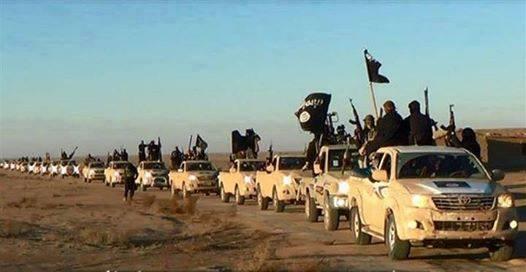
ISIS soldiers in convoy of confiscated trucks in Iraq. Photo: Twitter / nayelshafei.
Presidential candidate and billionaire businessman Donald Trump has the right idea on how to stop ISIS. “I would knock out the source of their wealth, the primary source of their wealth, which is oil,” he told MSNBC.
A year into the United States-led air campaign against the Islamic State in Iraq and Syria, this effort has done little, if anything, to stop the murderous Islamists group’s oil lifeline.
The U.S. Treasury Department estimated last month that ISIS netted at least $1 billion from public and private banks in the cities it has overrun. ISIS generates additional income from taxes, ransom, sexual slave trade, antiquities crimes, and smuggling. But the revenues from oil and oil products fuel the umbilical cord of ISIS. According to Assistant Secretary of the Treasury for Terrorist Financing, Daniel Glaser, ISIS has been making “about $500 million a year” from oil sales.
Soon after taking over Mosul in June 2014, ISIS embarked on developing the oil trafficking business. The U.S. and its allies could have stopped this industry in its infancy, but chose not to. Since then, ISIS has even issued ads for highly paid refinery and rig operators.
While allied targeted bombing has reportedly killed a few of ISIS’ leaders and hundreds of their easily replaceable fighters, they have not targeted ISIS’ oil resources.
Dr. Norman Bailey, of the Center for National Security Studies and Geostrategy at Haifa University, has pointed out the obvious. “The Islamic State’s barbaric conquests are financed by collaborators among the business and financial circles of the West.”
Bailey rightly argues that the “oil buyers are readily found in the West and tanker trucks are permitted to reach ports where oil tankers are waiting to load it… All this requires ready, willing and able collaborators among the business and financial circles of the West as well as surrounding countries… the buyers and the facilitators and the financiers are not that difficult to identify, so that if the opponents of Islamic State were really serious about doing something about it, along with the occasional bombing raid, the Islamic State could be starved of funds to continue its rampage of murder, destruction, rape and slavery.”
Bailey notes that while Iran was forced to the negotiating table because sanctions effectively deprived it “of necessary funds,” ISIS “doesn’t even have to negotiate. It has had no trouble finding collaborators among the worshipers of MAMMON in the West, allowing to pursue ISIS bloody conquests.”
President Obama opposes putting American troops on the ground to fight ISIS. But the longer ISIS is allowed to enrich itself, the more fighting power and supports it gains. However, the sooner that the oil fields and refineries under ISIS’ control are targeted by U.S. air-strikes – and bankers and banks who collaborate with ISIS are exposed and severely punished – the sooner this Islamist menace might be defeated.
Rachel Ehrenfeld is director of the New York-based American Center for Democracy and author of “Funding Evil: How Terrorism is Financed – and How to Stop It.”


