







New App Lets Users Demand Halt to Iranian Funding With One Click
Error: Contact form not found.

 by JNS.org

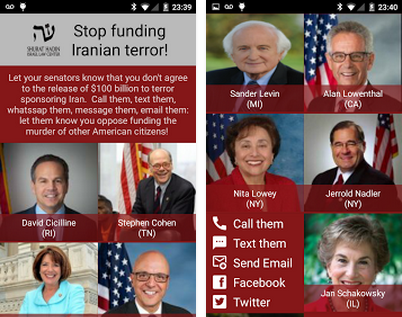
The new Shurat HaDin app on Iranian funding and U.S. legislators. Photo: Google Play
JNS.org – A new mobile app from the Shurat HaDin – Israel Law Center allows users to reach out to members of the U.S. Congress via Whatsapp, Facebook and Twitter with a single click in order to demand that American lawmakers halt the flow of up to $150 billion in sanctions relief to Iran through the nuclear deal.
The smartphone initiative is part of an online campaign launched by Shurat HaDin that has already garnered half a million views on Facebook and YouTube. The campaign is based on a video clip in which terrorists ask the American public to approve the nuclear deal so that Iran can receive the windfall of unfrozen funds to support the execution of terrorist attacks.
Attorney Nitsana Darshan-Leitner, the head of Shurat HaDin, said that “every citizen of Israel, the United States, and the countries of the free world should open the app and demand that the senators not transfer the promised billions to Iran.”