





Israel Missile-Defense Guru: Nuclear Deal Will Accelerate Iranian Missile Program
Error: Contact form not found.

 by Eliezer Sherman

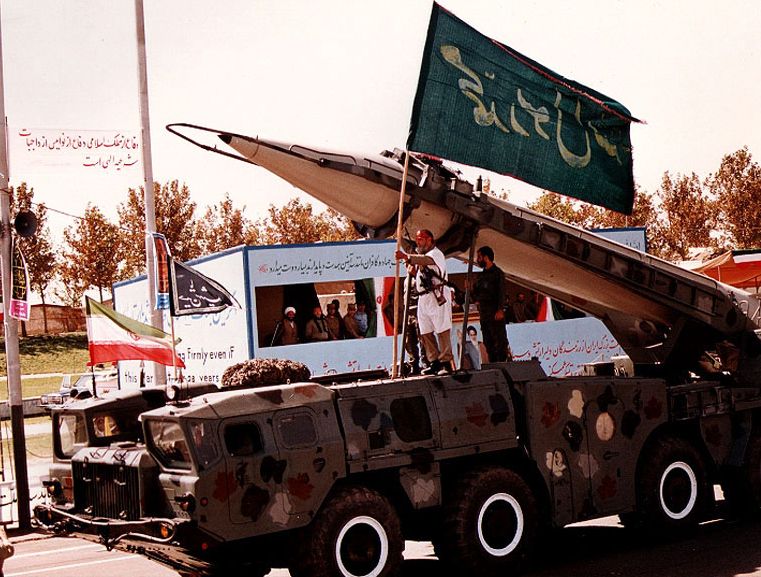
Iran’s Shahab 3 missile. Photo: wiki commons.
One of the consequences of the nuclear deal between Iran and world powers will be the acceleration of the country’s already multifarious missile program, Israeli missile-defense guru Uzi Rubin postulated in a piece for Defense News on Monday.
According to Dayan, the reasons for this acceleration are twofold: firstly, the deal frees up hundreds of billions of dollars in frozen assets to the ayatollah regime that could go toward arms R&D and, secondly, the language of the Joint Comprehensive Plan of Action is just vague enough to allow the Iranian military to pursue nearly any type of missile it wants as long as the stated intention is not for the delivery of a nuclear payload.
Iran deal supporters claim the JCPOA keeps restrictions against Iran’s conventional weapons and ballistic-missile programs intact for five and eight years, respectively. According to Dayan, the restriction against ballistic weapons is limited to those capable of carrying nuclear weapons, which is, in Dayan’s opinion, a restriction the Islamic state could easily flaunt since it claims to have never intended to build nuclear weapons in the first place.
According to Dayan, all of Iran’s missiles — whether short- or medium-range, cruise or ballistic or otherwise — could technically be described as non-nuclear weapons, without flaunting restrictions at all. Perhaps testing these waters, Iran recently released a clip revealing the testing of a 1,700-kilometer-range precise, terminally guided variant of the Shahab 3 missile, Dayan said.
Dayan also warned about the dangers of Iran’s shorter-range missiles capable of striking Air Force bases and “individual aircraft shelters,” inflicting significant damage normally associated with far more complex air strikes. Dayan did not mention whose Air Force bases he was talking about.
He also warned that Iran could use precision-guided missiles to take out civilian infrastructure such as desalination plants (which provide at least a third of Israel’s drinking water, for example) or the power grid.
Additionally, and this was pointed out by Iranian Foreign Minister and longtime negotiator with the West Javad Zarif shortly after the deal’s announcement, the JCPOA does not in and of itself mention Iran’s conventional weapons or ballistic missile programs; these are discussed in the U.N. Security Council resolution that was adopted approving the JCPOA and setting a timeline for lifting international sanctions against Tehran as long as Tehran complies with its commitments.
Since the signing of the JCPOA the Obama administration has sought to assure its traditional Mideast allies — Israel, the Gulf states, Egypt — that it would bolster their military capacities to counter Iran’s regional meddling and spreading influence.


