






Following Hezbollah Vow to Bomb Haifa Ammonia Facility, IDF Chief Calls Terror Group Israel’s ‘Greatest Security Threat’
Error: Contact form not found.

 by Eliezer Sherman

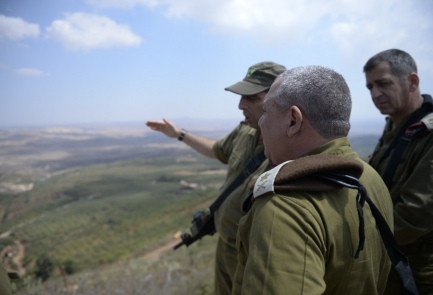
IDF Chief of Staff Lt. Gen. Gadi Eizenkot looking over the border. Photo: IDF Spokesperson’s Unit.
Hezbollah is Israel’s greatest security threat in the area, IDF Chief of General Staff Maj. Gen. Gadi Eizenkot said on Wednesday morning.
“Hezbollah is the organization with the most significant capabilities with regard to Israel,” Eizenkot warned, according to Army Radio.
His comments came a day after Hezbollah’s longtime secretary-general, Hassan Nasrallah, threatened to strike ammonia storage facilities in Haifa, which could result in thousands of casualties. While Israeli Environmental Protection Minister Avi Gabbai announced last year plans to build ammonia storage facilities in the Negev desert that would ultimately lead to the closure of the Haifa plants, they currently remain within range of Hezbollah’s arsenal.
Nasrallah has spent the last several years building up the group’s rocket arsenal and capabilities to be able to strike deep into Israeli population centers in Gush Dan — the metropolitan area orbiting Tel Aviv, where about a third of Israelis live — and other parts of the country, said Eizenkot.
The IDF chief also said that Israel has managed to effectively deter Hezbollah from engaging Israel in a serious conflict. “For the last decade, the Lebanese front has stayed quiet,” he said, referring to the period since the 2006 Lebanon war.
Nasrallah similarly stated in his televised address on Tuesday that his group has managed to deter Israel. The Second Lebanon War resulted in more than 1,000 civilian deaths in Lebanon, in addition to hundreds of dead Hezbollah fighters and more than 100 fallen Israeli soldiers and dozens of civilian casualties.
Israeli defense officials have said Hezbollah may have more than 100,000 rockets in its arsenal capable of striking Israel, but the group is currently over-extended by participating in the Syrian civil war, where hundreds of its fighters have died over the last couple of years.
Hostilities briefly escalated between Israel and Hezbollah in December, when Israeli war planes reportedly killed one of its agents, Lebanese Druze Samir Kuntar, in air strikes outside Damascus. Hezbollah apparently responded by firing on an IDF convoy in the North, although the attack caused no fatalities.
Israeli Defense Minister Moshe Ya’alon warned in January that as Iran’s proxy in the region, Hezbollah has the ability to declare war, and said Israel “preferred” the threat posed by ISIS to that of Iran and Hezbollah.


