

Trump’s Pick to Serve as Next US Envoy to Israel: Challenges of Reaching Peace Deal ‘Daunting’ While PA President Abbas Still in Power
Error: Contact form not found.

 by Barney Breen-Portnoy

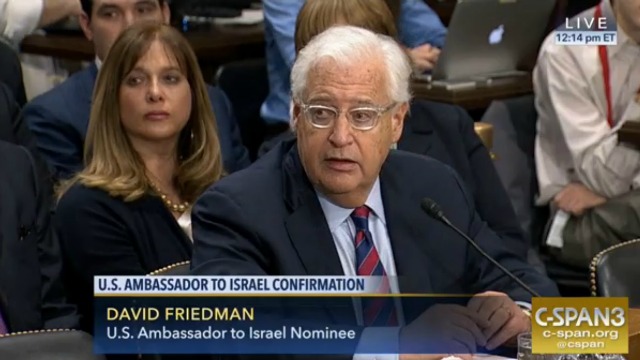
David Friedman, President Donald Trump’s pick to serve as the next US envoy to Israel. Photo: Screenshot.
The challenges of achieving an Israeli-Palestinian peace deal while PA President Mahmoud Abbas is still in power are “daunting,” attorney David Friedman — President Donald Trump’s pick to serve as the next US ambassador to Israel — said at his Senate Foreign Relations Committee confirmation hearing on Thursday.
The PA, Friedman noted, has “positions that are inconsistent with lasting peace.” For example, he pointed out, Abbas “refuses to accept Israel as a Jewish state.”
“I hope that there is a new generation of Palestinians that wants the same thing everybody wants, which is a better life, better opportunities for their children and to live in peace,” Friedman said. “We have to do what we can to help foster, both economically and politically, the development of that political class and accompanying middle class to try to draw out that type of leadership.”
Asked whether he supported or would advocate annexation of all or parts of the West Bank, Friedman replied, “I will not.”
Regarding the two-state solution, Friedman stated, “I think it’s the most ideal…I think it’s the path that’s received the most thought and effort and consideration. Obviously, it’s been tried for a long, long time and we continue to wrestle with it. Much smarter people than me have tried to make progress and have failed, but it still remains, I believe, the best possibility for peace in the region.”
Like Trump and Israeli Prime Minister Benjamin Netanyahu at a joint White House press conference on Wednesday, Friedman expressed optimism about the potential benefits of adopting a regional approach to Israeli-Palestinian peacemaking.
“I think the Saudis, the Emiratis, the Egyptians, the Jordanians and perhaps others…seem to be far more amenable to productive discussions that in the past,” Friedman said. “Israel does not seem to be the third rail that it once was with regards to these countries…it would seem to me that that’s a very productive avenue for future discussions.”
Thursday’s hearing was interrupted on several occasions by anti-Israel protesters, including two carrying Palestinian flags.
In a pre-election interview with The Algemeiner in early November, Friedman — then a senior adviser to the president-elect — said that a Trump administration would not expect Israel to uproot its citizens who now live in the West Bank and east Jerusalem as part of any future peace deal with the Palestinians.
“It is inconceivable there could be a mass evacuation on that magnitude, in the unlikely event that there was an otherwise comprehensive peace agreement,” Friedman said. “It makes no sense for Judea and Samaria to be ‘Judenrein [void of Jews],’ any more than it makes sense for Israel to be ‘Arabrein [void of Arabs].’ It’s not fair.”
Friedman went on: “The critical thing is to recognize that there is not going to be any progress on a Palestinian state until the Palestinians renounce violence and accept Israel as a Jewish state. Until that happens, there is really nothing to talk about in terms of a political process.”
What a Trump administration would not do, Friedman stated, “is put its finger on the scale and try to force Israel into a particular outcome, but rather will support Israel in reaching its own conclusion about how to best achieve peace with its neighbors.”
“We trust Israel,” he continued. “We think it is doing an excellent job of balancing its respect for human rights and its security needs in a very difficult neighborhood. Israel is a partner with the US in the global war against terrorism. And we want our partner to be attendant to that task and not distracted by foreign countries telling it what to do. That’s really the overall premise of the policy — to respect Israel as a partner, and not to unduly influence its decisions.”
Furthermore, Friedman said, “The only thing that makes sense now is to take small steps to try to improve circumstances on the ground and provide encouragement and assistance to Palestinians who are not pursuing a hateful agenda.”