




New York Times Bungles Settlement Story
Error: Contact form not found.

 by Ira Stoll

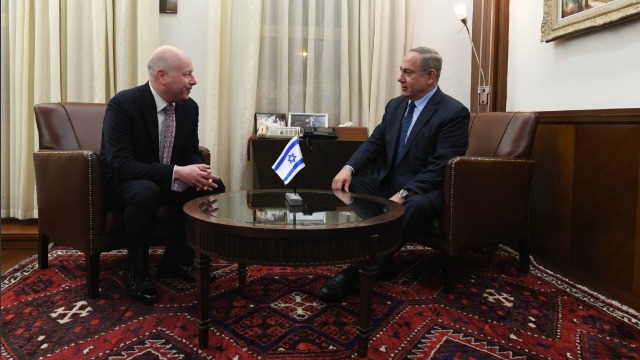
US diplomatic envoy Jason Greenblatt and Israeli Prime Minister Benjamin Netanyahu. Photo: Kobi Gideon / GPO via Netanyahu’s Twitter account.
A New York Times article about discussions between Israel and the United States regarding settlements in the West Bank includes this paragraph:
Extracting a deal from Mr. Netanyahu in current circumstances would be tricky. The Israeli leader is politically more vulnerable than he was eight years ago, when Mr. Obama demanded that he freeze all construction.
“Eight years ago,” the prime minister of Israel was Ehud Olmert. Netanyahu was still assembling a coalition. Netanyahu wasn’t “the Israeli leader,” and it’s not at all clear he is more “vulnerable” now than he was then.
Nor is it clear that even if Mr. Netanyahu were indeed more vulnerable now that he was when he eventually became prime minister later in 2009, that would make him less likely now to freeze settlements. The Times seems to assume that freezing settlements is something that only a politically strong Israeli leader would do. But one can make the opposite case, as well, that only a strong prime minister would be able to risk a big public fight with an American president over settlements, and that a weak one would be more likely to cave to American pressure.
It’s also the case that the Times erroneously analyzes the whole settlement issue as if the only variable is the Israeli political situation, as opposed to, say, the regional security landscape, the Palestinian Arab political situation, or the American political situation.
The entire dispatch doesn’t exactly engender confidence in the ability of the Times to cover this issue with accuracy, sophistication, or independent thinking. It’s a disappointment all too typical of Times reporting on this topic.
More of Ira Stoll’s media critique, a regular Algemeiner feature, can be found here.


