







Israel’s ‘Nuclear Ambiguity’ Under the Spotlight as 1967 War Commemorations Get Underway
Error: Contact form not found.

 by Ben Cohen


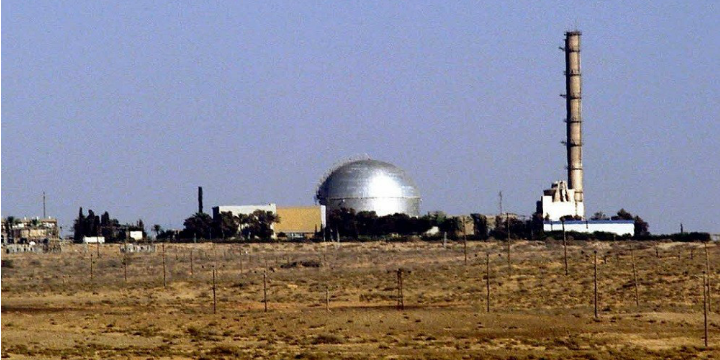
Israel’s nuclear reactor near Dimona. Photo: Wikimedia Commons.
As the fiftieth anniversary celebrations and commemorations of the 1967 Six-Day War get underway, Israel’s deliberate policy of ambiguity over whether it possesses nuclear weapons is increasingly being scrutinized by Middle East historians and policy experts.
Over the weekend, the New York Times ran an article detailing what it described as a “secret contingency plan, called a ‘doomsday operation'” that would have been executed in the event of an Israeli defeat in the war. The plan involved detonating a nuclear device atop a mountain in the Sinai Peninsula as a warning to Egyptian and other Arab forces, according to claims made by a former IDF Brigadier-General, Itzhak Yaakov. Yaakov, who died in 2013, made the assertion during a series of interviews with Avner Cohen, a noted Israeli expert on Israel’s nuclear program.
The revelations in the Times “certainly fit the pattern” of broader Israeli nuclear policy, Dr. Yoel Cohen — a professor at Ariel University and the author of a book about the Israeli nuclear spy, Mordechai Vanunu, entitled “The Whistleblower: Vanunu, Israel and the Bomb” — told The Algemeiner on Tuesday.
“The same thing happened in the 1973 war,” Cohen said. Citing research conducted in the late 1970s, Cohen said that on the fifth day of the Yom Kippur War, after Egyptian troops crossed the Suez Canal, Israeli “hints” about the existence of a nuclear option were delivered to the Egyptians through photographs taken by Soviet spy planes. Similar hints, Cohen said, were also made to the late former Iraqi dictator Saddam Hussein after his regime attacked Israel with Scud missiles — armed with conventional explosives — during the 1991 Gulf War.
The question mark over the existence, nature and extent of Israel’s nuclear strike capabilities was put in place as early as the 1950s, when France assisted the Jewish state in the construction of a nuclear plant near Dimona in the Negev Desert.
Cohen claimed that the desire to prevent an Israeli nuclear weapon was a key reason why the late Egyptian dictator Gamal Abdel Nasser went to war against Israel in 1967.
The persistence of the “nuclear ambiguity” doctrine, Cohen argued, is explained by Israel’s desire to maintain stable relations with the US, its closest ally, and one of only five states — along with Russia, France, China and the UK — to legally possess nuclear weapons.
In terms of the Middle East, Cohen said that current Israeli optimism about closer relations with Saudi Arabia and other Arab states in the context of the Iranian threat should not overlook the danger that these countries may also seek to develop independent nuclear capabilities.


