



New Study: Europe’s Rising Antisemitism Forcing Jews to Leave or Hide
Error: Contact form not found.

 by Abraham H. Miller / JNS.org

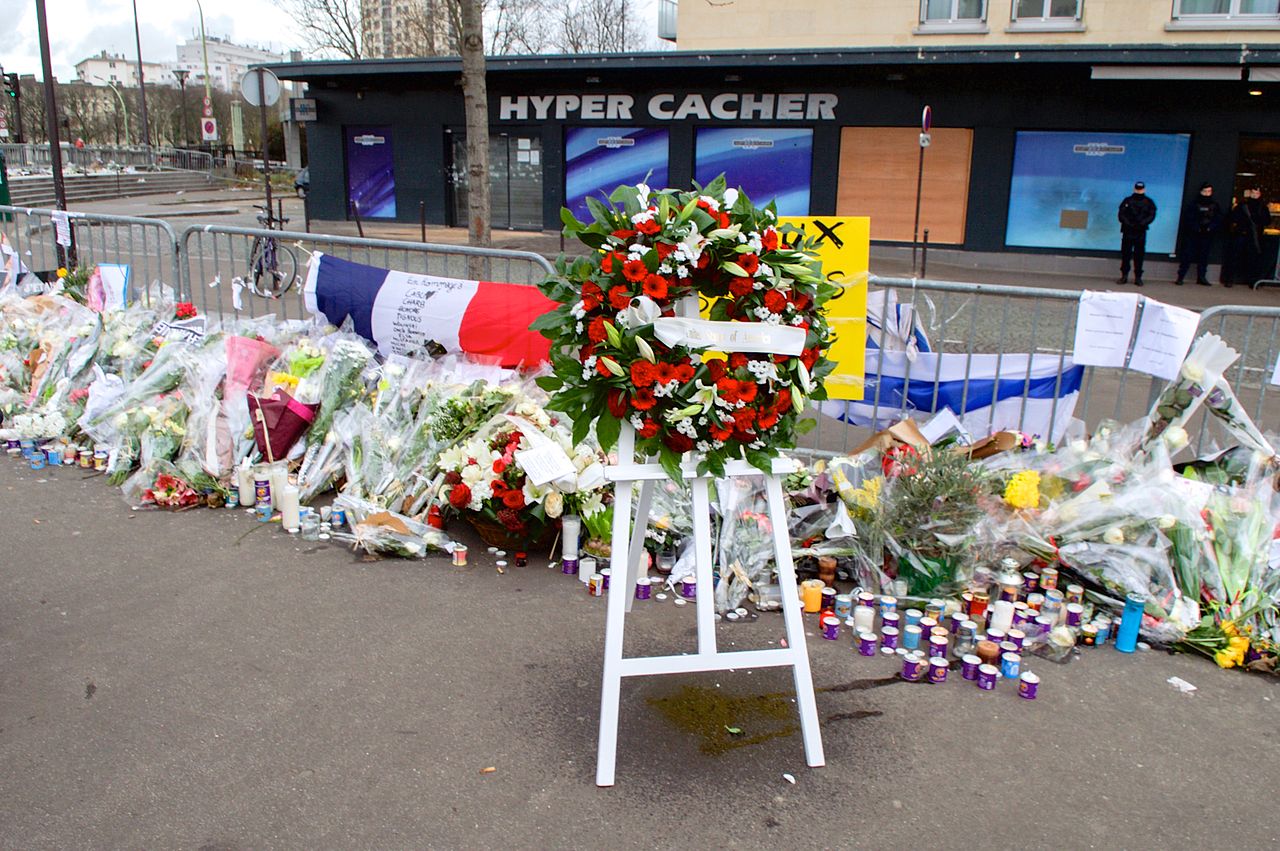
The kosher supermarket in Paris where four Jews were killed in a terrorist attack in January 2015. Photo: Wikimedia Commons.
JNS.org – Why do half of French Jews want to leave France? Because the recent rise of violent antisemitism has made French Jews justifiably concerned about their personal safety.
A University of Oslo study published in June is one of the most methodologically sophisticated and comprehensive reports exploring the growth of Europe’s antisemitism problem.
Authored by Dr. Johannes Due Enstad of the Center for Research on Extremism, the study documents violent antisemitism from 2005-2015, analyzing seven countries: France, the UK, Germany, Sweden, Norway, Denmark and Russia.
According to the study, many European Jews feel unsafe as a direct consequence of violent antisemitism, and — as a result — one in five Jews in Sweden and the UK, one in four in Germany, and half of the Jews in France have considered emigrating. In 2015, 10,000 Western European Jews departed for a new life in Israel — the largest number leaving Europe since 1948.
The study found that there has been a consistently elevated level of antisemitism in Europe during the last two decades as compared to the 1990s.
French Jews are more likely than German, Swedish and British Jews to have personally experienced a violent attack in the final five years covered by the study. Although the incidence of antisemitism in France is the highest, reports about personal attacks during the study’s final five years in Swedish and German Jews is not far behind. The largest gap in antisemitism is between British Jews and Jews living in Norway, Denmark and Russia.
According to the report, Jews in France and Sweden are more likely to not attend Jewish events or visit Jewish sites because they do not feel safe. More than half of the Jews in France and Sweden avoid wearing, carrying or displaying things that would cause others to recognize them as Jews, according to the study. This behavior does not rise to the same levels in Germany and the UK, but substantial numbers of Jews in those countries also avoid doing things in public that would label them as Jews out of fear for their safety.
Among French Jews, the elevated level of fear probably comes from France having experienced more violent, dramatic and fatal antisemitic incidents than other European countries. The barbarous attack on a Jewish school in 2012 in Toulouse — where three Jewish children and a rabbi were killed — undoubtedly contributed greatly to the insecurity of France’s Jews. Mohammed Merah, the 23-year-old terrorist who carried out the Toulouse attack, said he wanted to kill Jews because of the Israeli-Palestinian conflict.
More recently, the head of the Jewish community of Marseille — France’s second-largest city — told his fellow community members not to appear in public in any way that would identify them as Jews.
And who is responsible for the attacks on Jews in Europe? In every country studied, except for Russia, the perpetrators are disproportionately of Muslim background. A British study cited in the University of Oslo report notes that the proportion of Muslim perpetrators often increases in the wake of “trigger events” in the Middle East.
In what might be considered a clumsy attempt to downplay antisemitism there, German authorities do not classify anti-Israeli incidents as antisemitism. This results in absurdity. If any country should know better, it should be Germany.
The only country in the study where antisemitic incidents are not disproportionately perpetrated by Muslims is Russia, and — according to the study — Jews do not fear to express their Jewish identity when appearing in public there. This appears to perplex the study’s author, as Russia contains both large Jewish and Muslim populations.
Yet, in my view, the issue is easily resolved. In Russia, the large Muslim and Jewish populations live in the same country, but are generally separated by a vast expanse of land. Most Muslims live in the Eurasian Caucasus region, while most Jews live in Moscow and Saint Petersburg. This isn’t the case in the other European countries profiled in the Oslo report.
The future for European Jews who want to maintain the distinct characteristics of Judaism in public, and who want to go to synagogue unmolested, is not bright. The unwillingness of European authorities to call antisemitism what it is simply means that Jewish emigration from the continent will likely increase.
Abraham H. Miller is an emeritus professor of political science, University of Cincinnati, and a distinguished fellow with the Haym Salomon Center. Follow him on Twitter: @salomoncenter.