





Egypt Expert: Public Netanyahu-Sisi Meeting Likely Meant to Signal a Further Warming of Jerusalem-Cairo Ties
Error: Contact form not found.

 by Barney Breen-Portnoy

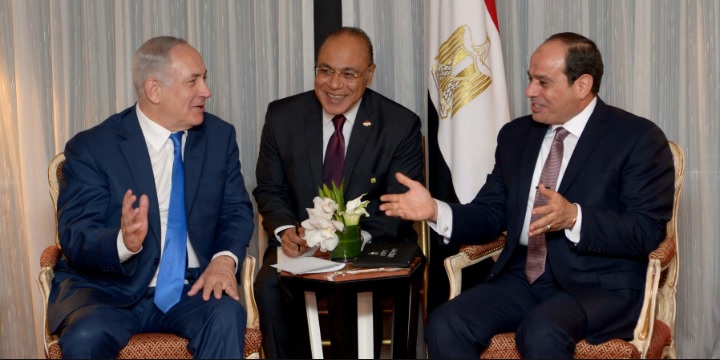
Israeli Prime Minister Benjamin Netanyahu and Egyptian President Abdel Fattah el-Sisi meet in New York City, Sept. 18, 2017. Photo: Avi Ohayon / GPO.
Monday’s public sit-down in New York City between Israeli Prime Minister Benjamin Netanyahu and Egyptian President Abdel Fattah el-Sisi was a manifestation of increasingly close Jerusalem-Cairo ties, an expert on Egyptian politics told The Algemeiner on Tuesday.
“It appears as though this meeting was designed to signal a further warming of relations, and take what had been a behind-the-scenes strategic relationship public,” Eric Trager — the Esther K. Wagner Fellow at the Washington Institute for Near East Policy think tank — said of the event, which took place on the sidelines of the 72nd UN General Assembly session.
“Sisi and Netanyahu met, ostensibly, to discuss the Israeli-Palestinian peace process, but, in all likelihood, it covered a range of shared interests, including the situation in Sinai, as well as their mutual concerns regarding Turkish and Qatari support for various Islamist movements,” Trager noted.
Furthermore, he said, the two leaders “likely also covered recent developments regarding Hamas, which is increasingly in Egypt’s orbit, rather than Qatar’s.”
“From Israel’s standpoint, that is likely preferable, given that it trusts Sisi more than it trusts Doha,” Trager explained.
It is believed, Trager added, that Netanyahu and Sisi had met twice previously, without cameras, and have also spoken numerous times by phone.
In 1979, Egypt became the first Arab country to sign a peace agreement with Israel (as part of which the Sinai Peninsula — which had been taken control of by Israel during the 1967 Six-Day War — was given back), though the relationship has at times been strained over the years, particularly when there have been outbursts of violence in the unresolved Israeli-Palestinian conflict.
Ties have steadily improved since Sisi took power in 2013, after ousting his predecessor, Mohamed Morsi, an Islamist affiliated with the Muslim Brotherhood.
Israel and Egypt share a number of regional interests — including the containment of Iran and combating ISIS.
In July 2016, Sameh Shoukry became the first Egyptian foreign minister to visit Israel since 2007.
However, normalization of the relationship with Israel remains a sensitive topic for much of the Egyptian public.
Sisi, Trager pointed out, would like to play a role in brokering peace between Israel and the Palestinians. “He has, on multiple occasions, expressed a desire for an Israeli-Palestinian peace agreement, and even at one point sketched out some ideas about how the two sides could get to the table,” Trager said.