



New York Times’ David Brooks Offers Up a False Trichotomy
Error: Contact form not found.

 by Ira Stoll

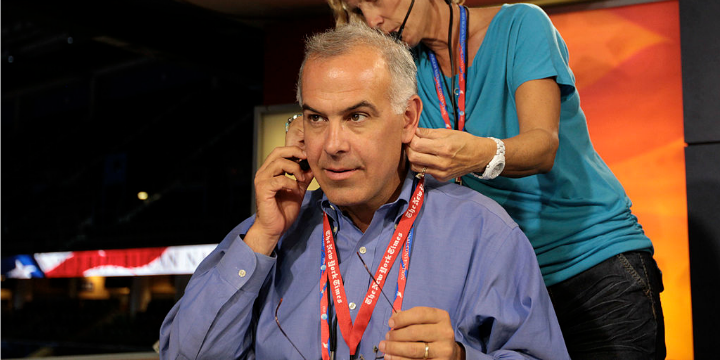
David Brooks. Photo: Wikipedia/PBS.
One of David Brooks’s favorite column writing tricks is the false dichotomy — presenting two choices as mutually exclusive when in fact there is overlap between them.
In his latest New York Times column, though, Brooks has raised the stakes, offering up a false trichotomy.
Brooks writes, “Human beings can be rallied around one of three things: religion, tribe or ideals.”
That sentence stopped me in my tracks as a Jewish reader, because Judaism includes elements of all three rallying elements. It’s a religion that also includes ideals such as justice, truth, and freedom. The Jewish people of the Bible included 12 tribes, and the modern Jewish people are often described, accurately or inaccurately, as having some tribal aspects.
The Brooks column is positive about ideals but negative about tribe and religion, at least as I read it. But in the absence of tribe or religion, ideals tend to get abstract pretty fast, and can easily degenerate into violence, as the examples of the French and Russian revolutions demonstrate. Of course, tribe and religion can degenerate into violence, too.
The most complicated of the “three things” is probably what Brooks calls “tribe.” He uses it as shorthand for “race,” which in America as well as in Germany has led to unjust and deadly discrimination. But nationalism can be a kind of tribalism, and not all nationalism is bad. And there are plenty of innocuous and even benevolent ways that the tribalism of extended kinship ties can function. Think of the charities or burial societies organized in America in the last century by immigrants. To take a non-Jewish and still-in-business example from my home city of Boston, the Italian Home for Children was an orphanage that combined religion (Roman Catholicism), tribe (Italian), and ideals (helping the needy).
Brooks certainly doesn’t have a history of hostility to religion — he’s written favorably in the past about religious thinkers and doers including Augustine, Joseph Soloveitchik, and Dorothy Day. So I don’t want to make too much of the two words “one of” in one Brooks column. But even the best columnists sometimes need editors. In this case, it would have been a better column had some editor asked Brooks — “Hey, what about just cutting the words ‘one of’ out of that sentence so that you don’t damage your credibility by overstating your case and by risking offending your Jewish readers who rally around not just one but all three of these?”
More of Ira Stoll’s media critique, a regular Algemeiner feature, can be found here.


