







It’s Time to Get Tough on US Allies at the UN
Error: Contact form not found.

 by Eric Rozenman / JNS.org

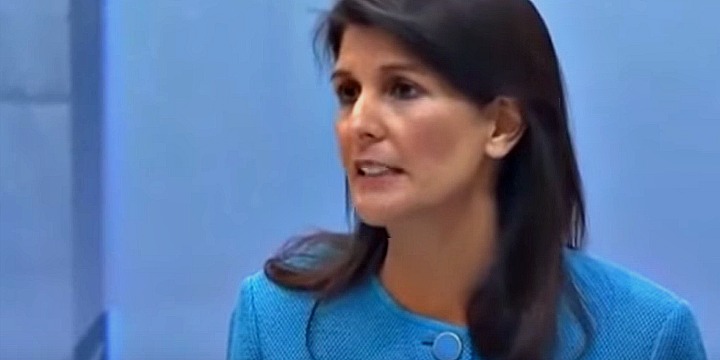
US Amassador to the UN Nikki Haley addresses the American Enterprise Institute. Photo: Screenshot.
JNS.org – The Trump administration’s decision to withdraw from the United Nations Educational, Scientific and Cultural Organization (UNESCO) is one shot across the UN’s bow.
And UNESCO — which has been notoriously hospitable to dictatorships hostile to Israel and other nefarious actors — deserves the warning.
But what is the US doing about UN member countries that consistently vote against it, and against Israel? The answer is not enough.
Many of the countries in question are not US adversaries, like Russia or Iran, that pursue policies inimical to American interests. Rather, these countries are either beneficiaries of US aid, or states whose own concerns would seem to parallel those of the US.
For example, according to the American Jewish International Relations Institute (AJIRI), in 2016, six countries ranking as major beneficiaries of US tourism and assistance — and lacking a policy pretext to do so — nevertheless voted overwhelmingly against the US on 67 roll call resolutions at the UN General Assembly.
These countries were the Caribbean states of St. Lucia (voting against the US 70.3 percent of the time); Belize (69.8 percent); the Dominican Republic (68.7); Bahamas (68.2); Jamaica (67.7); and Barbados (67.2).
And when it came to 18 anti-Israel UN resolutions last year opposed by the US, all of the above countries voted unanimously in favor of them — except Jamaica. It backed 17 of the anti-Israel measures, but abstained on one.
Five African countries that receive major US foreign assistance had similar records. AJIRI noted that Kenya — which in fiscal year 2017 gladly accepted $649 million of Uncle Sam’s money — voted against Washington at the UN 76.3 percent of the time in 2016. Zambia, which received $436 million, opposed the US 75.9 percent of the time.
Not far behind was Mozambique, a recipient of $420 million in American foreign aid, voting against the US at a rate of 75.4 percent; Tanzania, $611 million, 75 percent; and Ethiopia, $385 million, 71.7 percent.
On those 18 specifically anti-Israel resolutions, all but Ethiopia were unanimously in favor. Ethiopia voted yes 16 times, but abstained twice. Like the six Caribbean countries, none of the five African states displayed the courage to vote “no” even once.
There have been recent hints of a break in the UN’s anti-Israel lockstep policy. The world body’s new secretary-general, former Portuguese Prime Minister Antonio Guterres, sounds like a believer in George Orwell’s observation that “sometimes the first duty of intelligent men is the restatement of the obvious.”
In April, Guterres vowed to fight antisemitism and called the denial of Israel’s right to exist a modern form of anti-Jewish hatred. “As secretary-general of the United Nations, I can say that the State of Israel needs to be treated as any other state, with exactly the same rules,” he said.
If so, then the UN has a long way to go. Last year’s 18 General Assembly condemnations of Israel compared with only six measures criticizing any of the UN’s other 192 other members.
In February, Guterres contradicted a noxious piece of anti-Jewish, anti-Israel revisionism adopted late last year by UNESCO. The organization had declared Jerusalem’s Temple Mount an Islamic-only shrine. But in February, the secretary-general said that it was “completely clear that the Temple the Romans destroyed in Jerusalem was a Jewish temple.” Further, he said “no one can deny the fact that Jerusalem is sacred to the three monotheistic religions” — Judaism, Christianity and Islam.
The Palestinian Authority (PA), led by President Mahmoud Abbas’ Fatah Party, demanded an apology, claiming that Guterres’ statement “violated all legal, diplomatic and humanitarian customs.”
Reforming the UN secretariat’s sclerotic, chronically anti-US bureaucracy will be hard enough for Guterres. Therefore, getting a fairer shake in the General Assembly for the US and Israel must begin in Washington.
A good start would be spotlighting countries — like those highlighted above –that benefit from US aid, but routinely vote against it. Countries who do so should get friendly reminders. If they enjoy profitable relationships with the US — benefiting from bilateral economic, technological, military and cultural ties — these countries should align their voting patterns with their national interests. Failure to do so should warrant a cost, like the one that the US imposed on UNESCO.
Eric Rozenman is communications consultant for the Washington, D.C.-based Jewish Policy Center.


