



Alan Dershowitz: Violence Should Not Determine Policy
Error: Contact form not found.

 by Alan Dershowitz

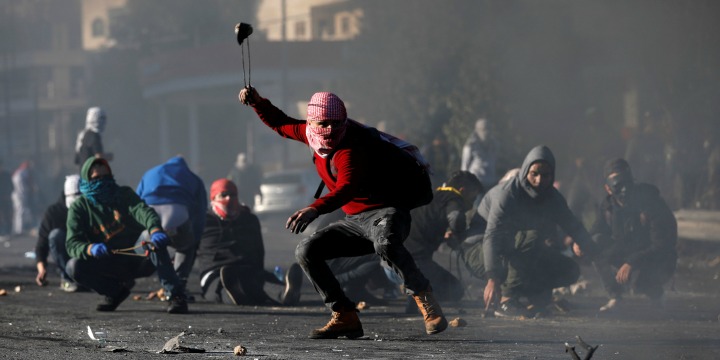
A Palestinian rioter in the West Bank, Friday, Dec. 7, 2017. Photo: Reuters / Mohamad Torokman.
This article was originally published by Gatestone Institute.
Many who are opposed to President Trump’s decision to recognize Jerusalem as Israel’s capital point to the call for violence by Hamas and the scattered violence on the West Bank as evidence that Trump was wrong. But violence should never influence US policy. The leaders of Hamas and other Palestinian groups use violence as a deliberate tactic to get their way. If policy-makers allow this tactic to deter them from doing the right thing, it will only incentivize the opponents of a peaceful resolution of the conflict to threaten and employ violence every time they do not get what they want. Violence should be responded to by police and military action, not by giving in to the unreasonable demands of those who use violence as a tactic.
Palestinian violence is rarely spontaneous. It is usually well organized by leaders who decide when to turn it on and off. The reason violence — whether rock-throwing or more lethal forms of terrorism — is used is because it works. And it works because policy-makers often make or refrain from making controversial decisions based on the fear of violent reactions. Palestinian leaders, especially Yasser Arafat, honed the tactic of terrorism as a way to extort concessions from the world. Many countries submitted to this violent extortion, so it continued and spread. If we stopped rewarding violence, it might well abate.
Palestinian leaders called for a violent intifada when they turned down the generous offer of statehood made by former President Bill Clinton and Prime Minister Ehud Barak in 2000-2001. The result was 4,000 deaths. They again called for violence when Israel opened an exit from the Western Wall Tunnel into the souq area, even though the new exit brought considerable new business to Palestinian shopkeepers and restaurant owners. And when Israel placed security cameras on the Temple Mount to protect Muslims attending the mosques, the response was not a reasoned call for negotiation or lawsuit in the Israel Supreme Court – it was violence.
Now just imagine what will happen if peace negotiations are commenced and both sides have to compromise. Israel’s comprises will be met with lawsuits, political pushback and possibly resistance from some settlers who will have to be uprooted. That is what happened when former Israeli Prime Minister Ariel Sharon ordered the evacuation of all Jewish settlements in the Gaza Strip.
Palestinian compromises will be met with street violence, terrorism and assassinations. That has long been the modus operandi of Palestinian leaders and dissidents.
A clear message must be sent now to these leaders and dissenters: violence will not be rewarded or tolerated. It will be responded to not with policy changes but with police and military action. As the late Yitzhak Rabin put it when he was prime minister: “We will pursue the peace process as if there no terrorism, and respond to terrorism as if there were no peace process.”
So, let the peace process move forward toward a two-state solution, regardless of the violence that may be tactically deployed by the enemies of peace. Do not be fooled by those who say that the two-state solution is dead or that it is time to adopt a one-state solution. Under any resolution, Jerusalem would be recognized as the capital of Israel and its holiest places would remain under Israeli control. Do not allow President Trump’s decision to keep his promise to recognize Jerusalem as Israel’s capital to become the latest excuse by Palestinian leaders to refuse to sit down, negotiate and make the painful compromises necessary for a complete resolution of the outstanding issues. President Trump’s decision merely restores the balance that was undone by President Obama’s decision to engineer a one-sided Security Council resolution that changed the status quo.
The time has come to end violence as a tool of diplomacy and for both sides to sit down at the negotiation table and agree to an outcome based on honest negotiations.
Alan M. Dershowitz, Felix Frankfurter Professor of Law, Emeritus, at Harvard Law School and author of Trumped Up, How Criminalization of Political Differences Endangers Democracy. Follow Alan M. Dershowitz on Twitter and Facebook.