







Japan Prime Minister Abe Honors ‘Japanese Schindler’ Chiune Sugihara in Lithuania
Error: Contact form not found.

 by Reuters and Algemeiner Staff

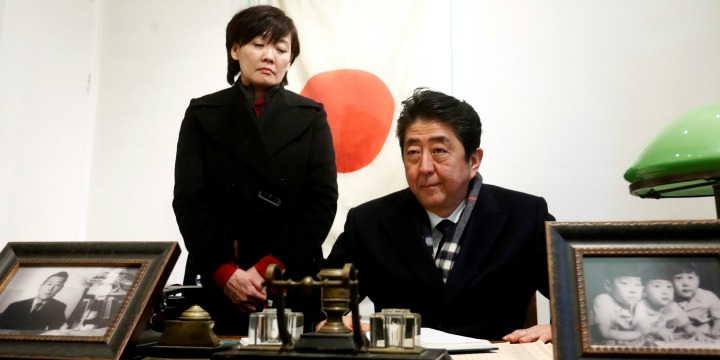
Japan’s Prime Minister Shinzo Abe and his wife Akie Abe visit a former home of Chiune Sugihara in Kaunas, Lithuania on January 14, 2018. Photo: Reuters / Ints Kalnins.
Japan’s Prime Minister Shinzo Abe visited the former Japanese consulate in Lithuania on Sunday to commemorate a Japanese diplomat credited with saving an estimated 6,000 Jews from almost certain death in 1940.
Chiune Sugihara was serving as Japanese consul in Kaunas, then capital of Lithuania, when he disobeyed his superiors and issued Japanese visas to Jews fleeing Nazi-occupied Poland despite his country being a close ally of Nazi Germany.
Abe’s visit to Lithuania, the first by a Japanese prime minister, comes as Japan seeks greater cooperation with countries such as China, a former adversary in World War Two, in the face of rising tensions over North Korea’s nuclear and missile programs.
“The courageous and humanitarian action of Mr. Sugihara provides us with guidance as to how to we should survive in this world, where rule-of-law-based international order is being challenged in various forms,” Abe told reporters on Saturday.
Japan had several of its former leaders convicted and executed by an Allied tribunal as war criminals after the end of World War Two.
Both China and South Korea have called on Japan to face up to its wartime past after Abe sent an offering to a shrine to war dead last August, the anniversary of Japan’s surrender.
Sugihara was named as “Righteous among the Nations” by Israel’s Yad Vashem museum among some 22,000 people honored for helping Jews avoid death in the Nazi Holocaust.
He issued thousands of Japanese transit visas to Jewish refugees in July and August 1940, opening a route for them to escape through Russia to Japan. His diplomatic career was cut short after the war and his actions remained largely unknown in Japan for decades after the conflict ended.
Most of Lithuania’s Jewish population — about 200,000 people — were shot dead in the first few months after Nazi Germany occupied its territory in June 1941, ending centuries of the thriving culture.


