





A US-Russia Military Encounter in Syria: Implications for Israel
Error: Contact form not found.

 by Louis René Beres

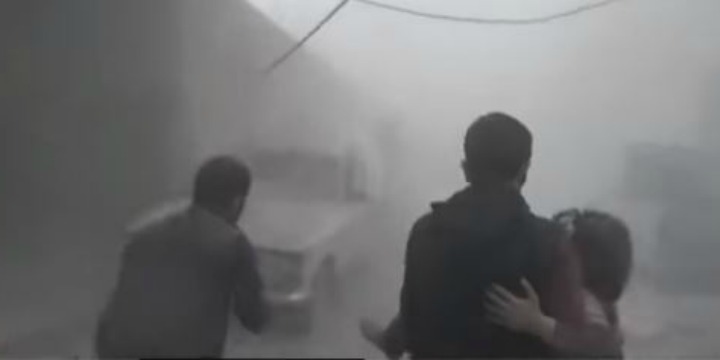
A scene from Syria’s civil war. Photo: Screenshot.
For the most part, Israel has always been able to identify and manage its own particular involvements with Syria, regarding both the incessantly criminal regime of Bashar al-Assad, and the sub-national groups in-league with the dictator or opposed to him. Nonetheless, the increasingly belligerent rhetoric of the American president toward both Assad and his principal mentor in Moscow now suggest some potentially imminent and far-reaching conflict transformations in the entire region.
In turn, such changes could quickly produce very grave hazards to Israel– risks that lie ominously beyond its own national scope of operational competence or political influence. Ultimately, of course, the most serious of any such transformations would concern a nuclear war between the superpowers.
In those notably unprecedented circumstances, virtually all traditional geopolitical models that were once au courant in Tel Aviv and Jerusalem would summarily become moot.
For the United States, the corresponding “trick” will be to meet both military and legal objectives without simultaneously generating a nuclear war. Significantly, at least on the military side, there are no available experts on the subject of nuclear war — not in Washington, not in Moscow, not in Jerusalem. This is the case, moreover, whether we are presently concerned with deliberate or inadvertent nuclear war. Arguably, in this particular geo-strategic context, the latter would appear more portentous than the former, at least from the standpoint of plausibility or presumptive likelihood.
For US President Donald Trump, it will be necessary above all to avoid any direct military confrontations with Russian forces or identifiable weapon system assets. In this connection, it is entirely possible that Russian President Vladimir Putin would deploy Russian soldiers to some of the areas most likely to be targeted by the United States. These Russian deployments could be undertaken for purely tactical reasons, or instead for less conspicuous purposes of enhancing credible deterrence.
In essence, the latter purposes would be to erect a suitable “trip wire.” Accordingly, the purpose of the deployed Russian troops would not be to actually fight against the Americans, but rather to “trip” certain expectedly desirable escalations with the United States. Naturally, drawing an exact line between desirable and undesirable escalations here would prove very difficult in practice, and could have a broad variety of possible conflict outcomes.
To be sure, these murky and historically unique circumstances could slowly or suddenly escalate out of control, triggering either an inadvertent or very deliberate nuclear war. In either case, most other states in the Middle East could be more-or-less directly impacted — Israel, of course, in particular. Significantly, because true probabilities can only be calculated according to the discernible frequency of pertinent past events, there would be no reliable way to figure out how it would end.
In the obviously worst-case scenario, the ending would involve multiple firings of nuclear missiles and/or bombs — issuing from both superpower combatants.
What about the Russian soldiers in Syria? Their only predictable function in such an inherently ambiguous scenario would be to die. Plainly, they could serve no other ordinary military function.
Furthermore, even if Vladimir Putin would not purposefully introduce a trip wire force into the conflict, his already deployed S-400 advanced surface-to-air missile systems could readily elicit identically perilous consequences. In essence, because the Americans would necessarily strike these missile targets first, Russian military personnel could plausibly be among the first casualties of any impending superpower military engagement in Syria.
Then what? For Israel, the answers would depend, in large measure, upon the actual physical and human costs being inflicted upon the Jewish state, whether intentional or as “collateral” harms.
Where might President Trump and the United States go now? It’s a question for Israelis, as well as for Americans.
Insofar as Mr. Trump has already announced an allegedly irrevocable decision to employ armed force against Syria, the president’s operational choices are probably foreseeable in Moscow. In response, Mr. Putin could take various prompt military steps to counter the growing American preparations, or to best avoid any forms of superpower military engagement altogether.
For Israel, that decision taken in Moscow could produce manifestly different but still decisively consequential outcomes.
All things considered, US President Donald Trump’s available policy options could lead incrementally and/or inexorably to certain direct US-Russian military encounters. Among other things, Mr. Trump’s most advanced strategic thinkers (not ordinary tactical planners) would then need to work very quickly and capably through the hideously complex dialectics of virtually all possible nuclear attack scenarios.
In the final analysis, what will be needed in Washington will be exceptional intellectual skills, not just the far more usual and orthodox operational talents. For the United States, the overriding task must not be to merely maximize target damage in Syria, but also to prevent any grievously destructive nuclear war in the area. Depending upon the precise extent to which Trump can keep this sensitive equation correctly in mind, the resultant outcomes will be more or less welcome in Israel.
For the moment, less seems far more plausible.
This article was first published at Israel Defense.